

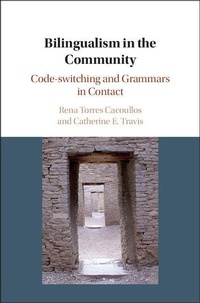
Bilingualism in the Community
Code-switching and Grammars in Contact
Published on 8. March 2018
Book
Hardback
254 pages
978-1-108-41582-8 (ISBN)
Description
Does the use of two languages by bilinguals inevitably bring about grammatical change? Does switching between languages serve as a catalyst in such change? It is widely held that linguistic code-switching inherently promotes grammatical convergence - languages becoming more similar to each other through contact; evidence for this, however, remains elusive. A model of how to study language contact scientifically, Bilingualism in the Community highlights variation patterns in speech, using a new bilingual corpus of English and Spanish spontaneously produced by the same speakers. Putting forward quantitative diagnostics of grammatical similarity, it shows how bilinguals' two languages differ from each other, aligning with their respective monolingual benchmarks. The authors argue that grammatical change through contact is far from a foregone conclusion in bilingual communities, where speakers are adept at keeping their languages together, yet separate. The book is compelling reading for anyone interested in bilingualism and its importance in society.
Reviews / Votes
'This book takes us out of our comfort zone in critically examining the evidence for supposed convergence between Spanish and English in the Southwestern United States. It sets new standards in language contact research and the team of Rena Torres Cacoullos and Catherine Travis has produced an impeccable study, using state of the art methodology and analytical tools.' Pieter Muysken, Radboud University, Nijmegen 'Thanks to impeccable scientific methodology and singularly rich data, this ground-breaking study of the oldest bilingual community in the US stands the received wisdom about contact-induced change on its head. A must-read for all serious students of language contact, regardless of perspective or approach!' Shana Poplack, University of Ottawa 'This rich linguistic and sociolinguistic analysis of Spanish and English in a traditionally bilingual community where code-switching is the norm sets a new standard for the study of language contact. The careful quantitative analysis produces the surprising result that code-switching speakers maintain distinct structures and constraints in their two languages. The methods and the results constitute a ground-breaking contribution to the study of language change.' Joan Bybee, University of New Mexico 'Bilingualism in the Community sets a high standard of variationist studies of contact-induced change and applies a systematic comparative methodology that includes comparing with a previous, monolingual variety and monolingual benchmarks. The book is in general very well written and is recommended to scholars interested in language contact, variation, and the interplay of the two both within and outside the variationist framework.' Maria Khachaturyan, The LINGUIST ListMore details
Language
English
Place of publication
Cambridge
United Kingdom
Target group
College/higher education
Professional and scholarly
Illustrations
Worked examples or Exercises; 17 Tables, black and white; 1 Maps; 61 Halftones, black and white
Dimensions
Height: 235 mm
Width: 157 mm
Thickness: 19 mm
Weight
529 gr
ISBN-13
978-1-108-41582-8 (9781108415828)
Copyright in bibliographic data and cover images is held by Nielsen Book Services Limited or by the publishers or by their respective licensors: all rights reserved.
Schweitzer Classification
Other editions
Additional editions
Rena Torres Cacoullos | Catherine E. Travis
Bilingualism in the Community
Code-switching and Grammars in Contact
Book
04/2020
Cambridge University Press
€48.90
Shipment within 15-20 days
E-Book
03/2018
Cambridge University Press
€21.99
Available for download
Rena Torres Cacoullos | Catherine E. Travis
Bilingualism in the Community
Code-switching and Grammars in Contact
E-Book
02/2018
Cambridge University Press
€100.99
Available for download
Persons
Rena Torres Cacoullos is Professor of Spanish and Linguistics at the Pennsylvania State University and editor-in-chief of Language Variation and Change. Catherine Travis is Professor of Modern European Languages at the Australian National University, and a Chief Investigator in the Centre of Excellence for the Dynamics of Language.
Content
1. Language contact through the lens of variation; 2. The community basis of bilingual phenomena; 3. Good data: Capturing language use; 4. Characterizing the bilingual speaker; 5. Subject pronoun expression: reconsidering the constraints; 6. Cross-language comparisons: foundations for assessing contact-induced change; 7. Assessing change and continuity; 8. The most intimate contact: the bilinguals' two languages; 9. Code-switching without convergence; 10. Code-switching and priming; 11. Bilingualism in its linguistic and social context.