

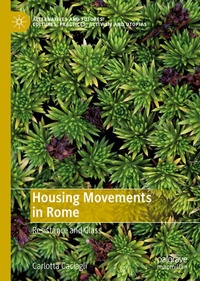
Housing Movements in Rome
Description
This book explores contemporary challenges of housing movement organizations, looking specifically at the case of Rome, Italy. The work identifies conditions that allow the re-composition of a class of housing dispossessed and, consequently, the features of its action in urban spaces. The book offers fresh analytical perspectives to understanding contemporary urban transformation via new spatial and strategic approaches. In striking detail, Carlotta Caciagli shows how space is a crucial variable in shaping the strategies that allow for the politicisation of a movement's social base. She illustrates how new spatial configurations of urban space result from unique struggles of the recomposed collective subject. Most notably, three main conceptual tools are introduced to disentangle the relationship between the recomposed precarious class and space: "the spatial opportunity structure", "configurations of strategies" and "educational sites of resistance".
Reviews / Votes
"In this theoretically original and empirically very well researched volume, Carlotta Caciagli addresses a main focus in the social science literature on the right to the city: the contentious politics around housing precarity. Developing a spatial approach to urban movements, her ethnographic research singles out the relational dynamics within and around squatted places, studied as educational sites of resistance. A very stimulating reading on a topic that is destined to become all the more central in post-pandemic times."
-
Donatella Della Porta
, Dean of the Faculty of Political and Social Sciences, Director of Centre of Social Movements Studies, Director of the PhD Program in Political Science and Sociology, Scuola Normale Superiore
"Carlotta Caciagli has been able to write an impressive volume that makes both empirical and theoretical contributions to how the housing struggles seek to shape contemporary cities. This is a must read for scholars and students interested in urban activism, but it is also a very important work for activists themselves."
- Lorenzo Bosi , Associate Professor, Director of Graduate Studies, Faculty of Political and Social Sciences, Scuola Normale Superiore.
"Space remains a theoretical and empirical black box of the social movement literature. In this fascinating book, Carlotta Caciagli provides a compelling account of how space both constitutes housing activists and shapes their strategic options as they assert their right to the city. By doing this, Caciagli shows how marginalized urban residents can become a potent and disruptive political subject in increasingly unequal and neoliberal cities"- Wlater Nicholls , Associate Professor of Urban Planning and Public Policy, PhD Urban Planning, University of California, Los Angeles.
More details
Other editions
Additional editions
Person
Carlotta Caciagli is a Research Fellow in sociology at the department of Urban Studies, Polytechnic of Milan (Italy). She holds a Ph.D. in Political Sciences from the Scuola Normale Superiore, in Florence. Her research interests include social movements, urban transformations, and socio-spatial inequalities. Her research has been published in international journals, such as Antipode , Critical Sociology and others.