

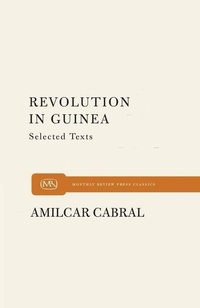
Revolution in Guinea
Selected Texts
Published on 31. October 2024
Book
Paperback/Softback
176 pages
978-1-68590-121-9 (ISBN)
Description
"As a revolutionary theoretician Cabral has few equals anywhere in the world."--The Tribune (London)
The success of the liberation movement of Guinea Bissau and Cape Verde in the 1960s and '70s was due in considerable measure to the political genius of Amilcar Cabral. Engineer turned guerilla, he followed no "school" imported from abroad. The speeches, writings, and interviews in this volume show a distinctive strategy based upon meticulous study of conditions in his own country and they summarize the principles of the PAIGC---the African Party for the Independence of Guinea and Cape Verde.More details
Language
English
Place of publication
New York
United States
Product notice
Paperback (trade)
Unsewn / adhesive bound
Dimensions
Height: 203 mm
Width: 133 mm
Thickness: 10 mm
Weight
204 gr
ISBN-13
978-1-68590-121-9 (9781685901219)
Copyright in bibliographic data and cover images is held by Nielsen Book Services Limited or by the publishers or by their respective licensors: all rights reserved.
Schweitzer Classification
Person
Amilcar Cabral (1924-1973) was a Pan-African freedom fighter and anti-imperialist theorist, best known for bringing the Portuguese empire to its knees. He was born in the Guinea Bissau town of Bafatá, to Cape Verdean parents of divergent classes, living under Portuguese colonial dominion. During a restive period in the development of African nationalist movements, he studied agronomy in Portugal alongside other African colonial subjects who joined together to form student movements dedicated to opposing the ruling dictatorship of Portugal and promoting the cause of independence for all Portuguese colonies in Africa. Upon his return to Africa in the 1950s, he managed, in under a decade, to steer Guinea Bissau towards near total independence. On January 20, 1973, Portuguese agents assassinated Cabral, but his murder did not deter his people from unilaterally declaring independence just eight months later. In life and death, he became an inspiration to revolutionary socialists and national independence movements worldwide.