

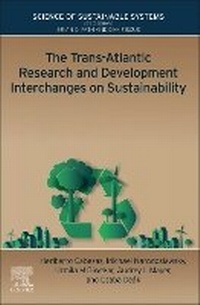
The Trans-Atlantic Research and Development Interchanges on Sustainability
Published on 9. December 2025
Book
Paperback/Softback
200 pages
978-0-12-824529-3 (ISBN)
Description
The Trans-Atlantic Research and Development Interchanges on Sustainability is a comprehensive foundational look at sustainability science, developed directly from the outcomes and learnings of the Trans-Atlantic Research and Development Interchanges on Sustainability (TARDIS) workshop that has been ongoing since 2004. The book brings together the most thorough recent advances in concepts, theories, methods, models and applications to steer the course towards a sustainable and resilient future. It provides a source of information on sustainability science directly from the experiences of global sustainability scientists and their research data not found elsewhere.
This book will be an all-encompassing source of information on all aspects of sustainability science for academics, researchers and students in sustainability science and any applicable science that takes sustainability into account.
This book will be an all-encompassing source of information on all aspects of sustainability science for academics, researchers and students in sustainability science and any applicable science that takes sustainability into account.
More details
Series
Language
English
Place of publication
United States
Target group
Professional and scholarly
Primary: Academics, researchers, undergraduates and postgraduates in sustainability science and any applicable science that takes sustainability into account
Secondary: Ecology, environmental science, earth science, engineering, environmental management and related fields
Dimensions
Height: 229 mm
Width: 152 mm
Weight
450 gr
ISBN-13
978-0-12-824529-3 (9780128245293)
Copyright in bibliographic data and cover images is held by Nielsen Book Services Limited or by the publishers or by their respective licensors: all rights reserved.
Schweitzer Classification
Other editions
Additional editions
Heriberto Cabezas | Urmila M. Diwekar | Michael Narodoslawsky
The Trans-Atlantic Research and Development Interchanges on Sustainability
E-Book
12/2025
Elsevier
€131.00
Available for download
Persons
Heriberto Cabezas is a Research Professor at the Department of Applied Sustainability at the Szechenyi Istvan University in Gyor, Hungary. He is a Senior Advisor at the Vishwamitra Research Institute in Chicago, Illinois, USA, and an Honorary Professor at the University of Miskolc in Hungary. He led the workgroup on global sustainability at the Pazmany Peter Catholic University in Budapest, Hungary. He served as a Senior Science Advisor (Ret.) at the United States Environmental Protection Agency. Urmila Diwekar is President of the Vishwamitra Research Institute, a non-profit research institute that she founded to pursue multidisciplinary research in the areas of optimization under uncertainty and computer-aided design applied to energy, environment, and sustainability. From 2002-2004, she was a Professor in the Departments of Chemical Engineering, Bio-Engineering, and Industrial Engineering, and the Institute for Environmental Science and Policy, at the University of Illinois at Chicago, USA. From 1991-2002 she was on the faculty of the Carnegie Mellon University, USA. She is the author of more than 175 peer-reviewed research papers, 7 books, 15 chapters, has given over 350 presentations and seminars, and has chaired numerous sessions in national and international meetings. She has been the principal advisor to 43 Ph.D. and M.S. students, and has advised 13 post-doctoral fellows and researchers. Michael Narodoslawsky was Head of the Institute for Resource Efficient and Sustainable Systems at Technische Universitat Graz since its foundation in 2003 until 2006 and until 2004 he acted as chairman of the National Research Network SUSTAIN, the first interdisciplinary Austrian initiative at research for sustainability. He also headed the European Network ENSURE dealing with urban and regional sustainable development. He co-developed the Sustainable Process Index, a comprehensive ecological footprint evaluation method that allows reliable forecasting of ecological performance of products and services and has participated in numerous international projects on ecological evaluation, including the first European Commission research project on Operational Indicators for Sustainable Development. His most recent research includes life cycle analysis for technologies on renewable resources and regional technology networks for renewable resources and biorefinery development. Prof. Narodoslawsky headed the research group Process Synthesis, Process Evaluation and Regional Development at the Technische Universitat Graz and headed the Bioenergy Working Group within the SET-Plan Education Task force of the E.C. Prof. Narodoslawsky currently chairs the working group Bioresources of the European Sustainable Energy Innovation Alliance. Audrey Mayer earned her B.A. in Biology and Public Policy Analysis from Pomona College in 1994, and her Ph.D. in Ecology and Evolutionary Biology from the University of Tennessee in 2000. After completing a postdoctoral research position at the University of Cincinnati, studying the impacts of land use change on bird diversity, she served as an ecologist at the U.S. Environmental Protection Agency. While there, she and her team measured the impact of green infrastructure on urban water quality and created sustainability assessments for multidimensional, dynamic systems. She then moved to the University of Helsinki, Finland, and studied the impact of harvesting on the biodiversity of Finnish and Russian Forests. She began her current faculty position at Michigan Technological University in 2009, teaching and conducting research in ecology and environmental policy, with a focus on biodiversity conservation, forested landscapes, urban green infrastructure, and sustainability assessment. Csaba Deak is a Professor and University Chancellor at the University of Miskolc, Hungary. Dr. Deak received his Ph.D. in Economics from the University of Miskolc in 2001, and his Habilitation in Innovation and Project Management from the University of Pannonia in 2010. He also holds a Master of Economics Degree and a Bachelor of Science in Business Administration from the University of Miskolc. He served as Vice-President of the National Development, Research and Innovation Office in Hungary (2012-2014). He is also a Fellow of the International Society for Professional Innovation Management, Finance and Economic Development, and a Member of the Hungarian Academy of Sciences Miskolc Chapter. Dr. Deak also holds many other prominent appointments and honors, and has a background with extensive experience in economics, business, and innovation which are critically important elements of progress towards sustainability.
Author
Research Professor, Department of Applied Sustainability, Szechenyi Istvan University, Gyor, Hungary; Senior Advisor, Vishwamitra Research Institute, Chicago, Illinois, USA; Honorary Professor, University of Miskolc, Hungary
President, Vishwamitra Research Institute, USA
Head, Institute for Resource Efficient and Sustainable Systems, Technische Universitat Graz, Graz, Austria
Michigan Technological University, USA
Professor and University Chancellor, University of Miskolc, Hungary
Content
1. Introduction to Sustainability
2. Sustainability as a Normative Enterprise
3. Scientific Principles of Sustainability
4. Are There Natural and Other Limits to Sustainability?
5. Mathematical Modeling of Sustainable Systems
6. The Role of Uncertainty in Sustainability
7. The Region as a Focus of Sustainability 8. Progress towards Sustainability
9. Summary
2. Sustainability as a Normative Enterprise
3. Scientific Principles of Sustainability
4. Are There Natural and Other Limits to Sustainability?
5. Mathematical Modeling of Sustainable Systems
6. The Role of Uncertainty in Sustainability
7. The Region as a Focus of Sustainability 8. Progress towards Sustainability
9. Summary