

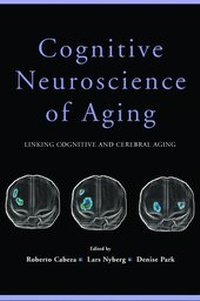
Cognitive Neuroscience of Aging
Linking Cognitive and Cerebral Aging
Published on 18. November 2004
Book
Hardback
408 pages
978-0-19-515674-4 (ISBN)
Description
Until very recently, what we knew about the neural basis of cognitive ageing was based on two disciplines that had very little contact with each other. Whereas the neuroscience of ageing investigated the effects of aging on the brain independently of age-related changes in cognition, the cognitive psychology of ageing investigated the effects of ageing on cognition independently of age related changes in the brain. Because an increasing number of studies have focused on the relationships between cognitive ageing and cerebral ageing, these two disciplines have begun to interact. This rapidly growing body of research has come to constitute a new discipline: cognitive neuroscience of ageing. The goal of this book is to introduce this new discipline at a level that is useful to both professionals and students in cognitive neuroscience, cognitive psychology, neuroscience, neuropsychology, neurology, and related areas. The book is divided into four main sections.
The first section describes non-invasive measures of cerebral ageing, including structural (eg volumetric MRI), chemical, (eg dopamine PET), electrophysiological (eg ERP's), and themodynamic measures (eg fMRI), and discusses how they can be linked to behavioural measures of cognitive ageing. The second section reviews evidence for the effects of ageing on neural activity during different cognitive functions, including perception and attention, use of imagery, working memory, long-term memory, and prospective memory. The third section focuses on clinical and applied concerns, such as the distinction between health ageing and ageing with Alzheimer's disease, and the use of cognitive training to ameliorate age-related cognitive decline. The final section describes theories that relate cognitive and cerebral ageing, including models accounting for functional neuroimaging evidence and models supported by computer simulations. Taken together, the chapters in this volume provide the first unified and comprehensive overview of the new discipline of cognitive neuroscience of ageing.
The first section describes non-invasive measures of cerebral ageing, including structural (eg volumetric MRI), chemical, (eg dopamine PET), electrophysiological (eg ERP's), and themodynamic measures (eg fMRI), and discusses how they can be linked to behavioural measures of cognitive ageing. The second section reviews evidence for the effects of ageing on neural activity during different cognitive functions, including perception and attention, use of imagery, working memory, long-term memory, and prospective memory. The third section focuses on clinical and applied concerns, such as the distinction between health ageing and ageing with Alzheimer's disease, and the use of cognitive training to ameliorate age-related cognitive decline. The final section describes theories that relate cognitive and cerebral ageing, including models accounting for functional neuroimaging evidence and models supported by computer simulations. Taken together, the chapters in this volume provide the first unified and comprehensive overview of the new discipline of cognitive neuroscience of ageing.
Reviews / Votes
By drawing together two distinct, but related, disciplines this book generates a number of questions which should inspire academics and research-hungry clinicians. Since the majority of us will grow old one day, and we will be a big majority, there will be huge implications for care, treatment, quality of life and lifestyle. Not before time, I would say to this introduction to cognitive and cerebral ageing. The PsychologistMore details
Language
English
Place of publication
New York
United States
Target group
Professional and scholarly
Professionals and students in cognitive neuroscience, cognitive psychology, neuroscience, neuropsychology, neurology and related areas.
Illustrations
num. fig., 10 farbige Bildtafeln
10pp colour plates, numerous line figures
Dimensions
Height: 234 mm
Width: 156 mm
Weight
748 gr
ISBN-13
978-0-19-515674-4 (9780195156744)
Copyright in bibliographic data and cover images is held by Nielsen Book Services Limited or by the publishers or by their respective licensors: all rights reserved.
Schweitzer Classification
Other editions
Additional editions
Roberto Cabeza | Lars Nyberg | Denise Park
Cognitive Neuroscience of Aging
Linking Cognitive and Cerebral Aging
E-Book
04/2009
1st Edition
OUP eBook
€44.99
Available for download
Roberto Cabeza | Lars Nyberg | Denise Park
Cognitive Neuroscience of Aging
Linking Cognitive and Cerebral Aging
E-Book
11/2004
1st Edition
OUP eBook
€44.99
Available for download
Persons
Roberto Cabeza, Center for Cognitive Neuroscience, Duke University, USA, Lars Nyberg, Department of Psychology, Umea University, Sweden, and Denise Park, Department of Psychology, University of Michigan, USA
Content
INTRODUCTION; 1. Cognitive neuroscience of ageing: emergence of a new discipline; PART 1: IMAGING MEASURES; 2. The ageing brain observed in vivo: differential changes and their modifiers; 3. The role of dopamine receptors in cognitive ageing; 4. Electrophysiological and optical measures of cognitive ageing; 5. Functional MRI and cognitive ageing; 6. The relationship between brain activity, cognitive performance and ageing: the case of memory; PART 2: BASIC COGNITIVE PROCESSES; 7. Age-related changes in neural activity during visual perception and attention; 8. The cognitive neuroscience of working memory and agting; 9. Long-term memory and ageing: a cognitive neuroscience perspective; 10. The neural basis of age-related declines in prospective memory; PART 3: CLINICAL AND APPLIED ISSUES; 11. Three principles for cognitive ageing research: multiple causes sequelae, variance in expression and response, and the need for integrative theory; 12. Functional connectivity during memory tasks in healthy ageing and dementia; 13. Cognitive training in health ageing: a cognitive neuroscience perspective; PART 4: MODELS IN COGNITIVE NEUROSCIENCE OF AGEING; 14. Age-related changes in hemospheric organization; 15. Neurocomputational perspectives linking neuromodulation, processing noise, representational distinctiveness, and cognitive ageing