

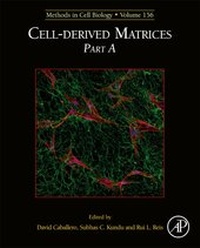
Cell-derived Matrices Part A: Volume 156
Published on 24. March 2020
Book
Hardback
350 pages
978-0-12-820172-5 (ISBN)
Description
Cell-Derived Matrices, Part A, Volume 156, provides a detailed description and step-by-step methods surrounding the use of three-dimensional cell-derived matrices for tissue engineering applications. Biochemical, biophysical and cell biological approaches are presented, along with sample results. Specific chapters cover Anisotropic cell-derived matrices with controlled 3D architecture, Generation of functional fluorescently-labelled cell-derived matrices by means of genetically-modified fibroblasts, Bi-layered cell-derived matrices, Engineering clinically-relevant cell-derived matrices using primary fibroblasts, Decellularized matrices for bioprinting applications, and much more.
More details
Series
Language
English
Place of publication
San Diego
United States
Publishing group
Elsevier Science Publishing Co Inc
Target group
Professional and scholarly
Postgraduates and researchers in the area of tissue engineering, biophysics and cellular biology, and other related scientific areas
Dimensions
Height: 235 mm
Width: 191 mm
Weight
860 gr
ISBN-13
978-0-12-820172-5 (9780128201725)
Copyright in bibliographic data and cover images is held by Nielsen Book Services Limited or by the publishers or by their respective licensors: all rights reserved.
Schweitzer Classification
Other editions
Additional editions
Persons
Dr. David Caballero is a senior Research Associate at the 3B's Research Group, I3Bs - Institute for Biomaterials, Biodegradables and Biomimetics at University of Minho (Portugal). Dr. Caballero has broad experience in the fields of biophysics, bioengineering, microfluidics, and nanotechnology. His main research interests include the development of novel bioengineered in vitro models to study the mechanistic determinants of cancer cell invasion. Currently, Dr. Caballero work focuses in the development of innovative multi-organ-on-chip tumor models using engineered native-like 3D biomaterials for drug screening applications. Subhas C. Kundu, PhD, is a Research Coordinator and former European Research Area Chair and Professor at the 3B?s Research Group, I3Bs - Institute on Biomaterials, Biodegradables and Biomimetics of the University of Minho, Portugal. His research interests include silk biomaterial matrices for biomedical applications, including 3D in vitro cancer models for investigating tumour growth and progression. In addition, he is using natural-based biomaterials for 3D cancer modelling and drug screening. Dr. Rui Reis is Vice-President for Research and Innovation of University of Minho, Portugal, Director of 3B's Research Group and Director of ICVS/3B?s Associate Laboratory, both of UMinho. He's the CEO of the European Institute of Excellence on Tissue Engineering and Regenerative Medicine, the Coordinator of the Discoveries Centre for Regenerative and Precision Medicine, the Global Past-President of the Tissue Engineering and Regenerative Medicine International Society and the Editor-in-chief of the Journal of Tissue Engineering and Regenerative Medicine. He's edited 18 books, 10 special issue journals, 280 book chapters and has more than 1225 published works listed on ISI Web of Knowledge, being an inventor of around 70 patents. He's been awarded many important international prizes, including the TERMIS-EU contributions to the literature Award and the TERMIS-EU Career Achievement Award, and recently the UNESCO- International Life Sciences Award and the IET A. F. Harvey Engineering Research Prize.
Volume editor
Senior Research Associate, 3B's Research Group, I3Bs - Institute for Biomaterials, Biodegradables and Biomimetics, University of Minho, Portugal
Research Coordinator and former European Research Area Chair, 3B?s Research Group, I3Bs, Institute on Biomaterials, Biodegradables and Biomimetics, University of Minho, Portugal
Content
Preface
David Caballero, Subhas C Kundu and Rui L Reis
Section 1: Decellularization and characterization methods
1.A step-by-step protocol for generating human fibroblast cell-derived completely biological extracellular matrix scaffolds
Dhavan Sharma, Morgan Ferguson and Feng Zhao
2.Preparation of osteogenic matrices from cultured cells
Carl A. Gregory, Eoin McNeill and Simin Pan
3.Decellularized hASCs-derived matrices as biomaterials for 3D in vitro approaches
Fatima Raquel Maia, Rui Luis Reis and Joaquim Miguel Oiveira
4.Characterization of the elastic properties of extracellular matrix models by atomic force microscopy
J. Otero, D. Navajas and J. Alcaraz
5.Glycosaminoglycan disaccharide compositional analysis of cell-derived extracellular matrices using liquid chromatography-tandem mass spectrometry
Joao C. Silva, Marta S. Carvalho, Ke Xia, Joaquim M. S. Cabral, Claudia L. da Silva, Frederico C. Ferreira, Deepak Vashishth and Robert J. Linhardt
Section 2: Engineering cell-derived matrices with advanced characteristics
6.Engineering clinically-relevant human fibroblastic cell-derived extracellular matrices
Janusz Franco-Barraza, Kristopher S. Raghavan, Tiffany Luong and Edna Cukierman
7.Engineering cell-derived matrices with controlled 3D architectures for pathophysiological studies
Enrico Almici, David Caballero, Joan Montero Boronat and Josep Samitier Marti
8.Generation of fluorescent cell-derived-matrix to study 3D cell migration
Amelie Luise Godeau, Helene Delanoe-Ayari and Daniel Riveline
9.Re-engineered cell-derived extracellular matrix as a new approach to clarify the role of native ECM
Insung Yong, Seung Won Oh and Pilnam Kim
Section 3: Cell-derived matrices for biomedical applications
10.Cell-derived matrices (CDM)-Methods, challenges and applications
Cheng HW, Yuan MT, Li CW and Chan BP.
11.Boosting collagen deposition with a lysyl oxidase/bone morphogenetic protein-1 cocktail
Tamara Rosell-Garcia and Fernando Rodriguez-Pascual
12.Generating specific cell-derived matrices from human trabecular meshwork cell cultures for mechanistic studies
Felix Yemanyi, Janice Vranka and VijayKrishna Raghunathan
13.Methods in cell biology: Cell-derived matrices
Elizabeth Pavez Lorie and Petra Boukamp
David Caballero, Subhas C Kundu and Rui L Reis
Section 1: Decellularization and characterization methods
1.A step-by-step protocol for generating human fibroblast cell-derived completely biological extracellular matrix scaffolds
Dhavan Sharma, Morgan Ferguson and Feng Zhao
2.Preparation of osteogenic matrices from cultured cells
Carl A. Gregory, Eoin McNeill and Simin Pan
3.Decellularized hASCs-derived matrices as biomaterials for 3D in vitro approaches
Fatima Raquel Maia, Rui Luis Reis and Joaquim Miguel Oiveira
4.Characterization of the elastic properties of extracellular matrix models by atomic force microscopy
J. Otero, D. Navajas and J. Alcaraz
5.Glycosaminoglycan disaccharide compositional analysis of cell-derived extracellular matrices using liquid chromatography-tandem mass spectrometry
Joao C. Silva, Marta S. Carvalho, Ke Xia, Joaquim M. S. Cabral, Claudia L. da Silva, Frederico C. Ferreira, Deepak Vashishth and Robert J. Linhardt
Section 2: Engineering cell-derived matrices with advanced characteristics
6.Engineering clinically-relevant human fibroblastic cell-derived extracellular matrices
Janusz Franco-Barraza, Kristopher S. Raghavan, Tiffany Luong and Edna Cukierman
7.Engineering cell-derived matrices with controlled 3D architectures for pathophysiological studies
Enrico Almici, David Caballero, Joan Montero Boronat and Josep Samitier Marti
8.Generation of fluorescent cell-derived-matrix to study 3D cell migration
Amelie Luise Godeau, Helene Delanoe-Ayari and Daniel Riveline
9.Re-engineered cell-derived extracellular matrix as a new approach to clarify the role of native ECM
Insung Yong, Seung Won Oh and Pilnam Kim
Section 3: Cell-derived matrices for biomedical applications
10.Cell-derived matrices (CDM)-Methods, challenges and applications
Cheng HW, Yuan MT, Li CW and Chan BP.
11.Boosting collagen deposition with a lysyl oxidase/bone morphogenetic protein-1 cocktail
Tamara Rosell-Garcia and Fernando Rodriguez-Pascual
12.Generating specific cell-derived matrices from human trabecular meshwork cell cultures for mechanistic studies
Felix Yemanyi, Janice Vranka and VijayKrishna Raghunathan
13.Methods in cell biology: Cell-derived matrices
Elizabeth Pavez Lorie and Petra Boukamp