

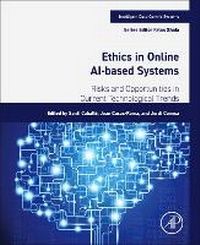
Ethics in Online AI-Based Systems
Risks and Opportunities in Current Technological Trends
Published on 10. April 2024
Book
Paperback/Softback
424 pages
978-0-443-18851-0 (ISBN)
Description
Ethics in Online AI-Based Systems: Risks and Opportunities in Current Technological Trends creates a space to explore the ethical relevance that new technologies under development may have. Stimulating reflection and considerations with respect to the design, deployment, and use of technology helps readers guide current and future technological advancements from an ethically informed position to ensure that such advancements contribute towards solving current global and social challenges that we, as a society, have today. This will not only be useful for researchers and professional engineers, but also for educators, policy makers, and ethicists.
Recent technological advancements have deeply transformed society and the way people interact with each other. Instantaneous communication platforms have allowed connections with other people, forming global communities and creating unprecedented opportunities in many sectors, making access to online resources more ubiquitous by reducing limitations imposed by geographical distance and temporal constrains. These technological developments bear ethically relevant consequences with their deployment, and legislations often lag behind such advancements. Because the appearance and deployment of these technologies happen much faster than legislative procedures, the way these technologies affect social interactions have profound ethical effects before any legislative regulation can be built in order to prevent and mitigate those effects.
Recent technological advancements have deeply transformed society and the way people interact with each other. Instantaneous communication platforms have allowed connections with other people, forming global communities and creating unprecedented opportunities in many sectors, making access to online resources more ubiquitous by reducing limitations imposed by geographical distance and temporal constrains. These technological developments bear ethically relevant consequences with their deployment, and legislations often lag behind such advancements. Because the appearance and deployment of these technologies happen much faster than legislative procedures, the way these technologies affect social interactions have profound ethical effects before any legislative regulation can be built in order to prevent and mitigate those effects.
More details
Series
Language
English
Place of publication
San Diego
United States
Publishing group
Elsevier Science Publishing Co Inc
Target group
Professional and scholarly
Product notice
Paperback (trade)
Dimensions
Height: 235 mm
Width: 191 mm
Thickness: 22 mm
Weight
726 gr
ISBN-13
978-0-443-18851-0 (9780443188510)
Copyright in bibliographic data and cover images is held by Nielsen Book Services Limited or by the publishers or by their respective licensors: all rights reserved.
Schweitzer Classification
Other editions
Additional editions
Santi Caballé | Joan Casas-Roma | Jordi Conesa
Ethics in Online AI-Based Systems
Risks and Opportunities in Current Technological Trends
E-Book
04/2024
Academic Press
€148.00
Available for download
Persons
Santi Caballe is a full professor at the Universitat Oberta de Catalunya (UOC) based in Barcelona, Spain. He holds a PhD, Master's, and Bachelor's in computing engineering from the UOC where he teaches on-line courses on software engineering and conducts research activity on the interdisciplinary field of learning engineering by combining e-learning, artificial intelligence, software engineering and distributed computing. He has over 250 peer-reviewed publications, including 15 books, 60 papers in indexed journals, and 150 conference papers. Professor Caballe has led and participated in over 30 national and international research projects and has been involved in the organization of many international research events. He also serves as editor for books and special issues of leading international journals. Joan Casas-Roma is a postdoctoral research fellow at the Universitat Oberta de Catalunya, where he works on AI and ethics in the context of online education. He received his PhD in Knowledge and Information Society from the Universitat Oberta de Catalunya on the areas of formal logic and philosophy of mind. He is also a lecturer at Falmouth University (UK), teaching and leading different modules on design, theory, and computing for digital games. His research interests concern the areas of AI ethics and ethics of technology, as well as different topics in ethics and moral philosophy and philosophy of AI. He has published several papers in international conferences and journals, participated in national research projects in collaboration with other universities, and has participated in the organization and chairing of various conferences. Jordi Conesa is an associate professor of computer science at the Universitat Oberta de Catalunya. He received his PhD in software engineering from the Technical University of Catalonia, after a research stay in Georgia State University of Atlanta (US). His research interest concerns the areas of conceptual modelling, ontologies, semantic web, knowledge-based systems, and e-learning. His long-term goal is to develop methodologies and tools to use ontologies effectively in several application domains, such as conceptual modelling, software engineering, and e-learning. He has authored more than 60 research papers, has participated in several research projects, including EU-FP7, CICYT and AVANZA funded projects, and has contributed in the organization of international conferences and has been program chair and program committee member of several international conferences. Finally, he also serves as external reviewer for many conferences and journals.
Content
PART I: Ethical Implications of Artificial Intelligence in Applications for Education
1. Adverse effects of intelligent support in CSCL - The Ethics of Conversational Agents
2. Navigating the Ethical Landscape of Multimodal Learning Analytics: A Guiding Framework
3. Ethics in Online AI-Based Assessment Systems
4. Ethical aspects regarding automatic emotion recognition used in online learning environments
5. Data-Driven Educational Decision-Making Model to Curriculum Optimization
PART II: Ethical Implications of Artificial Intelligence in Autonomous Services and Systems
6. The Ethical Issues Raised By The Use Of AI Products For The Disabled: An Analysis By Two Disabled People
7. The Implications of Ethical Perspectives in AI and Autonomous Systems
8. The ethics of online AI-driven agricultural and food systems
9. AI and grief. A prospective study on the ethical and psychological implications of deathbots
PART III: Ethical Implications of Artificial Intelligence Models and Experiences
10. On pitfalls (and advantages) of sophisticated Large Language Models
11. Perspectives on the Ethics of a VR- based Empathy Experience for Educators
12. Assessing and Implementing Trustworthy AI Across Multiple Dimensions
13. Artificial Intelligence and Basic Human Needs: The Shadow Aspects of Emerging Technology
14. Beyond Artificial Intelligence (AI) Ethics: Exploring Empathetic Ethical Outcomes for AI
PART IV: Ethical Implications of Artificial Intelligence in Social and Political Involvement
15. Who Decides What Online and Beyond: Freedom of Choice in Predictive Machine-Learning Algorithms
16. The hard problem of the androcentric context of AI: Challenges for EU policy agendas
17. Curse of the Cyborg Mammoths: The Use of Artificial Intelligence in Manipulating and Mobilizing Human Emotions
18. On Deterring Hate Speech, Whilst Maximising Security and Privacy
1. Adverse effects of intelligent support in CSCL - The Ethics of Conversational Agents
2. Navigating the Ethical Landscape of Multimodal Learning Analytics: A Guiding Framework
3. Ethics in Online AI-Based Assessment Systems
4. Ethical aspects regarding automatic emotion recognition used in online learning environments
5. Data-Driven Educational Decision-Making Model to Curriculum Optimization
PART II: Ethical Implications of Artificial Intelligence in Autonomous Services and Systems
6. The Ethical Issues Raised By The Use Of AI Products For The Disabled: An Analysis By Two Disabled People
7. The Implications of Ethical Perspectives in AI and Autonomous Systems
8. The ethics of online AI-driven agricultural and food systems
9. AI and grief. A prospective study on the ethical and psychological implications of deathbots
PART III: Ethical Implications of Artificial Intelligence Models and Experiences
10. On pitfalls (and advantages) of sophisticated Large Language Models
11. Perspectives on the Ethics of a VR- based Empathy Experience for Educators
12. Assessing and Implementing Trustworthy AI Across Multiple Dimensions
13. Artificial Intelligence and Basic Human Needs: The Shadow Aspects of Emerging Technology
14. Beyond Artificial Intelligence (AI) Ethics: Exploring Empathetic Ethical Outcomes for AI
PART IV: Ethical Implications of Artificial Intelligence in Social and Political Involvement
15. Who Decides What Online and Beyond: Freedom of Choice in Predictive Machine-Learning Algorithms
16. The hard problem of the androcentric context of AI: Challenges for EU policy agendas
17. Curse of the Cyborg Mammoths: The Use of Artificial Intelligence in Manipulating and Mobilizing Human Emotions
18. On Deterring Hate Speech, Whilst Maximising Security and Privacy