

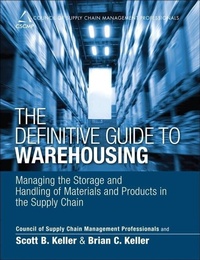
Definitive Guide to Warehousing, The
Managing the Storage and Handling of Materials and Products in the Supply Chain
Published on 23. January 2014
Book
Hardback
288 pages
978-0-13-344890-0 (ISBN)
Description
The proper management of warehousing is vital to the fulfillment of customer demand and the ultimate success of a supply chain. Now, there's an authoritative and comprehensive guide to managing warehouse processes and operations in any supply chain. Authored by expert Scott Keller alongside the Council of Supply Chain Management Professionals (CSCMP), this reference brings together authoritative knowledge about all facets of warehouse process and operations supply management.
The authors fully address each warehousing option, basic warehousing storage and handling operations, strategic planning, and the effects of warehousing design and service decisions on total logistics costs and customer service. Coverage includes:
Basic warehousing management concepts and their essential role in demand fulfillment, including warehousing functions, efficiency, organizational roles, and benefits
Key elements, processes, and interactions in warehousing operations management; including product handling, labor management, warehouse support, and extended value chain processes
Principles and strategies for effectively planning and managing warehouse operations, including decisions about facility ownership, planning, and strategy
Principles and strategies for designing materials handling operations in warehousing facilities, including dock and material handling equipment, AGVs, storage systems, order picking equipment, and more
Critical roles of technology, including warehouse management systems, Auto-ID, and emerging technology issues and capabilities
Best practices for assessing the performance of warehousing operations using standard metrics and frameworks
The authors fully address each warehousing option, basic warehousing storage and handling operations, strategic planning, and the effects of warehousing design and service decisions on total logistics costs and customer service. Coverage includes:
Basic warehousing management concepts and their essential role in demand fulfillment, including warehousing functions, efficiency, organizational roles, and benefits
Key elements, processes, and interactions in warehousing operations management; including product handling, labor management, warehouse support, and extended value chain processes
Principles and strategies for effectively planning and managing warehouse operations, including decisions about facility ownership, planning, and strategy
Principles and strategies for designing materials handling operations in warehousing facilities, including dock and material handling equipment, AGVs, storage systems, order picking equipment, and more
Critical roles of technology, including warehouse management systems, Auto-ID, and emerging technology issues and capabilities
Best practices for assessing the performance of warehousing operations using standard metrics and frameworks
More details
Series
Language
English
Place of publication
NJ
United States
Publishing group
Pearson Education (US)
Target group
Professional and scholarly
Product notice
sewn/stitched
Cloth over boards
Dimensions
Height: 238 mm
Width: 184 mm
Thickness: 22 mm
Weight
620 gr
ISBN-13
978-0-13-344890-0 (9780133448900)
Schweitzer Classification
Other editions
Additional editions
CSCMP | Scott Keller | Brian Keller
Definitive Guide to Warehousing, The
Managing the Storage and Handling of Materials and Products in the Supply Chain
E-Book
12/2013
1st Edition
Pearson
€104.99
Available for download
CSCMP | Scott B. Keller | Brian C. Keller
Definitive Guide to Warehousing, The
Managing the Storage and Handling of Materials and Products in the Supply Chain
E-Book
12/2013
1st Edition
Pearson FT Press
from
€78.89
Available for download
Persons
Scott B. Keller is a professor of logistics and marketing at the University of West Florida. He received his Ph.D. from the University of Arkansas and has been on faculty at Penn State and Michigan State. His research interests include issues in personnel development and performance, and the development of market-oriented cultures within logistics operations. He has conducted research for numerous corporations, and his work has appeared in leading logistics journals. He is the co-editor of the International Journal of Logistics Management, an associate editor of the Journal of Business Logistics and a member of the Council of Supply Chain Management Professionals. His managerial experience is in warehousing, motor carrier operations, and ocean freight terminal operations.
Brian Keller became an independent consultant in 2006. In this capacity, he has supported commercial industry companies as well as Government entities including the Office of the Deputy Under Secretary of Defense for Innovation & Technology Transition, the Defense Advanced Research Projects Agency (DARPA), and the Defense Science Board. Previously, Keller was chairman and president of GMA Cover Corporation, a multinational company that designed, manufactured, and supported signature management products including the Ultra Lightweight Camouflage Net System (ULCANS). During Keller's tenure, GMA won the Department of the Army competitive procurement for a $1.7B ULCANS production contract. Prior to GMA, Keller was a vice president for Stewart & Stevenson (now part of BAE) where he was responsible for the Family of Medium Tactical Vehicle (FMTV) A1R program including the successful award of the $4B rebuy production contract. Keller completed a 21-year military career as a logistician, Lieutenant Colonel, and the Army Product Manager for Field Support Systems. He is an alumni of the Harvard Business School, received a Bachelor of Science degree from the United States Military Academy at West Point, an MBA degree from the Florida Institute of Technology, and an MS degree in industrial engineering from the University of Alabama.
Brian Keller became an independent consultant in 2006. In this capacity, he has supported commercial industry companies as well as Government entities including the Office of the Deputy Under Secretary of Defense for Innovation & Technology Transition, the Defense Advanced Research Projects Agency (DARPA), and the Defense Science Board. Previously, Keller was chairman and president of GMA Cover Corporation, a multinational company that designed, manufactured, and supported signature management products including the Ultra Lightweight Camouflage Net System (ULCANS). During Keller's tenure, GMA won the Department of the Army competitive procurement for a $1.7B ULCANS production contract. Prior to GMA, Keller was a vice president for Stewart & Stevenson (now part of BAE) where he was responsible for the Family of Medium Tactical Vehicle (FMTV) A1R program including the successful award of the $4B rebuy production contract. Keller completed a 21-year military career as a logistician, Lieutenant Colonel, and the Army Product Manager for Field Support Systems. He is an alumni of the Harvard Business School, received a Bachelor of Science degree from the United States Military Academy at West Point, an MBA degree from the Florida Institute of Technology, and an MS degree in industrial engineering from the University of Alabama.
Content
Chapter 1: Warehousing's Role in the Supply Chain 1
Chapter 2: Distribution Center Concept 15
Chapter 3: General Warehousing and Distribution Center Strategies 21
Chapter 4: Design and Layout 45
Chapter 5: Personnel 57
Chapter 6: Warehouse Negotiations, Agreements, and Contracts 79
Chapter 7: Warehouse Management 87
Chapter 8: Warehouse Performance 99
Chapter 9: The Role of Industrial Product Packaging 111
Chapter 10: Warehousing and Transportation Interface 121
Chapter 11: The Importance of Managing Inventory 145
Chapter 12: Selecting Warehouse Locations 161
Chapter 13: Safety and Security 173
Chapter 14: Equipment and Information Technology 195
Chapter 15: Unique Functioning and Unique Materials Warehousing 221
Glossary of Key Terms and Definitions 231
Index 257
Chapter 2: Distribution Center Concept 15
Chapter 3: General Warehousing and Distribution Center Strategies 21
Chapter 4: Design and Layout 45
Chapter 5: Personnel 57
Chapter 6: Warehouse Negotiations, Agreements, and Contracts 79
Chapter 7: Warehouse Management 87
Chapter 8: Warehouse Performance 99
Chapter 9: The Role of Industrial Product Packaging 111
Chapter 10: Warehousing and Transportation Interface 121
Chapter 11: The Importance of Managing Inventory 145
Chapter 12: Selecting Warehouse Locations 161
Chapter 13: Safety and Security 173
Chapter 14: Equipment and Information Technology 195
Chapter 15: Unique Functioning and Unique Materials Warehousing 221
Glossary of Key Terms and Definitions 231
Index 257