

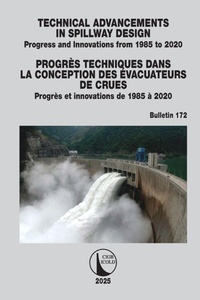
Technical Advancements in Spillway Design / Progres Techniques dans la Conception des Evacuateurs de Crues
Progress and Innovations from 1985 to 2020 / Progres et innovations de 1985 a 2020
1st Edition
Will be published approx. on 23. December 2025
Book
Paperback/Softback
408 pages
978-1-041-08378-8 (ISBN)
Description
The purpose of this bulletin is to provide the dam engineering community with information on the technical characteristics of the various types of spillways that have been developed and implemented over the past four decades, as well as the hydraulic characteristics associated with these structures.
Although spillways as such can be built with different types of structures and arrangements, the approach of this bulletin has been to retain some specific types of structures - step spillways, labyrinth spillways, PKW and tunnel spillways - and to analyze more conventional types of spillways operating under special conditions - very high flows, very high heads, very cold climates.
In each chapter, the topics covered focus on the major issues related to the specific problems and structures considered, with the goal of providing information to the designer and owner to assist in the choices to be made during project development.
Recent technological developments in the design, construction, and operation of spillways have focused primarily on economic and safety issues. Spillways are a key element of a dam project, providing the necessary protection of the project from the destructive effects of floods. This has led to the development of different approaches to selecting and defining the best type of spillway for each project. The purpose of this bulletin is to present and discuss the latest results of this evolution.
L'objectif du bulletin du est de fournir a la communaute des ingenieurs des barrages une information sur les caracteristiques techniques des differents types d'evacuateurs de crue developpes et implementes durant les quatre dernieres decennies, ainsi que des caracteristiques hydrauliques associees a ces structures.
Bien que les evacuateurs de crue, en tant que tels, peuvent etre construits avec differents types de structures et de dispositions, l'approche de ce bulletin a ete de retenir certains types specifiques de structures - evacuateurs de crue a marche d'escalier, labyrinthes, PKW et evacuateurs de crue en tunnel, et d'analyser des types plus conventionnels d'evacuateurs de crue operant dans des conditions speciales - tres grands debits, tres haute chute, climat tres froid.
Dans chaque chapitre, les sujets traites se concentrent sur les principales questions concernant les problematiques et structures specifiques considerees, dans l'objectif de fournir des informations au concepteur du projet et au proprietaire, pour aider aux choix a operer dans le cadre du developpement du projet.
La recente evolution des technologies en lien avec la conception, la construction et l'exploitation des evacuateurs de crue, s'est concentree essentiellement sur les sujets economiques et de securite. Les evacuateurs de crue sont un element cle d'un projet de barrage, pour assurer la protection necessaire du projet vis-a-vis de l'action destructrice des crues. Ceci a mene au developpement de differentes approches pour selectionner et definir le meilleur type d'evacuateur pour chaque projet. Ce bulletin vise a presenter et discuter les resultats les plus recents de cette evolution.
Although spillways as such can be built with different types of structures and arrangements, the approach of this bulletin has been to retain some specific types of structures - step spillways, labyrinth spillways, PKW and tunnel spillways - and to analyze more conventional types of spillways operating under special conditions - very high flows, very high heads, very cold climates.
In each chapter, the topics covered focus on the major issues related to the specific problems and structures considered, with the goal of providing information to the designer and owner to assist in the choices to be made during project development.
Recent technological developments in the design, construction, and operation of spillways have focused primarily on economic and safety issues. Spillways are a key element of a dam project, providing the necessary protection of the project from the destructive effects of floods. This has led to the development of different approaches to selecting and defining the best type of spillway for each project. The purpose of this bulletin is to present and discuss the latest results of this evolution.
L'objectif du bulletin du est de fournir a la communaute des ingenieurs des barrages une information sur les caracteristiques techniques des differents types d'evacuateurs de crue developpes et implementes durant les quatre dernieres decennies, ainsi que des caracteristiques hydrauliques associees a ces structures.
Bien que les evacuateurs de crue, en tant que tels, peuvent etre construits avec differents types de structures et de dispositions, l'approche de ce bulletin a ete de retenir certains types specifiques de structures - evacuateurs de crue a marche d'escalier, labyrinthes, PKW et evacuateurs de crue en tunnel, et d'analyser des types plus conventionnels d'evacuateurs de crue operant dans des conditions speciales - tres grands debits, tres haute chute, climat tres froid.
Dans chaque chapitre, les sujets traites se concentrent sur les principales questions concernant les problematiques et structures specifiques considerees, dans l'objectif de fournir des informations au concepteur du projet et au proprietaire, pour aider aux choix a operer dans le cadre du developpement du projet.
La recente evolution des technologies en lien avec la conception, la construction et l'exploitation des evacuateurs de crue, s'est concentree essentiellement sur les sujets economiques et de securite. Les evacuateurs de crue sont un element cle d'un projet de barrage, pour assurer la protection necessaire du projet vis-a-vis de l'action destructrice des crues. Ceci a mene au developpement de differentes approches pour selectionner et definir le meilleur type d'evacuateur pour chaque projet. Ce bulletin vise a presenter et discuter les resultats les plus recents de cette evolution.
More details
Series
Language
English
Place of publication
London
United Kingdom
Publishing group
Taylor & Francis Ltd
Target group
College/higher education
Professional and scholarly
Academic, Postgraduate, and Professional Reference
Dimensions
Height: 234 mm
Width: 156 mm
Thickness: 22 mm
Weight
620 gr
ISBN-13
978-1-041-08378-8 (9781041083788)
Copyright in bibliographic data and cover images is held by Nielsen Book Services Limited or by the publishers or by their respective licensors: all rights reserved.
Schweitzer Classification
Other editions
Additional editions
ICOLD /. CIGB
Technical Advancements in Spillway Design / Progres Techniques dans la Conception des Evacuateurs de Crues
Progress and Innovations from 1985 to 2020 / Progres et innovations de 1985 a 2020
E-Book
12/2025
1st Edition
CRC Press
€116.99
Available for download
ICOLD /. CIGB
Technical Advancements in Spillway Design / Progres Techniques dans la Conception des Evacuateurs de Crues
Progress and Innovations from 1985 to 2020 / Progres et innovations de 1985 a 2020
E-Book
12/2025
1st Edition
CRC Press
€116.99
Available for download
Person
The Commission Internationale des Grands Barrages (CIGB) / International Commission on Large Dams (ICOLD) is a non-governmental International Organization which provides a forum for the exchange of knowledge and experience in dam engineering. The Organization leads the profession in ensuring that dams are built safely, efficiently, economically, and without detrimental effects on the environment. Its original aim was to encourage advances in the planning, design, construction, operation, and maintenance of large dams and their associated civil works, by collecting and disseminating relevant information and by studying related technical questions. Since the late sixties, focus was put on subjects of current concern such as dam safety, monitoring of performance, reanalysis of older dams and spillways, effects of ageing and environmental impact. More recently, new subjects include cost studies at the planning and construction stages, harnessing international rivers, information for the public at large, and financing.
Content
1. Introduction 2. Large Capacity Spillways 3. High head spillways 4. Stepped Spillways 5. Labyrinth Spillways 6. PKW Spillways 7. Tunnel, Shaft and Vortex Spillways 8. Special Problems of Spillways in very Cold Climate 9. Composite Modelling of Hydraulic Structures 10. Economics, Risk and Safety in Spillway Design 1. Introduction 2. Les Deversoirs de Grande Capacite 3. Deversoirs a Hautes Chutes - Le Defi de la Dissipation D'energie et du Controle de L'affouillement a L'aval 4. Deversoirs en Marches D'escalier 5. Evacuateurs Labyrinthe 6. Evacuateur de Crue PKW 7. Evacuateurs de Crue en Tunnel, en Puits et a Vortex 8. Problemes Specifiques des Evacuateurs Dans des Climats Froids 9. Modelisation Hybride des Ouvrages Hydrauliques 10. Economie, Risque et Surete Dans la Conception des Evacuateurs de Crue