

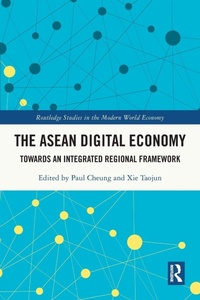
The ASEAN Digital Economy
Towards an Integrated Regional Framework
1st Edition
Published on 27. May 2025
Book
Paperback/Softback
190 pages
978-1-032-31248-4 (ISBN)
Description
Boasting the fastest growing Internet market in the world, Association of Southeast Asian Nations (ASEAN) is accelerating into the digital economy. This book assesses the potential economic impact of digital economy agreements (DEAs) and the readiness of some ASEAN member states to grow the digital economy in collaboration. The book presents a novel framework to assess countries' readiness to enter digital economy collaborations, following the architecture of Singapore's DEAs with its trading partners. It takes a bird's-eye view of the digital economy in ASEAN and reviews the current state of digital infrastructure and regulations.
The book also includes simulation exercises to project economic outcomes delivered by regional collaborations. It also elaborates on the specific strengths and weaknesses of five ASEAN member states. These ASEAN member states include Indonesia, Malaysia, the Philippines, Vietnam, and Cambodia. The book concludes by revisiting the ASEAN economy as a whole. It points out key issues country leaders need to work on as they proceed with digital economy collaborations.
This book is written for scholars, policymakers, and industrial practitioners who wish to learn the latest developments in the ASEAN digital economy.
The book also includes simulation exercises to project economic outcomes delivered by regional collaborations. It also elaborates on the specific strengths and weaknesses of five ASEAN member states. These ASEAN member states include Indonesia, Malaysia, the Philippines, Vietnam, and Cambodia. The book concludes by revisiting the ASEAN economy as a whole. It points out key issues country leaders need to work on as they proceed with digital economy collaborations.
This book is written for scholars, policymakers, and industrial practitioners who wish to learn the latest developments in the ASEAN digital economy.
More details
Series
Language
English
Place of publication
London
United Kingdom
Publishing group
Taylor & Francis Ltd
Target group
College/higher education
Postgraduate
Illustrations
62 s/w Abbildungen, 62 s/w Zeichnungen, 8 s/w Tabellen
8 Tables, black and white; 62 Line drawings, black and white; 62 Illustrations, black and white
Dimensions
Height: 234 mm
Width: 156 mm
Thickness: 12 mm
Weight
327 gr
ISBN-13
978-1-032-31248-4 (9781032312484)
Copyright in bibliographic data and cover images is held by Nielsen Book Services Limited or by the publishers or by their respective licensors: all rights reserved.
Schweitzer Classification
Other editions
Additional editions
E-Book
08/2023
1st Edition
Routledge
€60.99
Available for download
E-Book
08/2023
1st Edition
Routledge
€60.99
Available for download
Book
08/2023
1st Edition
Routledge
€206.20
Shipment within 10-20 days
Persons
Paul Cheung is a Professor (Practice) at the Lee Kuan Yew School of Public Policy. He returned to Singapore in January 2013 after serving for 9 years as the Director of the United Nations Statistics Division (UNSD) at the United Nations Headquarters in New York (2004-2012). Since April 1, 2020, he serves as the Director of the Asia Competitiveness Institute (ACI).
Xie Taojun is a Senior Research Fellow and Assistant Director (Research) at the Asia Competitiveness Institute (ACI), Lee Kuan Yew School of Public Policy, National University of Singapore. He obtained a Ph.D. degree in Economics from Nanyang Technological University. At ACI, Taojun oversees the cost of living indices for expatriates and ordinary residents. His research interests are in the economic implications of the digital economy, focussing on small open economies and emerging markets' contexts.
Xie Taojun is a Senior Research Fellow and Assistant Director (Research) at the Asia Competitiveness Institute (ACI), Lee Kuan Yew School of Public Policy, National University of Singapore. He obtained a Ph.D. degree in Economics from Nanyang Technological University. At ACI, Taojun oversees the cost of living indices for expatriates and ordinary residents. His research interests are in the economic implications of the digital economy, focussing on small open economies and emerging markets' contexts.
Content
1.Introduction 2. Evaluating the Impact of Digital Economy Collaborations in ASEAN: A Computable General Equilibrium Approach 3. Assessing Readiness for Digital Economy Collaboration 4. Indonesia: Advancing Southeast Asia's Largest Digital Economy 5. Malaysia: Digital Payments, Data Regulations and AI as Most Promising Areas for DEA Collaboration 6. Singapore-Philippine DEA: Digital Payments, Identification, and Paperless Trade Pose Challenges 7. Vietnam's Digital Economy: In a good position to spur the digital economy but challenges ahead 8. Is Cambodia ready for a Digital Economy Agreement with Singapore? 9. The AIDE framework: How Huawei supports national digital economic development 10. Addressing Key Trends in ASEAN's Digital Economy: Cyber Security and Industry 4.0 Disruption