

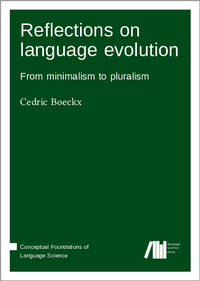
Reflections on language evolution
From minimalism to pluralism
1st Edition
Published on 18. October 2021
Book
Hardback
76 pages
978-3-98554-024-2 (ISBN)
Description
This essay reflects on the fact that as we learn more about the biological underpinnings of our language faculty, the dominant evolutionary narrative coming out of the linguistic tradition most explicitly oriented towards biology ("biolinguistics") appears increasingly implausible. This text offers ways of opening up linguistic inquiry and fostering interdisciplinarity, taking advantage of new opportunities to provide quantitative, testable hypotheses concerning the complex evolutionary path that led to the modern human language faculty.
The essay is structured around three main themes:
(i) renewed appreciation for the comparative method applied to cognitive questions, leading to the identification of elementary but fundamental abstractions in non-linguistic species relevant to language;
(ii) awareness of the conceptual gaps between disciplines, and the need to carefully link genotype and phenotype without bypassing any "intermediate" levels of description (certainly not the brain); and
(iii) adoption of a "philosophical" outlook that puts the complexity of biological entities front and center.
More details
Series
Edition
1. Auflage
Language
English
Place of publication
Berlin
Germany
Target group
Professional and scholarly
WIssenschaft
Product notice
sewn/stitched
Cloth over boards
Dimensions
Height: 246 mm
Width: 175 mm
Thickness: 11 mm
Weight
339 gr
ISBN-13
978-3-98554-024-2 (9783985540242)
Schweitzer Classification
Person
Author
Cedric Boeckx is Research Professor at the Catalan Institute for Research and Advanced Studies (ICREA), a member of the Linguistics section of the University of Barcelona, as well as of the university's Institute of Complex Systems. He is the author of numerous books, including Islands and Chain (2003), Linguistic Minimalism (2006), Language in Cognition (2010), and Elementary Syntactic Structures (2014). His graduate training and early career were in cognitive science and theoretical linguistics, but his more recent work seeks a more direct engagement with biology and has a more explicit evolutionary focus.