

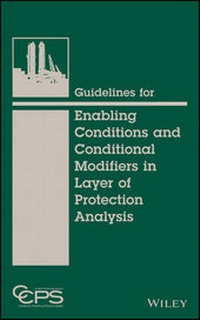
Guidelines for Enabling Conditions and Conditional Modifiers in Layer of Protection Analysis
Published on 10. December 2013
Book
Hardback
136 pages
978-1-118-77793-0 (ISBN)
Description
The initial Layer of protection analysis (LOPA) book published in 2001 set the rules and approaches for using LOPA as an intermediate method between purely qualitative hazards evaluation/analysis and more quantitative analysis methods. Basic LOPA provides an order-of-magnitude risk estimate of risk with fairly reproducible results. LOPA results are considered critical in determining safety integrity level for design of safety instrumented systems.
This guideline clarifies key concepts and reinforces the limitations and the requirements of LOPA. The main scope of the guideline is to provide examples of CMs and ECs and to provide concrete guidance on the protocols that must be followed to use these concepts. The book presents a brief overview of Layer of Protection Analysis (LOPA) and its variations, and summarizes terminology used for evaluating scenarios in the context of a typical incident sequence. It defines and illustrates the most common types of ECs and CMs and shows how they interrelate to risk criteria as well as their application to other methods.
More details
Other editions
Additional editions
CCPS (Center for Chemical Process Safety)
Guidelines for Enabling Conditions and Conditional Modifiers in Layer of Protection Analysis
E-Book
12/2013
Wiley-AIChE
€90.99
Available for download
CCPS (Center for Chemical Process Safety)
Guidelines for Enabling Conditions and Conditional Modifiers in Layer of Protection Analysis
E-Book
11/2013
Wiley-AIChE
€90.99
Available for download
Person
Since 1985, the Center for Chemical Process Safety (CCPS) has been the world leader in developing and disseminating information on process safety management and technology. CCPS, an industry technology alliance of the American Institute of Chemical Engineers (AIChE), has published over 80 books in its process safety guidelines and process safety concepts series, and over 100 training modules through its Safety in Chemical Engineering Education (SACHE) series.
Content
List of Tables ix
List of Figures xi
Abbreviations and Acronyms xiii
Glossary xv
Acknowledgements xxiii
Preface xxv
1 Context 1
1.1 LOPA Overview 1
1.2 Pertinent LOPA Variations 10
1.3 When to Use Enabling Conditions and Conditional Modifiers 13
1.4 Risk Criteria Endpoints 16
2 LOPA Enabling Conditions 23
2.1 Definition and Defining Characteristics 23
2.2 Interrelationship with Initiating Event 23
2.3 Time-At-Risk Enabling Conditions 23
2.4 Campaign Enabling Conditions 30
2.5 Other Possible Enabling Conditions 34
2.6 Documenting and Validating Enabling Conditions 34
3 LOPA Conditional Modifiers 37
3.1 Definition and Defining Characteristics 37
3.2 Probability of a Hazardous Atmosphere 42
3.3 Probability of Ignition or Initiation 44
3.4 Probability of Explosion 49
3.5 Probability of Personnel Presence 55
3.6 Probability of Injury or Fatality 60
3.7 Probability of Equipment Damage or Other Financial Impact 65
3.8 Documenting, Managing and Validating Conditional Modifiers 69
4 Application to Other Methods 71
4.1 Quantitative Risk Analysis 71
4.2 Use of Enabling Conditions and Conditional Modifiers with Scenario Identification Methods 75
4.3 Barrier Analysis and Diagrams 79
Appendices 81
A Simultaneous Failures and "Double Jeopardy" 83
B Peak Risk Concepts 91
C Example Rule Set for LOPA Enabling Conditions 95
Example Rule Set for LOPA Enabling Conditions 95
References 99
Index 103