

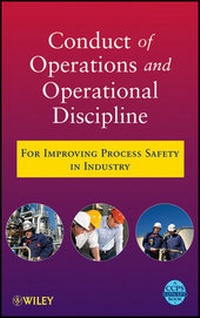
Conduct of Operations and Operational Discipline
For Improving Process Safety in Industry
Published on 12. April 2011
Book
Hardback
242 pages
978-0-470-76771-9 (ISBN)
Description
Process safety management (PSM) systems are only as effective as the day-to-day ability of the organization to rigorously execute system requirements correctly every time. The failure of just one person in completing a job task correctly just one time can unfortunately lead to serious injuries and potentially catastrophic incidents. In fact, the design, implementation, and daily execution of PSM systems are all dependent on workers at all levels in the organization doing their job tasks correctly every time. High levels of Operational Discipline, therefore, help ensure strong PSM performance and overall operational excellence.
This book details management practices which help ensure rigor in executing process safety programs in order to prevent major accidents
More details
Edition
1. Auflage
Language
English
Place of publication
United States
Publishing group
John Wiley & Sons Inc
Target group
Professional and scholarly
Product notice
Unsewn / adhesive bound
Paper over boards
Dimensions
Height: 249 mm
Width: 164 mm
Thickness: 20 mm
Weight
473 gr
ISBN-13
978-0-470-76771-9 (9780470767719)
Schweitzer Classification
Other editions
Additional editions
CCPS (Center for Chemical Process Safety)
Conduct of Operations and Operational Discipline
For Improving Process Safety in Industry
E-Book
12/2011
Wiley-AIChE
€137.99
Available for download
CCPS (Center for Chemical Process Safety)
Conduct of Operations and Operational Discipline
For Improving Process Safety in Industry
E-Book
04/2011
Wiley-AIChE
€134.99
Available for download
Person
Since 1985, the CENTER FOR CHEMICAL PROCESS SAFETY (CCPS) has been the world leader in developing and disseminating information on process safety management and technology. CCPS, an industry technology alliance of the American Institute of Chemical Engineers (AIChE), has published over eighty books in its process safety guidelines and process safety concepts series, and over one hundred training modules through its Safety in Chemical Engineering Education (SAChe) series.
Content
List of Tables.
List if Figures.
Online Materials Accompanying This Book.
Acronyms and Abbreviations.
Glossary.
Acknowledgments.
Preface.
Executive Summary.
1. What is COO/OD and How Can I Tell If I Need It?
1.1 Introduction.
1.2 Purpose of This Book.
1.3 Focus and Intended Audience.
1.4 Definitions.
1.5 How to Use This Book.
1.6 How DO I Know If I Need to Improve my COO/OD.
1.7 Basic COO/OD Concepts.
1.8 Implementation of the COO/OD System.
1.9 Scope of the Book.
1.10 Relationship to Other Management System Frameworks.
1.11 Summary.
1.12 References.
2. Benefits of COO/OD.
2.1 Introduction.
2.2 Objectives of COO/OD.
2.3 Evolution of COO/OD Systems.
2.4 Summary.
2.5 References.
2.6 Additional Reading.
3. Leadership's Role and Commitment.
3.1 Introduction.
3.2 Achieving Greatness with COO/OD.
3.3 Leadership's Role in Instituting COO/OD.
3.4 Summary.
3.5 References.
3.6 Additional Reading.
4. The Importance of Human Factors.
4.1 Introduction.
4.2 Human Behavior Issues.
4.3 What Is a Human Error?
4.4 Common Misconceptions About Human Performance.
4.5 Categories of Human Errors.
4.6 Human Error Initiators.
4.7 How Does A COO/OD System Prevent and Mitigate Human Errors?
4.8 Relationship Between COO/OD and Other Common Human Performance Tools.
4.9 Getting Everyone Involved in Human Factors.
4.10 Human Factors Metrics.
4.11 Summary.
4.12 References.
4.13 Additional Reading.
5. Key Attributes of Conduct of Operations.
5.1 Introduction.
5.2 COO Applied of Process Safety Management Systems.
5.3 Organization of this Chapter.
5.4 COO Foundations.
5.5 People.
5.6 Process.
5.7 Plant.
5.8 Management Systems.
5.9 Summary.
5.10 References.
5.11 Additional Reading.
6. Key Attributes of Operational Discipline.
6.1 Introduction.
6.2 Organizational Attributes.
6.3 Individual Attributes.
6.4 Summary.
6.5 References.
6.6 Additional Reading.
7. Implementing and Maintaining Effective COO/OD Systems.
7.1 Introduction.
7.2 Develop a Plan.
7.3 Implement the Plan.
7.4 Monitor Progress.
7.5 Adjust the Plan and Continuously Improve.
7.6 Application to Different Roles.
7.7 Summary.
7.8 References.
7.9 Additional Reading.