

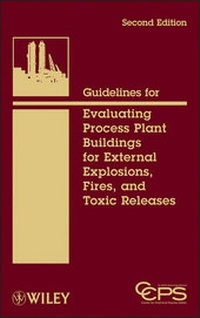
Guidelines for Evaluating Process Plant Buildings for External Explosions, Fires, and Toxic Releases
2nd Edition
Published on 27. April 2012
Book
Hardback
232 pages
978-0-470-64367-9 (ISBN)
Description
Siting of permanent and temporary buildings in process areas requires careful consideration of potential effects of explosions and fires arising from accidental release of flammable materials. This book, which updates the 1996 edition, provides a single-source reference that explains the American Petroleum Institute (API) permanent (752) and temporary (753) building recommended practices and details how to implement them. New coverage on toxicity and updated standards are also highlighted. Practical and easy-to-use, this reliable guide is a must-have for implementing safe building practices.
More details
Edition
2. Auflage
Language
English
Place of publication
United States
Publishing group
John Wiley & Sons Inc
Target group
Professional and scholarly
Product notice
sewn/stitched
Cloth over boards
Dimensions
Height: 250 mm
Width: 164 mm
Thickness: 20 mm
Weight
510 gr
ISBN-13
978-0-470-64367-9 (9780470643679)
Schweitzer Classification
Other editions
Additional editions
CCPS (Center for Chemical Process Safety)
Guidelines for Evaluating Process Plant Buildings for External Explosions, Fires, and Toxic Releases
E-Book
11/2012
2nd Edition
Wiley-AIChE
€125.99
Available for download
CCPS (Center for Chemical Process Safety)
Guidelines for Evaluating Process Plant Buildings for External Explosions, Fires, and Toxic Releases
E-Book
05/2012
2nd Edition
Wiley-AIChE
€121.99
Available for download
Previous edition

Center for Chemical Process Safety (CCPS)
Guidelines for Evaluating Process Plant Buildings for External Explosions and Fires
Book
09/1996
American Institute of Chemical Engineers
€170.84
Article exhausted; check for reprint
Person
Since 1985, the Center for Chemical Process Safety (CCPS) has been the world leader in developing and disseminating information on process safety management and technology. CCPS, an industry technology alliance of the American Institute of Chemical Engineers (AIChE), has published over 80 books in its process safety guidelines and process safety concepts series, and over 100 training modules through its Safety in Chemical Engineering Education (SACHE) series.
Content
1. Introduction 1
1.1 Objective 4
1.2 Building Siting Evaluation Process 5
1.3 Selection of Approach 6
1.4 Background 6
1.5 Phillips, Pasadena, Texas USA: Propylene HDPE Unit VCE ad BLEVEs 10
1.6 Evolution of Design and Siting Practices for Buildings in Process Plants 18
1.7 Organization of the Book 20
2. Management Overview 21
2.1 Process Overview 21
2.2 Management Responsibilities under API RP-752 and API RP-753 27
3. Determining the Scope of the Building Siting Evaluation 31
3.1 Introduction 31
3.2 Buildings Considered 31
3.3 Scenario Selection 36
4. Building Siting Evaluation Criteria 45
4.1 Introduction 45
4.2 Occupant Vulnerability 46
4.3 Criteria for Existing Buildings Exposed to Explosion Hazards 48
4.4 Criteria for Fires 58
4.5 Criteria for Toxic Exposures 62
4.6 Criteria for Building Upgrades and New Buildings 64
4.7 Risk Criteria 65
5. Explosion Hazards 71
5.1 Introduction 71
5.2 Select Explosion Approach 72
5.3 Modeling and Quantifying and Explosion Hazards 74
5.4 Building Response to Explosion Hazards 78
5.5 Occupant VULNERABILITY to Explosion Hazards 90
5.6 Actions Required at the Completion of the Evaluation 90
6. Fire Hazards Assessment 93
6.1 Introduction 93
6.2 Determining if a Fire Hazard Exists 97
6.3 Spacing Table Approach 97
6.4 Performing a Consequence-Based or Risk-Based building siting evaluation for Fire 99
6.5 Occupant Response to Fire Hazards 105
6.6 Defining the Fire Protection Concept 106
7. Toxic Hazards Assessment 109
7.1 Introduction 109
7.2 Determining if a Toxic Hazard Exists 109
7.3 Building siting evaluation for toxics 111
7.4 Defining the Toxic Protection Concept 120
7.5 Evacuation vs. Sheltering-In-Place 120
8. Frequency and Probability Assessment 125
8.1 Introduction 125
8.2 Developing a Scenario List 127
8.3 Calculation of Frequency of Initiating Event or accident 129
8.4 Probability and Frequency of Final Outcomes 144
8.5 Unit-Based Outcome Frequencies 149
9. Risk Assessment 151
9.1 Introduction 151
9.2 Risk Measure Types 154
9.3 Calculating Risk 158
9.4 Interpretation and Use of Risk Measures 169
10. Mitigation Plans and Ongoing Risk Management 171
10.1 Development of Mitigation Plans 171
10.2 Building Modifications 177
11. Managing the Building Siting Process 185
11.1 Management of Change 185
11.2 Documentation Requirements 187
11.3 Documentation of Mitigation Systems Criteria and Performance 188
11.4 Maintaining Documentation "EverGreen" 189