

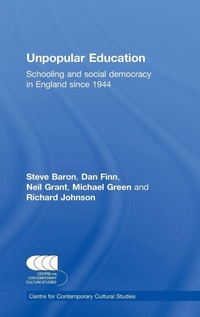
Unpopular Education
Schooling and Social Democracy in England since 1944
Published on 28. November 2006
Book
Hardback
314 pages
978-0-415-40832-5 (ISBN)
Description
Published in the year 2006, Unpopular Education is a valuable contribution to the field of Media and Cultural Studies.
More details
Language
English
Place of publication
London
United Kingdom
Publishing group
Taylor & Francis Ltd
Target group
College/higher education
Professional and scholarly
Undergraduate
Product notice
Unsewn / adhesive bound
Paper over boards
Illustrations
1 s/w Photographie bzw. Rasterbild
1 Halftones, black and white
Dimensions
Height: 238 mm
Width: 160 mm
Thickness: 23 mm
Weight
603 gr
ISBN-13
978-0-415-40832-5 (9780415408325)
Copyright in bibliographic data and cover images is held by Nielsen Book Services Limited or by the publishers or by their respective licensors: all rights reserved.
Schweitzer Classification
Other editions
Additional editions
E-Book
02/2013
1st Edition
Routledge
€60.49
Available for download
E-Book
02/2013
1st Edition
Routledge
€60.49
Available for download
Book
10/2012
Routledge
€73.22
Shipment within 15-20 days
Book
03/2012
Routledge
€54.66
Article exhausted; check different version
Person
The Centre for Contemporary Cultural Studies (CCCS) was a research centre at the University of Birmingham. It is notable for producing many key studies and researchers in the field of Cultural Studies. It was founded in 1964 by Richard Hoggart, who became the first centre director. The Cultural Studies department at the University of Birmingham was closed in 2002.
Content
Preface Part 1: Social democracy: the making 1. Perspectives on schooling and politics 2. Popular dilemmas, radical strategies and the inter-war Labour Party 3. Conservatism, citizenship and the 1944 settlement 4. Origins of the 1960s' settlement Part 2: Social democracy: the limits Introduction 5. Great expectations: the noise and practice of reform 6. The sociology of education: a critique 7. Schooling, skilling and social relations Conclusion Part 3: Social democracy: the breaking 8. Recession, protest and absent defence 9. Turning the tables: the Conservative education offensive 10. Labour's appropriation: the Great Debate and after 11. The rise of the Manpower Services Commission By no means concluded Notes and references Index