

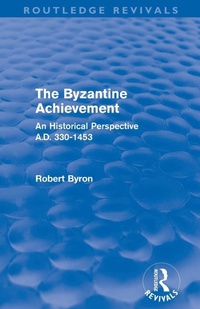
The Byzantine Achievement (Routledge Revivals)
An Historical Perspective, A.D. 330-1453
1st Edition
Published on 5. April 2013
Book
Paperback/Softback
354 pages
978-0-415-50596-3 (ISBN)
Description
First published in 1929, this highly influential study offers a historical perspective on the Byzantine Empire, from the establishment of Constantinople by Emperor Constantine around 330 AD, through to the fall of Constantinople at the hands of the Ottoman Empire in 1453 AD.
Byron's work considers the empire in its entirety, assessing the highs and lows across a thousand year period. He provides insights into trade, culture, the organs of state, religion, the imperial rulers, and the battle with the Ottoman Empire, which would ultimately end in the fall of the Byzantine Empire and the end of the final remnants of the Roman Empire.
Byron's work considers the empire in its entirety, assessing the highs and lows across a thousand year period. He provides insights into trade, culture, the organs of state, religion, the imperial rulers, and the battle with the Ottoman Empire, which would ultimately end in the fall of the Byzantine Empire and the end of the final remnants of the Roman Empire.
More details
Series
Language
English
Place of publication
London
United Kingdom
Publishing group
Taylor & Francis Ltd
Target group
College/higher education
Dimensions
Height: 216 mm
Width: 140 mm
Thickness: 20 mm
Weight
473 gr
ISBN-13
978-0-415-50596-3 (9780415505963)
Copyright in bibliographic data and cover images is held by Nielsen Book Services Limited or by the publishers or by their respective licensors: all rights reserved.
Schweitzer Classification
Other editions
Additional editions
E-Book
11/2012
1st Edition
Routledge
€54.99
Available for download
E-Book
11/2012
1st Edition
Routledge
€55.49
Available for download
Book
01/2012
1st Edition
Routledge
€282.26
Shipment within 15-20 days
Person
Robert Byron (1905-1941) was a British writer and art critic whose adventurous spirit and insightful prose left a lasting impact on travel literature. Born into a wealthy family, he rejected a traditional path, choosing instead to explore the world's diverse cultures and architectural wonders.Driven by an insatiable curiosity, Byron ventured across Europe, Asia, and the Middle East, capturing his experiences in vibrant and witty prose. He possessed a distinctive talent for weaving together personal anecdotes with astute observations on art, history, and the social landscapes he encountered. From the monasteries of Mount Athos to the ancient ruins of Persia, Byron sought to understand the soul of a place through its people and its past.His most acclaimed work, The Road to Oxiana, is considered a signature classic of travel writing, admired for its humor, erudition, and vivid descriptions. Byron was also a fervent champion of architectural preservation and a key figure in the resurgence of interest in Byzantine art.Though his life was tragically cut short when his ship was torpedoed by a German U-boat during World War II, Byron's legacy as a writer and explorer endures. His books continue to inspire those with a passion for travel and an appreciation for keen observation and mischievous wit.
Content
Part 1: The Historical Image 1. The Historian 2. The Greeks 3. The Byzantines Part 2: The Anatomy 4. The Triple Fusion 5. The Imperial Chronology 6. The Substance of the State 7. The Trade and the Bezant 8. The Quest of Reality 9. Culture 10. The Joyous Life 11. Battle for Europe