

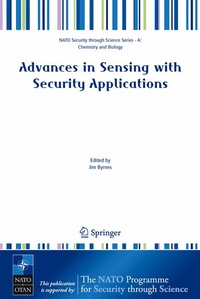
Advances in Sensing with Security Applications
Description
More details
Other editions
Additional editions
Content
Preface. Acknowledgments.Bistatic and multistatic radar sensors for homeland security; G.J. Baker and H.D. Griffiths. 1. Introduction .- 2 Definitions .-3. Bistatic essentials .- 4. Passive Coherent Location (PCL).- 5. Multistatic radar .-6. Conclusions.- 7. Acknowlegments .-References.The Terrorist Threat and Its Implications for Sensor Technologies; J. L. Brower.1. Introduction.- 2. What is Terrorism?.- 3. General Trends in Terrorism.- 4.Significant Domestic Threats.- 5. State Sponsored Terrorism.- 6. Future Threats.- 7. Preventions Efforts The Role of Sensors.- 8. Improving Sensors.- 9. Conclusions.- References. Advances in sensors; the lessons from Neurosciences; M. Costa.-1. Energies that affect earth living organisms survival.- 2. The emergence of a nervous system. 3. Neurons as excitable cells.- 4. Sensory neurons.- 5. Sensory transduction.- 6. Molecules of sensory transduction.- 7. Hearing system and mechanosensation.- 8. Temperature receptors.- 9. Pain receptors.- 10. Olfaction.- 11. Vision .-12. General view of the sensory systems.- References. Chemical sensors and chemical sensor systems; A. Orsini, A. D 'Amico. 1. Introduction-Parameters.- 2. Fundamentals Devices; 3. Thermopiles.- 4. Kelvin Probe.- 5. Bulk Acoustic Waves.- 6. Surface Acoustic Waves.- 7. Natural and Artificial Olfaction.- 8. Optical Fibre Sensor .- 9. Surface Plasmon Resonance.- 10. Conclusions.- References. Wireless Sensor Networks for Security: Issues and Challenges; T. Onel, et al. 1. Introduction.- 2. Neyman-Pearson Detection.- 3. Breach Probability Analysis [30].-
4. Data Processing Architecture for Target Tracking.- 5. Maximum Mutual Information Based Sensor Selection Algorithm.- 6. Simulation Results.- 7. Conclusion.-References. Internet-Scale Chemical Sensing ; D. Diamond. 1. Introduction.- 2. Chemical Sensing and Biosensing.- 3. Miniaturised Analytical Instruments - Lab on a Chip Devices.- 4. Analytical Device Hierarchy.-5. Networking Options.-
6. Integrating Chemical Sensors and Biosensors with Wireless Networks.- 7. Scale-up Issues for Densely Distributed Analytical Devices.- 8. Chemo- & Bio-warfare Agents.- 9. Sensor communities and group behaviour.- 10. pHealth.- 11. Conclusions.- References. Data analysis for chemical sensor arrays; .C. Di Natale et al.1. Feature extraction.-2. Data Pre-processing: Scaling .- 3. Normalization.-
4.- Multivariate data exploration.- 5. Principal Component Analysis.- 6. Supervised Classification .- 7. Linear Discrimination.- 8. Application to the investigation of Chemical Sensors properties.-
9. Conclusions.- References. Fundamentals of Tomography and Radar; H.D. Griffiths and C.J. Baker. 1. Introduction.-2. Imaging and Resolution.- 3. Tomographic Imaging.- 4. The Projection Slice Theorem .- 5. Tomography of Moving Targets.- 6. Applications.- 7. Automatic Target Recognition.- 8. Bandwidth Extrapolation.- 9. Target-matched Illumination.- 10. Conclusion.-11. Acknowledgements.- References. Remote Sensing using Space Based Radar; B. Himed, et al. 1. Introduction .- 2. Geometry.- 3. Range Foldover and Earth's Rotation.- 4. Application of STAP for SBR .-5. Orthogonal Pulsing Scheme.- References. Continuous wave radars-monostatic, multistatic and network ; K. Kulpa. 1.Introduction.- 2. Radar fundamentals.- 3. Linear Frequency Modulated Continuous Wave Radar.- 4. Noise Radar.- 5. Noise radar range equation .- 6. Bi-static and multi-static continuous wave radars.- 7. Target identification in continuous wave radars.-References.
Terahertz Imaging, Millimeter-Wave Radar; R. W. McMillan.1. Introduction .- 2. Atmospheric Limitations.- 3. Millimeter-Wave and Terahertz Sources of Radiation.-4. Millimeter-Wave and Terahertz Detectors and Receivers.- 5. Millimeter-Wave and Terahertz Optics.-6. Millimeter-Wave and Terahertz Systems.- 7. Summary.- References. Sensor Management for Radar: A Tutorial;
B. Moran et al. 1. Introduction .- 2. Radar Fundamentals.- 3. Sensor Management Overview.- 4. Theory of Waveform Libraries.-5. Sensor scheduling simulations and results.- References. Waveform Design, Range CFAR and Target Recognition; H. Rohling.1. Introduction.- 2. Combination of LFMCW and FSK modulation principles for automotive radar systems.- Automotive Radar Network Based On 77GHz FMCW Sensors.- 4. Range CFAR Techniques.- 5. Conclusion.-References. Tomography of Moving Targets (TMT) for Security and Surveillance; M. C. Wicks et al. 1.Introduction.- 2. Tomography Concept and Framework .-3. Bistatic Geometry and Observables .-4. Matched Filter Processing (MFP).- 5. TMT Netted Radar System.-6. TMT MFP Simulation.-
7. Detection Perfomance.-8. Summary.- 9. Acknowledgements.- References. Near Infrared Imaging and Spectroscopy for Brain Activity Monitoring; Il- Young Son, B. Yazici.1. Introduction.- 2. NIR Imaging and Spectroscopy Systems .- 3. Hemodynamic Response.- 4. Neuronal Response.- 5. Human Subject Studies.- 6. Concluding Remarks and Future Directions.-References.
Topic Index