

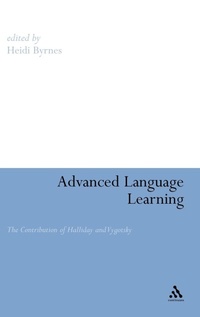
Advanced Language Learning
The Contribution of Halliday and Vygotsky
Published on 24. November 2006
Book
Hardback
288 pages
978-0-8264-9071-1 (ISBN)
Description
'The editor and authors in this volume make a convincing case for focusing on advanced foreign language instruction. Importantly, they invite consideration of this focus as an opportunity to re-examine conventional definitions of the target of instruction. In so doing, readers also learn more about the theories highlighted in this volume, and their capacity to enhance our understanding of advancedness and its development within an educational context. This book thus mediates between linguistic and language learning theories and educational practice, modelling the very best of what applied linguistics has to offer.' Diane Larsen-Freeman, Professor of Education, University of Michigan. The reality of multicultural societies and globalization has increased the demand for language abilities that far exceed those that have typically been associated with communicative competence in a second language. This book examines the acquisition of advanced levels of ability in three parts: theoretical; descriptive; and instructional. It moves beyond the traditional constraints of second language acquisition research by linking systemic functional linguistics and sociocultural theory.The contributors draw primarily on the work of Halliday, Vygotsky and Bakhtin, as well as empirical data from the language classroom, to suggest practical applications towards advanced literacy and linguistic competence.
Advanced Language Learning will be of interest to academics researching systemic functional linguistics, second language acquisition and applied linguistics.
Advanced Language Learning will be of interest to academics researching systemic functional linguistics, second language acquisition and applied linguistics.
Reviews / Votes
mention- Book News Inc./ August 2007 "With this edited volume, Byrnes has added one more publication to the growing body of literature (of her authorship and that of others) on advanced language learning (ALL). In this collection, the notion of advancedness in language learning and instruction is explored through a very special lens: the illuminating potential of Halliday's systemic functional linguistics (SFL) and Vygotskyan sociocultural theory (SCT)...This is an excellent volume. The chapters are all well written and rich in stimulating ideas. The book balances adequately the theoretical with the practical, offering support for a new approach to L2 classrooms that truly places meaning at the center of instruction and makes ALL both a possible and desirable goal...serves wonderfully as a point of departure for exploration of aspects of meaning, context, and use in advanced language teaching and learning from an integrated SFL and SCT perspective." -Maria C. M. De Guerreo, MLJ Reviews, (Modern Language Journal), Vol. 92 No. 2, 2008 -- Maria C. M. De Guerreo "The book, however, is not as well balanced in terms of the two perspectives used as theoretical bases, with the majority of the papers taking an SFL outlook rather than an SCT one. In addition, although the compatibility of Hallidayan and Vygotskyan theories is alluded to in several contributions, there is no thorough or extended treatment of how the two theories can complement each other in approaches to advanced language teaching." -Maria C. M. De Guerreo, MLJ Reviews, (Modern Language Journal), Vol. 92 No. 2, 2008More details
Language
English
Place of publication
London
United Kingdom
Publishing group
Bloomsbury Publishing PLC
Target group
Professional and scholarly
Academics
Dimensions
Height: 240 mm
Width: 161 mm
Thickness: 20 mm
Weight
587 gr
ISBN-13
978-0-8264-9071-1 (9780826490711)
Copyright in bibliographic data and cover images is held by Nielsen Book Services Limited or by the publishers or by their respective licensors: all rights reserved.
Schweitzer Classification
Person
Heidi Byrnes is Professor of German at Georgetown University, USA.
Content
Introduction; Part I: Theoretical considerations in advanced instructed learning; 1. Educating for advanced foreign language capacities - Christian M I M Matthiessen; 2. Generalised collective dialogue and advanced foreign language capacities - James V. Wertsch; 3. The relevance of languaculture and conceptual knowledge for advanced proficiency - James P. Lantolf; Part II: Description and Instruction; 4. Language, agency and collaboration in advanced second language proficiency - Merrill Swain; 5. The linguistic features of advanced language use - Mary Schleppegrell. 6. The problem of text construction and the advanced language learner - Marianna Ryshina-Pankova; 7. Bilingual heritage speakers acquiring Spanish - Teresa Oteiza; 8. Approaching second language writing instruction - Susan Strauss; 9. Academic French - Alice Caffarel; 10. Meaning-making in Italian - Roberta Piazza; 11. Grammatical metaphor - M. Cecilia Colombi; Part III: Pragmatic and curricular issues; 12. Meeting the challenge of comprehensive curriculum construction - Heidi Byrnes; 13. Genre as a curricular framework for collegiate L2 learning - Cori Crane.; 14. Developing a heritage language speaker track to support L2 acquisition - Sylvia Pessoa; 15. Advanced learning for intermediate learners - N A J Moore.