

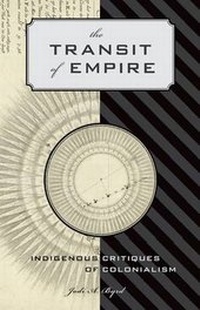
The Transit of Empire
Indigenous Critiques of Colonialism
Published on 6. September 2011
Book
Hardback
320 pages
978-0-8166-7640-8 (ISBN)
Description
In 1761 and again in 1768, European scientists raced around the world to observe the transit of Venus, a rare astronomical event in which the planet Venus passes in front of the sun. In The Transit of Empire, Jodi A. Byrd explores how indigeneity functions as transit, a trajectory of movement that serves as precedent within U.S. imperial history. Byrd argues that contemporary U.S. empire expands itself through a transferable "Indianness" that facilitates acquisitions of lands, territories, and resources.
Examining an array of literary texts, historical moments, and pending legislations-from the Cherokee Nation of Oklahoma's vote in 2007 to expel Cherokee Freedmen to the Native Hawaiian Government Reorganization bill-Byrd demonstrates that inclusion into the multicultural cosmopole does not end colonialism as it is purported to do. Rather, that inclusion is the very site of the colonization that feeds U.S. empire.
Byrd contends that the colonization of American Indian and indigenous nations is the necessary ground from which to reimagine a future where the losses of indigenous peoples are not only visible and, in turn, grieveable, but where indigenous peoples have agency to transform life on their own lands and on their own terms.
Examining an array of literary texts, historical moments, and pending legislations-from the Cherokee Nation of Oklahoma's vote in 2007 to expel Cherokee Freedmen to the Native Hawaiian Government Reorganization bill-Byrd demonstrates that inclusion into the multicultural cosmopole does not end colonialism as it is purported to do. Rather, that inclusion is the very site of the colonization that feeds U.S. empire.
Byrd contends that the colonization of American Indian and indigenous nations is the necessary ground from which to reimagine a future where the losses of indigenous peoples are not only visible and, in turn, grieveable, but where indigenous peoples have agency to transform life on their own lands and on their own terms.
Reviews / Votes
"Theoretically rich, and broad in its intellectual scope, The Transit of Empire puts Indianness at the center of American histories that are not only national, but explicitly imperial and colonial. Jodi Byrd's brilliant critique of contemporary multicultural liberalism places American Indian and Indigenous studies in close dialogue with postcolonial scholarship, transforming both in the process. It is a work of power, complexity, and commitment, and should not be missed by anyone in these fields." -Philip Deloria "The Transit of Empire is a sophisticated and groundbreaking work of indigenous critical theory in which Jodi Byrd reveals and explores the cacophonies of colonialism in literary, historical, and political settings." -Kevin Bruyneel, Babson CollegeMore details
Series
Language
English
Place of publication
Minnesota
United States
Dimensions
Height: 216 mm
Width: 140 mm
Thickness: 25 mm
ISBN-13
978-0-8166-7640-8 (9780816676408)
Copyright in bibliographic data and cover images is held by Nielsen Book Services Limited or by the publishers or by their respective licensors: all rights reserved.
Schweitzer Classification
Person
Jodi A. Byrd is a citizen of the Chickasaw Nation of Oklahoma and assistant professor of American Indian studies and English at the University of Illinois at Urbana-Champaign.
Content
Contents
Preface: Full Fathom Five
Introduction: Indigenous Critical Theory and the Diminishing Returns of Civilization
1. Is and Was: Poststructural Indians without Ancestry
2. "This Island's Mine": The Parallax Logics of Caliban's Cacophony
3. The Masks of Conquest: Wilson Harris's Jonestown and the Thresholds of Grievability
4. "Been to the Nation, Lord, but I Couldn't Stay There": Cherokee Freedmen, Internal Colonialism, and the Racialization of Citizenship
5. Satisfied with Stones: Native Hawaiian Government Reorganization and the Discourses of Resistance
6. Killing States: Removals, Other Americans, and the "Pale Promise of Democracy"
Conclusion: Zombie Imperialism
Acknowledgments
Notes
Index
Preface: Full Fathom Five
Introduction: Indigenous Critical Theory and the Diminishing Returns of Civilization
1. Is and Was: Poststructural Indians without Ancestry
2. "This Island's Mine": The Parallax Logics of Caliban's Cacophony
3. The Masks of Conquest: Wilson Harris's Jonestown and the Thresholds of Grievability
4. "Been to the Nation, Lord, but I Couldn't Stay There": Cherokee Freedmen, Internal Colonialism, and the Racialization of Citizenship
5. Satisfied with Stones: Native Hawaiian Government Reorganization and the Discourses of Resistance
6. Killing States: Removals, Other Americans, and the "Pale Promise of Democracy"
Conclusion: Zombie Imperialism
Acknowledgments
Notes
Index