

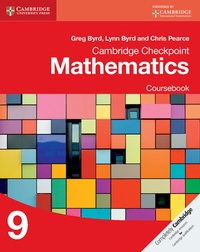
Cambridge Checkpoint Mathematics Coursebook 9
Published on 6. June 2013
Book
Paperback/Softback
196 pages
978-1-107-66801-0 (ISBN)
Description
Written by well-respected authors, the Cambridge Checkpoint Mathematics suite provides a comprehensive structured resource which covers the full Cambridge Secondary 1 Mathematics framework in three stages. This brightly illustrated Coursebook for Stage 9 offers a comprehensive introduction to all topics covered in the syllabus. Worked examples show students how to tackle different problems, and plenty of exercise questions prepare students for the different types of questions they will face in their Checkpoint exam. Coverage of the Problem Solving framework is integrated throughout the course, with questions relating to the Problem Solving framework statements highlighted in the Coursebook. There is an accompanying Practice Book and Teacher's Resource CD-ROM available separately.
More details
Language
English
Place of publication
Cambridge
United Kingdom
Target group
Primary & secondary/elementary & high school
Product notice
Paperback (trade)
Illustrations
Worked examples or Exercises
Dimensions
Height: 275 mm
Width: 220 mm
Thickness: 9 mm
Weight
510 gr
ISBN-13
978-1-107-66801-0 (9781107668010)
Copyright in bibliographic data and cover images is held by Nielsen Book Services Limited or by the publishers or by their respective licensors: all rights reserved.
Schweitzer Classification
Other editions
New editions
Lynn Byrd | Greg Byrd | Chris Pearce
Cambridge Lower Secondary Mathematics Learner's Book 9 with Digital Access (1 Year)
Book
06/2021
2nd Edition
Cambridge University Press
€36.00
Shipment within 15-20 days
Additional editions
Greg Byrd | Lynn Byrd | Chris Pearce
Cambridge Checkpoint Mathematics
E-Book
02/2014
1st Edition
Cambridge University Press
€18.99
Available for download
Content
Introduction; Acknowledgements; Unit 1. Integers, powers and roots; Unit 2. Sequences and functions; Unit 3. Place value, ordering and rounding; Unit 4. Length, mass, capacity and time; Unit 5. Shapes; Unit 6. Planning and collecting data; Unit 7. Fractions; Unit 8. Constructions, shapes and Pythagoras' theorem; Unit 9. Expressions and formulae; Unit 10. Processing and presenting data; Unit 11. Percentages; Unit 12. Tessellations, transformations and loci; Unit 13. Equations and inequalities; Unit 14. Ratio and proportion; Unit 15. Area, perimeter and volume; Unit 16. Probability; Unit 17. Bearings and scale drawing; Unit 18. Graphs; Unit 19. Interpreting and discussing results; End-of-year review; Glossary; Index.