

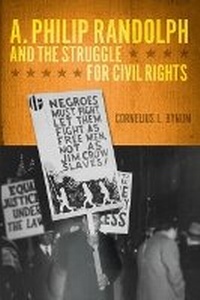
A. Philip Randolph and the Struggle for Civil Rights
Published on 13. December 2010
Book
Paperback/Softback
272 pages
978-0-252-07764-7 (ISBN)
Description
A. Philip Randolph's career as a trade unionist and civil rights activist fundamentally shaped the course of black protest in the mid-twentieth century. Standing alongside W. E. B. Du Bois, Marcus Garvey, and others at the center of the cultural renaissance and political radicalism that shaped communities such as Harlem in the 1920s and into the 1930s, Randolph fashioned an understanding of social justice that reflected a deep awareness of how race complicated class concerns, especially among black laborers. Examining Randolph's work in lobbying for the Brotherhood of Sleeping Car Porters, threatening to lead a march on Washington in 1941, and establishing the Fair Employment Practice Committee, Cornelius L. Bynum shows that Randolph's push for African American equality took place within a broader progressive program of industrial reform. Some of Randolph's pioneering plans for engineering change--which served as foundational strategies in the civil rights movement of the 1950s and 1960s--included direct mass action, nonviolent civil disobedience, and purposeful coalitions between black and white workers. Bynum interweaves biographical information on Randolph with details on how he gradually shifted his thinking about race and class, full citizenship rights, industrial organization, trade unionism, and civil rights protest throughout his activist career.
Reviews / Votes
"Bynum focuses on Randolph's career in the 1920s, '30s, and '40s, when he was formulating his ideas on social justice, race, and class. . . . The result is a deeper look at the ideals that drove Randolph."--Booklist "Bynum does an excellent job of discussing Randolph's attempts to secure bargaining for the Brotherhood of Sleeping Car Porters. In doing so, he exposes the shameful behavior of the union movement in its unwillingness to accept blacks."--Labor Studies Journal "Bynum's well-researched monograph makes a useful contribution to the growing body of literature on the 'long' civil rights movement."--The Journal of American History "An intriguing intellectual history."--The Journal of Southern History "Bynum's book is lucid and an excellent work that can be used for both academic research and casual reading. . . . Bynum's research has opened a window to new scholarship on Randolph's thinking, his role in the civil rights movement, and his demands for accountability from the U.S. government."--H-1960s "Relating Randolph's racial, economic, and political thought to his efforts to address injustice, Bynum does an excellent job of positioning Randolph's ideology with that of his contemporaries on the political left. This study is ideal for students and scholars of twentieth-century African American history, labor history, and race relations."--Cary D. Wintz, editor of African American Political Thought, 1890-1930: Washington, Du Bois, Garvey, and RandolpMore details
Language
English
Place of publication
Baltimore
United States
Target group
College/higher education
Professional and scholarly
Illustrations
10 black and white photographs
Dimensions
Height: 229 mm
Width: 152 mm
Thickness: 23 mm
Weight
313 gr
ISBN-13
978-0-252-07764-7 (9780252077647)
Copyright in bibliographic data and cover images is held by Nielsen Book Services Limited or by the publishers or by their respective licensors: all rights reserved.
Schweitzer Classification
Person
Cornelius L. Bynum is an assistant professor of history at Purdue University.
Content
Acknowledgments vii
Introduction ix
Part 1. Building Black Identity at the Turn of the Century
1. A. Philip Randolph, Racial Identity, and Family Relations: Tracing the Development of a Racial Self-Concept 3
2. Religious Faith and Black Empowerment: The AME Church and Randolph's Racial Identity and View of Social Justice 24
Part 2. Constructing Class Consciousness in the Jazz Age
3. Black Radicalism in Harlem: Randolph's Racial and Political Consciousness 47
4. Crossing the Color Line: Randolph's Transition from Race to Class Consciousness 63
Part 3. The Rise of the New Crowd Negroes
5. A New Crowd, A New Negro: The Messenger and New Negro Ideology in the 1920s 85
6. Black and White Unite: Randolph and the Divide between Class Theory and the Race Problem 101
Part 4. Blending Race and Class
7 Ridin' the Rails: Randolph and the Brotherhood of Sleeping Car Porters' Struggle for Union Recognition 119
8. Where Class Consciousness Falls Short: Randolph and the Brotherhood's Standing in the House of Labor 136
9. Marching Toward Fair Employment: Randolph, the Race/Class Connection, and the March on Washington Movement 157
Epilogue: A. Philip Randolph's Reconciliation of Race and Class in African American Protest Politics 185
Notes 201
Bibliography 227
Index 237
Illustrations follow page 82
Introduction ix
Part 1. Building Black Identity at the Turn of the Century
1. A. Philip Randolph, Racial Identity, and Family Relations: Tracing the Development of a Racial Self-Concept 3
2. Religious Faith and Black Empowerment: The AME Church and Randolph's Racial Identity and View of Social Justice 24
Part 2. Constructing Class Consciousness in the Jazz Age
3. Black Radicalism in Harlem: Randolph's Racial and Political Consciousness 47
4. Crossing the Color Line: Randolph's Transition from Race to Class Consciousness 63
Part 3. The Rise of the New Crowd Negroes
5. A New Crowd, A New Negro: The Messenger and New Negro Ideology in the 1920s 85
6. Black and White Unite: Randolph and the Divide between Class Theory and the Race Problem 101
Part 4. Blending Race and Class
7 Ridin' the Rails: Randolph and the Brotherhood of Sleeping Car Porters' Struggle for Union Recognition 119
8. Where Class Consciousness Falls Short: Randolph and the Brotherhood's Standing in the House of Labor 136
9. Marching Toward Fair Employment: Randolph, the Race/Class Connection, and the March on Washington Movement 157
Epilogue: A. Philip Randolph's Reconciliation of Race and Class in African American Protest Politics 185
Notes 201
Bibliography 227
Index 237
Illustrations follow page 82