

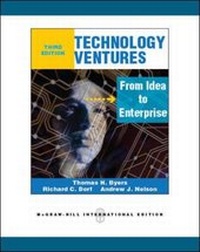
Technology Ventures: From Idea to Enterprise
3rd Edition
Published on 16. April 2010
Book
Paperback/Softback
704 pages
978-0-07-128921-4 (ISBN)
Description
For business, engineering, and science students and professionals who demand a comprehensive guide to high-growth entrepreneurship, Technology Ventures is the leading resource for analyzing opportunities and building new enterprises. Drawing on the latest academic research and practitioner insights, Technology Ventures integrates clear theoretical frameworks with action-oriented examples and exercises. Its broad perspective on "technology," including clean tech, information technology and the life sciences, ensures wide-ranging appeal to anyone with an interest in high-potential ventures.
More details
Edition
3rd edition
Language
English
Place of publication
London
United States
Publishing group
McGraw-Hill Education - Europe
Target group
Professional and scholarly
Dimensions
Height: 234 mm
Width: 187 mm
Thickness: 27 mm
Weight
1 gr
ISBN-13
978-0-07-128921-4 (9780071289214)
Copyright in bibliographic data and cover images is held by Nielsen Book Services Limited or by the publishers or by their respective licensors: all rights reserved.
Schweitzer Classification
Persons
Tom Byers is Professor of Management Science and Engineering at Stanford University and founder of the Stanford Technology Ventures Program, which is dedicated to accelerating high-technology entrepreneurship education and creating scholarly research on technology-based firms. After receiving his Ph.D. from UC Berkeley, Tom spent over a decade in leadership positions in technology companies including Symantec Corporation. His teaching awards include Stanford's highest honor in 2005 and three national awards for entrepreneurship educators.
Richard C. Dorf is Professor of Electrical Engineering and Professor of Management at the University of California, Davis. He is author of Introduction to Electric Circuits (7th Ed.), Modern Control Systems (10th Ed.), Handbook of Electrical Engineering (3rd Ed.), Handbook of Engineering (2nd Ed.), and Handbook of Technology Management. He is the co-founder of six technology firms and was recently elected a Fellow Member in The American Society for Engineering Education (ASEE)in recognition of his outstanding contributions to the Society.
Andrew J. Nelson is Assistant Professor of Management at the University of Oregon's Lundquist College of Business, where he teaches courses in strategy and entrepreneurship. He received his Ph.D. and B.A. degrees from Stanford University and his M.Sc. from Oxford University. Prior to joining the University of Oregon, he held the post of Lecturer in management science and engineering at Stanford University. Dr. Nelson is well known for his research into university-based entrepreneurship
Richard C. Dorf is Professor of Electrical Engineering and Professor of Management at the University of California, Davis. He is author of Introduction to Electric Circuits (7th Ed.), Modern Control Systems (10th Ed.), Handbook of Electrical Engineering (3rd Ed.), Handbook of Engineering (2nd Ed.), and Handbook of Technology Management. He is the co-founder of six technology firms and was recently elected a Fellow Member in The American Society for Engineering Education (ASEE)in recognition of his outstanding contributions to the Society.
Andrew J. Nelson is Assistant Professor of Management at the University of Oregon's Lundquist College of Business, where he teaches courses in strategy and entrepreneurship. He received his Ph.D. and B.A. degrees from Stanford University and his M.Sc. from Oxford University. Prior to joining the University of Oregon, he held the post of Lecturer in management science and engineering at Stanford University. Dr. Nelson is well known for his research into university-based entrepreneurship
Content
Part 1: Venture Opportunity, Concept, and StrategyChapter 1: Economic Growth and the Technology EntrepreneurChapter 2: Opportunity and the Concept SummaryChapter 3: Vision and the Business ModelChapter 4: Competitive StrategyChapter 5: Innovation StrategiesPart 2: Venture Formation and PlanningChapter 6: Risk and ReturnChapter 7: The Business PlanChapter 8: Types of VenturesChapter 9: Knowledge, Learning, and DesignChapter 10: Legal Formation and Intellectual PropertyPart 3: Detailed Functional Planning for the VentureChapter 11: The Marketing and Sales PlanChapter 12: Organizational DevelopmentChapter 13: Acquiring and Organizing ResourcesChapter 14: Management of OperationsChapter 15: Acquisitions and Global ExpansionPart 4: Financing and Building the VentureChapter 16: Profit and HarvestChapter 17: The Financial PlanChapter 18: Sources of CapitalChapter 19: Presentations and Deal NegotiationsChapter 20: Leading Ventures to Success