

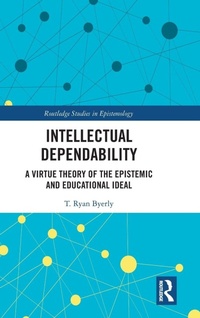
Intellectual Dependability
A Virtue Theory of the Epistemic and Educational Ideal
1st Edition
Published on 31. March 2021
Book
Hardback
204 pages
978-0-367-33369-0 (ISBN)
Description
Intellectual Dependability is the first research monograph devoted to addressing the question of what it is to be an intellectually dependable person-the sort of person on whom one's fellow inquirers can depend in their pursuit of epistemic goods. While neglected in recent scholarship, this question is an important one for both epistemology-how we should conceptualize the ideal inquirer-and education-how we can enable developing learners to grow toward this ideal.
The book defends a virtue theory according to which being an intellectually dependable person is distinctively a matter of possessing a suite of neglected virtues called "the virtues of intellectual dependability" that are themselves distinctively concerned with promoting epistemic goods in others' inquiries. After defending the existence and educational significance of these virtues as a group, the book turns toward the project of identifying and conceptualizing several specific instances of these virtues in detail. Virtues discussed include intellectual benevolence, intellectual transparency, communicative clarity, audience sensitivity, and epistemic guidance. In each case, an interdisciplinary treatment of the nature of the virtue and its relationship to other virtues, vices, and personality features is offered, drawing especially on relevant research in Philosophy and Psychology. The book concludes with a chapter devoted to identifying distinctive ways these virtues of intellectual dependability are manifested when it is inquiring communities, rather than individuals, that occupy the position of intellectual dependence.
By directing attention to the ideal of intellectual dependability, the book marks a novel turn of scholarly interest explicitly toward a neglected dimension of the ideal inquirer that will inform both epistemological theorizing and educational practice.
The book defends a virtue theory according to which being an intellectually dependable person is distinctively a matter of possessing a suite of neglected virtues called "the virtues of intellectual dependability" that are themselves distinctively concerned with promoting epistemic goods in others' inquiries. After defending the existence and educational significance of these virtues as a group, the book turns toward the project of identifying and conceptualizing several specific instances of these virtues in detail. Virtues discussed include intellectual benevolence, intellectual transparency, communicative clarity, audience sensitivity, and epistemic guidance. In each case, an interdisciplinary treatment of the nature of the virtue and its relationship to other virtues, vices, and personality features is offered, drawing especially on relevant research in Philosophy and Psychology. The book concludes with a chapter devoted to identifying distinctive ways these virtues of intellectual dependability are manifested when it is inquiring communities, rather than individuals, that occupy the position of intellectual dependence.
By directing attention to the ideal of intellectual dependability, the book marks a novel turn of scholarly interest explicitly toward a neglected dimension of the ideal inquirer that will inform both epistemological theorizing and educational practice.
More details
Series
Language
English
Place of publication
London
United Kingdom
Publishing group
Taylor & Francis Ltd
Target group
College/higher education
Dimensions
Height: 235 mm
Width: 157 mm
Thickness: 16 mm
Weight
471 gr
ISBN-13
978-0-367-33369-0 (9780367333690)
Copyright in bibliographic data and cover images is held by Nielsen Book Services Limited or by the publishers or by their respective licensors: all rights reserved.
Schweitzer Classification
Other editions
Additional editions
Book
09/2023
1st Edition
Routledge
€63.10
Shipment within 15-20 days
E-Book
03/2021
1st Edition
Routledge
€55.49
Available for download
E-Book
03/2021
1st Edition
Routledge
€55.49
Available for download
Person
T. Ryan Byerly is Senior Lecturer in the Philosophy Department at the University of Sheffield. He is author or editor of several books, including Putting Others First: The Christian Ideal of Others-Centeredness (Routledge, 2019).
Content
Introduction 1
PART I
1 The Intellectually Dependable Person 9
2 The Virtues of Intellectual Dependability 34
3 Educating for Intellectual Dependability 56
PART II
4 Intellectual Benevolence 83
5 Intellectual Transparency 105
6 Communicative Clarity 125
7 Audience Sensitivity 143
8 Epistemic Guidance 163
9 Being Intellectually Dependable for Groups 179
PART I
1 The Intellectually Dependable Person 9
2 The Virtues of Intellectual Dependability 34
3 Educating for Intellectual Dependability 56
PART II
4 Intellectual Benevolence 83
5 Intellectual Transparency 105
6 Communicative Clarity 125
7 Audience Sensitivity 143
8 Epistemic Guidance 163
9 Being Intellectually Dependable for Groups 179