

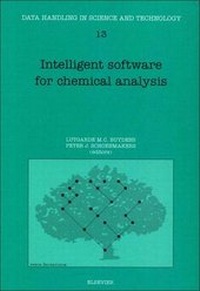
Intelligent Software for Chemical Analysis
Published in August 1993
Book
Hardback
366 pages
978-0-444-89207-2 (ISBN)
Description
Various emerging techniques for automating intelligent functions in the laboratory are described in this book. Explanations on how systems work are given and possible application areas are suggested. The main part of the book is devoted to providing data which will enable the reader to develop and test his own systems. The emphasis is on expert systems; however, promising developments such as self-adaptive systems, neural networks and genetic algorithms are also described. The book has been written by chemists with practical experience in developing and testing intelligent software, and therefore offers first-hand knowledge. Laboratory staff and managers confronted with commercial intelligent software will find information on the functioning, possibilities and limitations thereof, enabling them to select and use modern software in an optimum fashion. Finally, computer scientists and information scientists will find a wealth of data on the application of contemporary artificial intelligence techniques.
More details
Series
Language
English
Place of publication
Oxford
United Kingdom
Publishing group
Elsevier Science & Technology
Target group
Professional and scholarly
Illustrations
bibliographies, index
Dimensions
Height: 230 mm
ISBN-13
978-0-444-89207-2 (9780444892072)
Copyright in bibliographic data and cover images is held by Nielsen Book Services Limited or by the publishers or by their respective licensors: all rights reserved.
Schweitzer Classification
Other editions
Additional editions
L. M. C. Buydens | P. J. Schoenmakers
Intelligent Software for Chemical Analysis
E-Book
05/2014
Elsevier
€54.95
Available for download
Content
1. Introduction: Automation and intelligent software; Expert systems; Neural networks and genetic algorithms; Reader's guide: Concepts; Conclusions. 2. Knowledge-based Systems in Chemical Analysis, P. Schoenmakers: Computers in analytical chemistry; Sample preparation; Method selection; Method development; Instrument control and error diagnosis; Data handling and calibration; Data interpretation; Validation; Laboratory management; Concluding remarks; Concepts. 3. Developing Expert Systems, H. van Leeuwen: Prerequisites; Knowledge acquisition; Knowledge engineering; Inferencing; Explanation facilities; The integration of separate systems; Expert-system testing validation and evaluation; Concepts. 4. Expert-System-Development Tools, L. Buydens, H. van Leeuwen, R. Wehrens: Tools for implementing expert systems; Tool selection; Knowledge-acquisition tools; Concepts. 5. Validation and Evaluation of Expert Systems for HPLC Method Development - Case Studies, F. Maris, R. Hindriks: Case study 1 - Expert systems for method selection and selectivity optimization; Case study 2 - System-optimization expert system; Case study 3 - Expert system for repeatability testing, applied for trouble-shooting in HPLC; Case study 4 - Ruggedness-testing expert system; General comments on the evaluations; Concepts. 6. Self-adaptive Expert Systems, R. Wehrens: Introduction - maintaining expert systems; Self-adaptive expert systems - Methods and approaches; The refinement approach of SEEK; Examples from analytical chemistry; Concluding remarks; Concepts. 7. Inductive Expert Systems, R. Wehrens, L. Buydens: Inductive classification by ID3; Applications of ID3 in analytical chemistry; Concluding remarks; Concepts. 8. Genetic Algorithms and Neural Networks, G. Kateman: Genetic algorithms; Artificial neural networks; Concepts. 9. Perspectives: Limitations of Intelligent Software; Dealing with intelligent software; Potential of intelligent software.