

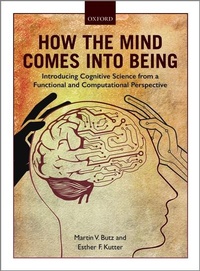
How the Mind Comes into Being
Introducing Cognitive Science from a Functional and Computational Perspective
Published on 12. January 2017
Book
Paperback/Softback
416 pages
978-0-19-873969-2 (ISBN)
Description
More than 2000 years ago Greek philosophers were pondering the puzzling dichotomy between our physical bodies and our seemingly non-physical minds. Yet even today, it remains puzzling how our mind controls our body, and vice versa, how our body shapes our mind. How is it that we can think highly abstract thoughts, seemingly fully detached from the actual, physical reality?
This book offers an interdisciplinary introduction to embodied cognitive science, addressing the question of how the mind comes into being while actively interacting with and learning from the environment by means of the own body. By pursuing a functional and computational perspective, concrete answers are provided about the fundamental mechanisms and developing structures that must bring the mind about, taking into account insights from biology, neuroscience, psychology, and philosophy as well as from computer science, machine learning, and artificial intelligence.
The book provides introductions to the most important challenges and available computational approaches on how the mind comes into being. The book includes exercises, helping the reader to grasp the material and understand it in a broader context. References to further studies, methodological details, and current developments support more advanced studies beyond the covered material.
While the book is written in advanced textbook style with the primary target group being undergraduates in cognitive science and related disciplines, readers with a basic scientific background and a strong interest in how the mind works will find this book intriguing and revealing.
This book offers an interdisciplinary introduction to embodied cognitive science, addressing the question of how the mind comes into being while actively interacting with and learning from the environment by means of the own body. By pursuing a functional and computational perspective, concrete answers are provided about the fundamental mechanisms and developing structures that must bring the mind about, taking into account insights from biology, neuroscience, psychology, and philosophy as well as from computer science, machine learning, and artificial intelligence.
The book provides introductions to the most important challenges and available computational approaches on how the mind comes into being. The book includes exercises, helping the reader to grasp the material and understand it in a broader context. References to further studies, methodological details, and current developments support more advanced studies beyond the covered material.
While the book is written in advanced textbook style with the primary target group being undergraduates in cognitive science and related disciplines, readers with a basic scientific background and a strong interest in how the mind works will find this book intriguing and revealing.
Reviews / Votes
`This is a very timely book. It rises to the challenge of providing a basic introduction to cognitive neuroscience, while being true to the fact that the brain is embodied. This book beautifully articulates intriguing puzzles about how our mind controls the body and how our body shapes the mind. In short, this book is a brilliant and accessible synthesis'Professor Karl J. Friston FMedSci, FRBS, FRS Wellcome Principal Fellow and Honorary Consultant in Neuropsychiatry Scientific Director: Wellcome Trust Centre for Neuroimaging Institute of Neurology, UCL `The last three decades have seen advancements in the core issues of cognitive science. In 1991, in a talk given at CMU, Allen Newell posed the question, "how can the human mind occur in the physical universe?"
This question was taken up by John Anderson as the title of his 2007 book which provided Anderson's answer to Newell's question. Science marches on and now Butz and Kutter provide the novice cognitive scientist an introduction to this set of deep and complex questions in the form of their very accessible and well-organized introductory
textbook: How the Mind Comes Into Being.
'
Professor Wayne Gray, Departments of Cognitive Science and Computer Science, Rensselaer Polytechnic Institute, USA `This book is a true adventure for anyone interested in the relation between cognition and human behavior. The key assumption, that cognition can only be understood in relation to real-world experiences, is so convincingly expressed over the different chapters, that even if you want to resist this assumption, you will be thrilled by all the innovative insights about cognition ranging from Evolution, Development, Language to the hard question of Consciousness. A must-read for all students and scholars in the field of cognitive science and related disciplines to advance insights about Cognitive Science at the Brain, Cognitive, Computational, and Behavioral level.
'
Prof. Dr. Harold Bekkering, Donders Institute for Brain, Cognition and Behaviour
More details
Language
English
Place of publication
Oxford
United Kingdom
Target group
College/higher education
Product notice
Paperback (trade)
Unsewn / adhesive bound
Dimensions
Height: 264 mm
Width: 195 mm
Thickness: 22 mm
Weight
988 gr
ISBN-13
978-0-19-873969-2 (9780198739692)
Copyright in bibliographic data and cover images is held by Nielsen Book Services Limited or by the publishers or by their respective licensors: all rights reserved.
Schweitzer Classification
Other editions
Additional editions
Martin V. Butz | Esther F. Kutter
How the Mind Comes into Being
Introducing Cognitive Science from a Functional and Computational Perspective
E-Book
02/2017
1st Edition
OUP eBook
€35.99
Available for download
Martin V. Butz | Esther F. Kutter
How the Mind Comes into Being
Introducing Cognitive Science from a Functional and Computational Perspective
E-Book
12/2016
1st Edition
OUP eBook
€35.99
Available for download
Persons
With a Diplom with honors in computer science with a minor in psychology (University of Wuerzburg, Germany, 08/2001) and a PhD in computer science (University of Illinois at Urbana-Champaign, IL, USA, 10/2004), Dr. Butz has been pursuing interdisciplinary, collaborative research in cognitive science for more than fifteen years. He has published more than fifty journal articles in various disciplinary and interdisciplinary journals including, for example, Neural Networks, Evolutionary Computation, Biological Cybernetics, Journal of Vision, Experimental Brain Research, PLoS ONE, and Psychological Review. Since 09/2011 Dr. Butz has been working as a full professor in Cognitive Modeling at the University of Tuebingen, Germany.
Esther Kutter has graduated with honors with a Master of Science in cognitive science (University of Tuebingen, Germany, 09/2015). Her primary research focus lies in understanding how the brain represents the own body and how abstract concepts and categories are established and encoded purposefully for enabling intelligent, goal-directed behavior. She is currently continuing her research as a PhD student in neuroscience at the department of Animal Research at the University of Tuebingen.
Esther Kutter has graduated with honors with a Master of Science in cognitive science (University of Tuebingen, Germany, 09/2015). Her primary research focus lies in understanding how the brain represents the own body and how abstract concepts and categories are established and encoded purposefully for enabling intelligent, goal-directed behavior. She is currently continuing her research as a PhD student in neuroscience at the department of Animal Research at the University of Tuebingen.
Author
Professor in Cognitive ModelingProfessor in Cognitive Modeling, Department of Computer Science and Department of Psychology, Faculty of Science, University of Tuebingen, Germany
PhD studentPhD student, Department of Computer Science and Department of Psychology, Faculty of Science, University of Tuebingen, Germany
Content
1: Embodied Cognitive Science
2: Cognitive Science is Interdisciplinary
3: Cognition is Embodied
4: Cognitive Development and Evolution
5: Behavior is Reward-Oriented
6: Behvioral Flexibility and Anticipatory Behavior
7: Brain Basics from a Computational Perspective
8: Primary Visual Perception from the Bottom Up
9: Top-Down Visual Predictions Determine Perceptions
10: Multisesnory Interactions
11: Attention
12: Decision Making, Motor Control, and Concept Formation
13: Language, concepts, and abstract thought
14: Retrospection and future perspectives
2: Cognitive Science is Interdisciplinary
3: Cognition is Embodied
4: Cognitive Development and Evolution
5: Behavior is Reward-Oriented
6: Behvioral Flexibility and Anticipatory Behavior
7: Brain Basics from a Computational Perspective
8: Primary Visual Perception from the Bottom Up
9: Top-Down Visual Predictions Determine Perceptions
10: Multisesnory Interactions
11: Attention
12: Decision Making, Motor Control, and Concept Formation
13: Language, concepts, and abstract thought
14: Retrospection and future perspectives