

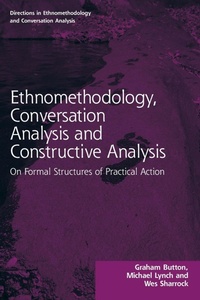
Ethnomethodology, Conversation Analysis and Constructive Analysis
On Formal Structures of Practical Action
1st Edition
Published on 23. September 2022
Book
Paperback/Softback
302 pages
978-1-032-11627-3 (ISBN)
Description
This book revisits the arguments by which Harvey Sacks and Harold Garfinkel opposed the widespread attempt in the social sciences to construct disciplinary theories and methods in place of common-sense knowledge of human action, and proposed instead an alternative that would investigate the organised methods of natural language use and common-sense reasoning that constitute social orders - arguments that led to the establishment and proliferation of ethnomethodology and conversation analysis.
As the very "constructive analysis" that they opposed has begun to be incorporated into influential lines of research in ethnomethodology and conversation analysis, the authors return to the founding insights of the field and reiterate the importance of Garfinkel and Sacks' original and controversial proposals for an "alternate" sociology of practical action and practical reasoning. Showing how constructive analysis has become entrenched in ethnomethodology and conversation analysis and arguing for a need to "re-boot" these approaches, this volume constitutes a call for a renewal of the radical alternative proposed by Garfinkel and Sacks.
As the very "constructive analysis" that they opposed has begun to be incorporated into influential lines of research in ethnomethodology and conversation analysis, the authors return to the founding insights of the field and reiterate the importance of Garfinkel and Sacks' original and controversial proposals for an "alternate" sociology of practical action and practical reasoning. Showing how constructive analysis has become entrenched in ethnomethodology and conversation analysis and arguing for a need to "re-boot" these approaches, this volume constitutes a call for a renewal of the radical alternative proposed by Garfinkel and Sacks.
More details
Series
Language
English
Place of publication
London
United Kingdom
Publishing group
Taylor & Francis Ltd
Target group
Professional and scholarly
Postgraduate and Undergraduate
Dimensions
Height: 234 mm
Width: 156 mm
Thickness: 17 mm
Weight
483 gr
ISBN-13
978-1-032-11627-3 (9781032116273)
Copyright in bibliographic data and cover images is held by Nielsen Book Services Limited or by the publishers or by their respective licensors: all rights reserved.
Schweitzer Classification
Other editions
Additional editions
Graham Button | Michael Lynch | Wes Sharrock
Ethnomethodology, Conversation Analysis and Constructive Analysis
On Formal Structures of Practical Action
E-Book
09/2022
1st Edition
Routledge
€53.99
Available for download
Graham Button | Michael Lynch | Wes Sharrock
Ethnomethodology, Conversation Analysis and Constructive Analysis
On Formal Structures of Practical Action
E-Book
09/2022
1st Edition
Routledge
€53.99
Available for download
Graham Button | Michael Lynch | Wes Sharrock
Ethnomethodology, Conversation Analysis and Constructive Analysis
On Formal Structures of Practical Action
Book
09/2022
1st Edition
Routledge
€206.90
Shipment within 10-20 days
Persons
Graham Button completed his PhD in sociology at the University of Manchester in 1975. He has published in the fields of both conversation analysis and ethnomethodological studies of work, and has developed collaborations with researchers in interactive computer systems design, extensively publishing in CSCW and HCI journals and books. His last appointment was Professor and Pro-Vice Chancellor for Arts, Computing, Engineering and Science at Sheffield Hallam University and before that he was the Laboratory Director of Xerox Research Centre Europe, first in Cambridge, and then in Grenoble. He has been a Principal lecturer in Sociology at the University of Plymouth; Visiting Faculty at the University of California, Los Angeles, and Boston University; Visiting Professor at the Universities of Nottingham and Plymouth; Visiting Scholar at the University of Cambridge and Visiting Senior Fellow at Tembusu College, the National University of Singapore. He currently enjoys being free of all institutional affiliations and obligations.
Michael Lynch is Emeritus Professor of Science & Technology Studies at Cornell University, and Research Professor in the School of Media and Information, University of Siegen, Germany. He received his PhD in Social Sciences at the University of California, Irvine, in 1979, and has held positions in Sociology, Human Sciences, and Science & Technology Studies at Whitman College, Boston University, Brunel University, and Cornell University. His major fields are ethnomethodology and social studies of science. He has investigated practical action, visual representation, and discursive interaction in scientific and legal settings, and also has written extensively about conceptual and analytical issues in the social sciences. He was Editor of Social Studies of Science from 2002 until 2012 and was President of the Society for Social Studies of Science in 2007-2009.
Wes Sharrock has been at the University of Manchester since 1965, first as a graduate student, and, since 1968, until retirement in 2018, as a member of the Sociology staff. He now has an Emeritus affiliation with the University. Troubled by Sociology's apparent inability to take a serious interest in the world of daily life, he was influenced by Manchester's social anthropologists and early drawn to the work of Ludwig Wittgenstein, Alfred Schutz, Harold Garfinkel, and Harvey Sacks, regarding them as - even now - largely under-appreciated. In company with collaborators of the same persuasion he has published on a diversity of sociological/philosophical topics in forms ranging from introductory guides to sociological theory and the philosophy of social research to journal papers on design projects, computer modelling in biology, print work, and mathematician's work inter alia. He has long wanted to write a piece called It's the language, stupid but hesitates to do so for fear it would cause offence.
Michael Lynch is Emeritus Professor of Science & Technology Studies at Cornell University, and Research Professor in the School of Media and Information, University of Siegen, Germany. He received his PhD in Social Sciences at the University of California, Irvine, in 1979, and has held positions in Sociology, Human Sciences, and Science & Technology Studies at Whitman College, Boston University, Brunel University, and Cornell University. His major fields are ethnomethodology and social studies of science. He has investigated practical action, visual representation, and discursive interaction in scientific and legal settings, and also has written extensively about conceptual and analytical issues in the social sciences. He was Editor of Social Studies of Science from 2002 until 2012 and was President of the Society for Social Studies of Science in 2007-2009.
Wes Sharrock has been at the University of Manchester since 1965, first as a graduate student, and, since 1968, until retirement in 2018, as a member of the Sociology staff. He now has an Emeritus affiliation with the University. Troubled by Sociology's apparent inability to take a serious interest in the world of daily life, he was influenced by Manchester's social anthropologists and early drawn to the work of Ludwig Wittgenstein, Alfred Schutz, Harold Garfinkel, and Harvey Sacks, regarding them as - even now - largely under-appreciated. In company with collaborators of the same persuasion he has published on a diversity of sociological/philosophical topics in forms ranging from introductory guides to sociological theory and the philosophy of social research to journal papers on design projects, computer modelling in biology, print work, and mathematician's work inter alia. He has long wanted to write a piece called It's the language, stupid but hesitates to do so for fear it would cause offence.
Content
Introduction. Part I: Foundations 1. On Formal Structures of Practical Action. 2. Sequential Analysis as an Investigation of Formal Structures of Practical Action. 3. Ethnomethodological Studies of Work. Part II: Conversation Analysis. 4. Autonomous Structures of Conversational Actions. 5. Technical and Vernacular Description. Part III: Studies of Work and Organisational Contexts. 6. Institutional Talk. 7. Workplace and Work-Practice Studies. Part IV: Normalising EMCA. 8. Importing Constructive Analytic Theory and Method. 9. The Problem with Collections. 10. A Case Study: Apologies and Constructive Analysis. 11. Conclusion. References.