

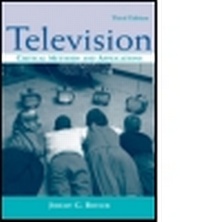
Television
Critical Methods and Applications
3rd Edition
Published on 8. September 2006
Book
Paperback/Softback
528 pages
978-0-8058-5415-2 (ISBN)
Description
Written in clear and lively prose, Television explains how television programs and commercials are made, and how they function as producers of meaning. Author Jeremy Butler demonstrates the ways in which cinematography and videography, acting, lighting, set design, editing, and sound combine to produce meanings that viewers take away from their television experience. This popular text teaches students to read between the lines, encouraging them to incorporate critical thinking into their own television viewing.
Television provides essential critical and historical context, lucidly explaining how different critical methods have been applied to the medium, such as genre study, ideological criticism, and cultural studies. Hundreds of illustrations from television programs introduce the reader to the varied ways in which television goes about telling stories, presenting news, and selling products, and a companion Web site (www.TVcrit.com) supplements the text with color frame grabs and illustrative video clips.
Highlights of this third edition include:
*new segments on "reality" television and television animation since 1990;
*an updated and expanded chapter surveying critical methods applied to television;
*a wide variety of examples, including recent television shows; and
*a supplemental DVD to provide teachers with video examples and exercises.
With its distinctive approach to examining television, this text is appropriate for courses in television studies, media criticism, and general critical studies. In addition, Television will encourage critical thinking in television production courses.
Television provides essential critical and historical context, lucidly explaining how different critical methods have been applied to the medium, such as genre study, ideological criticism, and cultural studies. Hundreds of illustrations from television programs introduce the reader to the varied ways in which television goes about telling stories, presenting news, and selling products, and a companion Web site (www.TVcrit.com) supplements the text with color frame grabs and illustrative video clips.
Highlights of this third edition include:
*new segments on "reality" television and television animation since 1990;
*an updated and expanded chapter surveying critical methods applied to television;
*a wide variety of examples, including recent television shows; and
*a supplemental DVD to provide teachers with video examples and exercises.
With its distinctive approach to examining television, this text is appropriate for courses in television studies, media criticism, and general critical studies. In addition, Television will encourage critical thinking in television production courses.
More details
Edition
3rd New edition
Language
English
Place of publication
New York
United States
Publishing group
Taylor & Francis Inc
Target group
College/higher education
Professional and scholarly
Edition type
New edition
Dimensions
Height: 254 mm
Width: 178 mm
Weight
907 gr
ISBN-13
978-0-8058-5415-2 (9780805854152)
Copyright in bibliographic data and cover images is held by Nielsen Book Services Limited or by the publishers or by their respective licensors: all rights reserved.
Schweitzer Classification
Other editions
New editions
Book
12/2011
4th Edition
Routledge
€97.98
Article exhausted; check for reprint
Previous edition
Book
07/2001
2nd Edition
Lawrence Erlbaum Associates Inc
€59.60
Article exhausted; check for reprint
Person
Jeremy G. Butler is the author of the forthcoming book, Television Style (Routledge, November 2009).
Content
Contents: Preface. Part I: Understanding Television's Structures and Systems. Television's Ebb and Flow in the Postnetwork Era. Narrative Structure: Television Stories. Building Narrative: Character, Actor, Star. Beyond and Beside Narrative Structure. Part II: Television's Style: Image and Sound. Style and Setting: Mise-en-Scene. Style and the Camera: Videography and Cinematography. Style and Editing. Style and Sound. A History of Television Style-Gary A. Copeland. Music Television-Blaine Allan. Animated Television: The Narrative Cartoon. The Television Commercial. Television Studies: Alternatives to Empirical Approaches. Appendix.