

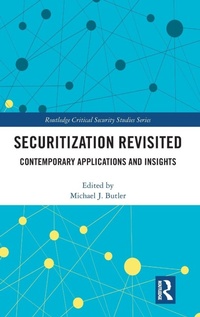
Securitization Revisited
Contemporary Applications and Insights
1st Edition
Published on 26. July 2019
Book
Hardback
232 pages
978-0-367-15037-2 (ISBN)
Description
This book seeks to interrogate how contemporary policy issues become 'securitized' and, furthermore, what the implications of this process are. A generation after the introduction of the concept of securitization to the security studies field, this book engages with how securitization and desecuritization 'works' within and across a wide range of security domains including terrorism and counter-terrorism, climate change, sexual and gender-based violence, inter-state and intra-state conflict, identity, and memory in various geographic and social contexts. Blending theory and application, the contributors to this volume - drawn from different disciplinary, ontological, and geographic 'spaces' - orient their investigations around three common analytical objectives: revealing deficiencies in and through application(s) of securitization; considering securitization through speech-acts and discourse as well as other mechanisms; and exposing latent orthodoxies embedded in securitization research. The volume demonstrates the dynamic and elastic quality of securitization and desecuritization as concepts that bear explanatory fruit when applied across a wide range of security issues, actors, and audiences. It also reveals the deficiencies in restricting securitization research to an overly narrow set of issues, actors, and mechanisms.
This volume will be of great interest to scholars of critical security studies, international security, and International Relations.
Chapter 6 of this book is freely available as a downloadable Open Access PDF at http://www.taylorfrancis.com under a Creative Commons Attribution-Non Commercial-No Derivatives (CC-BY-NC-ND) 4.0 license.
This volume will be of great interest to scholars of critical security studies, international security, and International Relations.
Chapter 6 of this book is freely available as a downloadable Open Access PDF at http://www.taylorfrancis.com under a Creative Commons Attribution-Non Commercial-No Derivatives (CC-BY-NC-ND) 4.0 license.
More details
Series
Language
English
Place of publication
London
United Kingdom
Publishing group
Taylor & Francis Ltd
Target group
College/higher education
Professional and scholarly
Illustrations
16 s/w Abbildungen, 12 s/w Photographien bzw. Rasterbilder, 4 s/w Zeichnungen, 1 s/w Tabelle
1 Tables, black and white; 4 Line drawings, black and white; 12 Halftones, black and white; 16 Illustrations, black and white
Dimensions
Height: 240 mm
Width: 161 mm
Thickness: 18 mm
Weight
540 gr
ISBN-13
978-0-367-15037-2 (9780367150372)
Copyright in bibliographic data and cover images is held by Nielsen Book Services Limited or by the publishers or by their respective licensors: all rights reserved.
Schweitzer Classification
Other editions
Additional editions
Book
03/2021
1st Edition
Routledge
€55.50
Shipment within 15-20 days
E-Book
07/2019
Routledge
€44.99
Available for download
E-Book
07/2019
Routledge
€44.99
Available for download
Person
Michael J. Butler is Associate Professor of Political Science and Director of the Leir Luxembourg Program at Clark University. His publications include Deconstructing the Responsibility to Protect (Routledge, forthcoming), Selling a 'Just' War: Framing, Legitimacy, and U.S. Military Intervention (Palgrave, 2012), and International Conflict Management (Routledge, 2009).
Content
PART I: THEORETICAL INSIGHTS Introduction: Revisiting Securitization: The 'Constructivist Turn' in Security Studies 1. Assessing Securitization Theory: Theoretical Discussions and Empirical Developments 2. Regional Security Complex Theory: Reflections and Reformulations PART II: SECURITIZATION IN APPLICATION 3. Counter-Terrorism as a Technology of Securitization: Approaching the Moroccan Case 4. When Advocacy Securitizes: Non-state Actors and the Circulation of Narratives around Sexualized Violence in Conflict 5. Securitizing the Environment: Climate Change as First-Order Threat PART III: MECHANISMS OF DE-SECURITIZATION 6. Conflict Management Redux: Desecuritizing Intractable Conflicts 7. Beyond the Speech Act: Contact, Desecuritization, and Peacebuilding in Cyprus 8. The Role of Memory in the Desecuritization of Inter-Societal Conflicts Conclusion: Securitization, Revisited: Revealed Insights, Future Directions