

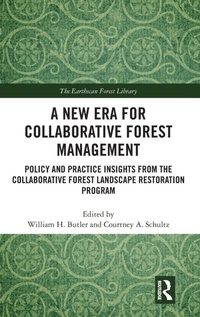
A New Era for Collaborative Forest Management
Policy and Practice insights from the Collaborative Forest Landscape Restoration Program
1st Edition
Published on 16. January 2019
Book
Hardback
266 pages
978-1-138-49127-4 (ISBN)
Description
This book assesses the Collaborative Forest Landscape Restoration Program (CFLRP) and identifies lessons learned for governance and policy through this new and innovative approach to collaborative forest management.
Unlike anything else in US public land management, the CFLRP is a nationwide program that requires collaboration throughout the life of national forest restoration projects, joining agency partners and local stakeholder groups in a kind of decade-long restoration marriage. This book provides a comprehensive assessment of the governance dynamics of the program, examining: questions about collaborative governance processes and the dynamics of trust, accountability and capacity; how scientific information is used in making decisions and integrated into adaptive management processes; and the topic of collaboration through implementation, an underdeveloped area of collaborative governance literature. Bringing together chapters from a community of social science and policy researchers who have conducted studies across multiple CFLRP projects, this volume generates insights, not just about the program, but also about dynamics that are central to collaborative and landscape approaches to land management and relevant for broader practice.
This volume is a timely and important contribution to environmental governance scholarship. It will be of interest to researchers and students of natural resource management, environmental governance, and forestry, as well as practitioners and policy makers involved in forest and ecosystem restoration efforts, and collaborative natural resource management more broadly.
Unlike anything else in US public land management, the CFLRP is a nationwide program that requires collaboration throughout the life of national forest restoration projects, joining agency partners and local stakeholder groups in a kind of decade-long restoration marriage. This book provides a comprehensive assessment of the governance dynamics of the program, examining: questions about collaborative governance processes and the dynamics of trust, accountability and capacity; how scientific information is used in making decisions and integrated into adaptive management processes; and the topic of collaboration through implementation, an underdeveloped area of collaborative governance literature. Bringing together chapters from a community of social science and policy researchers who have conducted studies across multiple CFLRP projects, this volume generates insights, not just about the program, but also about dynamics that are central to collaborative and landscape approaches to land management and relevant for broader practice.
This volume is a timely and important contribution to environmental governance scholarship. It will be of interest to researchers and students of natural resource management, environmental governance, and forestry, as well as practitioners and policy makers involved in forest and ecosystem restoration efforts, and collaborative natural resource management more broadly.
Reviews / Votes
"CFLRP has shown us a path forward in this era of declining resources and escalating environmental challenges. It was a wholly unique policy experiment that helped us understand changing practice as we cope with increasing complexity in public lands management. The work in this volume captures the lessons learned, and points to the policy and practice implications and theoretical contributions for collaborative environmental governance. Regardless of whether the program continues, understanding the lessons learned and capturing the experience of these projects is an essential component of the ongoing, collective project of fostering collaborative approaches to forest management that can support work across landscapes to manage fire, water, commodity production, and recreation opportunities within and surrounding US public lands." - Laura McCarthy, take from the ForewordMore details
Series
Language
English
Place of publication
London
United Kingdom
Publishing group
Taylor & Francis Ltd
Target group
College/higher education
Illustrations
14 s/w Abbildungen, 1 s/w Photographie bzw. Rasterbild, 6 s/w Zeichnungen, 7 s/w Tabellen
7 Tables, black and white; 6 Line drawings, black and white; 1 Halftones, black and white; 14 Illustrations, black and white
Dimensions
Height: 240 mm
Width: 161 mm
Thickness: 19 mm
Weight
570 gr
ISBN-13
978-1-138-49127-4 (9781138491274)
Copyright in bibliographic data and cover images is held by Nielsen Book Services Limited or by the publishers or by their respective licensors: all rights reserved.
Schweitzer Classification
Other editions
Additional editions
William H. Butler | Courtney A. Schultz
A New Era for Collaborative Forest Management
Policy and Practice insights from the Collaborative Forest Landscape Restoration Program
Book
09/2020
1st Edition
Routledge
€68.50
Shipment within 15-20 days
William H. Butler | Courtney A. Schultz
A New Era for Collaborative Forest Management
Policy and Practice insights from the Collaborative Forest Landscape Restoration Program
E-Book
01/2019
1st Edition
Routledge
€61.99
Available for download
William H. Butler | Courtney A. Schultz
A New Era for Collaborative Forest Management
Policy and Practice insights from the Collaborative Forest Landscape Restoration Program
E-Book
01/2019
Routledge
€61.99
Available for download
Persons
William H. Butler is Associate Professor of Environmental Planning in the Department of Urban and Regional Planning at Florida State University, USA. His research has focused on collaborative environmental planning and management, particularly in forest management, ecological restoration, and climate change adaptation.
Courtney A. Schultz is Associate Professor of Forest and Natural Resource Policy and Director of the Public Lands Policy Group in the Department of Forest and Rangeland Stewardship at Colorado State University, USA. Her research focuses on the intersection of science, policy, and law in natural resource management, particularly how policy mediates the adoption and application of science-based land management principles.
Courtney A. Schultz is Associate Professor of Forest and Natural Resource Policy and Director of the Public Lands Policy Group in the Department of Forest and Rangeland Stewardship at Colorado State University, USA. Her research focuses on the intersection of science, policy, and law in natural resource management, particularly how policy mediates the adoption and application of science-based land management principles.
Content
Foreword by Laura McCarthy Introduction: The Changing Landscape of Collaborative Forest Restoration 1. Collaborative Forest Landscape Restoration in Action: An Overview of the CFLRP cases Part I: Collaborative Governance Dynamics 2. Trust Ecology and Collaborative Natural Resource Management 3. Navigating accountability tensions in collaborative ecological restoration of public lands 4. Creating and Sustaining Collaborative Capacity for Forest Landscape Restoration 5. Commentary on Collaborative Governance Dynamics Part II: Science and Adaptive Management in Collaborative Restoration 6. From conflict to shared visions: Science, learning, and developing common ground 7. Challenges and opportunities for collaborative adaptive management in forest landscape restoration 8. Use of Scientific Information to Inform Decision Making on CFLRP Projects 9. Commentary on Science and Adaptive Management in Collaborative Restoration Part III: Collaborative Implementation 10. Collaborative Implementation: Implications for Adaptive Management and Restoration 11. Participating in Collaborative Implementation: The Role of Collaborative History and Context 12. Policy Design to Support Collaborative Landscape Restoration: Lessons from the CFLRP 13. Commentary on Collaborative Implementation Conclusion: The Future of Collaborative Forest Restoration: Scholarship, Policy and Practice