

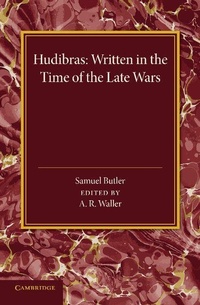
Hudibras
Written in the Time of the Late Wars
Published on 2. October 2014
Book
Paperback/Softback
346 pages
978-1-107-43276-5 (ISBN)
Description
Originally published in 1905 as part of the Cambridge English Classics series, this book contains the text of Hudibras by the satirical poet Samuel Butler (1613-80). The text is taken from the 1678 edition of the poem, and notes on the variations on the text found in previous versions are included at the back of the book. This book will be of value to anyone with an interest in English satire or Restoration literature.
More details
Language
English
Place of publication
Cambridge
United Kingdom
Target group
Professional and scholarly
Product notice
Paperback (trade)
Dimensions
Height: 203 mm
Width: 133 mm
Thickness: 20 mm
Weight
436 gr
ISBN-13
978-1-107-43276-5 (9781107432765)
Copyright in bibliographic data and cover images is held by Nielsen Book Services Limited or by the publishers or by their respective licensors: all rights reserved.
Schweitzer Classification
Persons
Samuel Butler (1835-1902) was an English novelist, essayist, critic, translator, and independent thinker whose work challenged many of the dominant assumptions of Victorian intellectual life. Educated at Cambridge and originally expected to enter the clergy, Butler instead moved away from conventional religious belief and developed a career as one of the most provocative prose writers of his age. His interests ranged across literature, theology, evolution, music, art, classical studies, and social criticism, and his best work is marked by scepticism, wit, intellectual boldness, and a deep suspicion of inherited systems of authority.Butler is best known for Erewhon, his satirical fiction of an imaginary society, and The Way of All Flesh, his posthumously published novel attacking Victorian family life, religious hypocrisy, and oppressive moral convention. In Erewhon, Butler brought together travel narrative, speculative fiction, philosophical satire, and social criticism, creating a work that still speaks to readers interested in utopian and dystopian fiction, Victorian literature, classic speculative fiction, critiques of technology, and the literary ancestry of modern science fiction. His writing remains valuable because it refuses passive respectability: Butler's best books question the institutions, habits, and ideas that most societies prefer not to examine too closely.
Content
Hubibras: written in the time of the late wars.