

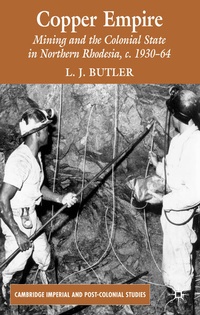
Copper Empire
Mining and the Colonial State in Northern Rhodesia, c.1930-64
Published on 11. October 2007
Book
Hardback
XII, 426 pages
978-0-230-55526-6 (ISBN)
Description
This is a study of the evolving relationship between the British colonial state and the copper mining industry in Northern Rhodesia, from the early stages of development to decolonization, encompassing depression, wartime mobilization and fundamental changes in the nature and context of colonial rule.
Reviews / Votes
'A valuable contribution to the historiography of business in central Africa, particularly during the period of decolonisation.'
Andrew Cohen, The Journal of Imperial and Commonwealth History
More details
Series
Edition
2007 edition
Language
English
Place of publication
London
United Kingdom
Target group
Professional and scholarly
Product notice
Unsewn / adhesive bound
Cloth over boards
With dust jacket
Illustrations
XII, 426 p.
Dimensions
Height: 218 mm
Width: 153 mm
Thickness: 29 mm
Weight
653 gr
ISBN-13
978-0-230-55526-6 (9780230555266)
DOI
10.1057/9780230589766
Schweitzer Classification
Other editions
Additional editions
E-Book
10/2007
Palgrave Macmillan
€96.29
Available for download
Book
01/2007
Palgrave Macmillan
€106.99
Shipment within 15-20 days
Person
LARRY BUTLER was educated at the Polytechnic of North London and King's College London, UK. He has taught at the University of East Anglia since 2002. Among his previous publications are
Industrialisation and the British Colonial State: West Africa, 1939-1951
and
Britain and Empire: Adjusting to a Post-Imperial World
Content
Maps Introduction The Colonial State and the Development of the Copperbelt Wartime mobilisation The Post-war Commodity Boom (1946-1953) The Debate on Controlling the Mining Industry (1939-1952) The Copperbelt and the Central African Federation (1949-1957) The Demise of the Federation The Mining Industry and Zambian Independence Postscript: Northern Rhodesian Copper Mining: The Prospects at Independence Conclusion