

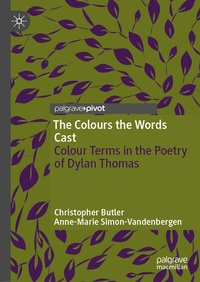
The Colours the Words Cast
Description
This book examines the use of colour terms in the poetry of Dylan Thomas, adopting a primarily linguistic and stylistic - rather than literary - approach. Although critical studies of the poetry of Dylan Thomas abound, systematic and detailed linguistic studies of his poems are relatively rare. The authors' main aim is to investigate in detail the use of colour terms, and in particular to link this to the associations between colours and their connotative symbolic meanings, which form the basis for what have been called colour metaphors. They also provide a rich database of these associations which will be of use to researchers who may be interested in the use of colour terms in other texts, whether literary or non-literary. This book will be of interest primarily to academics and advanced students in the field of linguistic stylistics.
Reviews / Votes
"This fascinating book offers a unique perspective on Dylan Thomas's poetry. As an exercise in the linguistic analysis of literature, it is a peerless demonstration of both the practice and value of stylistic analysis. At the same time, it is a significant addition to literary scholarship on Thomas's poetry and is an exemplar of the level of critical detail that can be uncovered via linguistic methods." (Dan McIntyre, Professor of English Language, Uppsala University, Sweden, co-author of Stylistics (Cambridge University Press) and Corpus Stylistics (Edinburgh University Press))
"Chris Butler and Anne-Marie Simon-Vandenbergen have provided us with an impressive linguistic and quantitative account of colour terms in the poetry of Dylan Thomas. Fascinating in its own right, it provides an invaluable resource for researchers and students studying Thomas's poetry." (Mick Short, Professor Emeritus of English Language and Literature, University of Lancaster, UK, National Teaching Fellow and the author of Exploring the Language of Poems, Prose and Plays (Longman))
"The poetry of Dylan Thomas is among the best-known and yet least-understood of the twentieth century. Avoiding the mythology which so often distorts a just appreciation of his work, this new study of Thomas's colour vocabulary by Christopher Butler and Anne-Marie Simon-Vandenbergen sheds a highly original light on a crucial technical aspect of the subtle 'craft and art' of his poems. Lucidly written and rigorously organised, it helps us to better understand just how he 'bent the iron of English' to his richly expressive purpose. It is a model of its kind, and can be recommended to any serious scholar of Thomas's language." (John Goodby, Professor of Arts and Culture, Sheffield Hallam University)
More details
Other editions
Additional editions
Persons
Christopher S. Butler taught linguistics at the University of Nottingham for many years and then held a professorial position at what is now York St John University, UK. He retired in 1998. His research interests include theoretical and descriptive aspects of form, meaning and use, within the framework of a functional approach to language, mainly but not exclusively in English and Spanish.
Anne-Marie Simon-Vandenbergen is Professor Emerita at Ghent University, Belgium. Her research interests include functional approaches to grammatical issues in English, with a special focus on modality, and contrastive grammar of English, French and Dutch.
Content
1. Prologue: aims of the study and structure of the book.- 2. Studying colour in poetry, with particular reference to the poems of Dylan Thomas.- 3. Corpus of poems and methodology.- 4. Accounts of symbolic associations of colours with other domains.- 5. Frequency data.- Part II: Chromatic primary basic colour terms and related non-basic terms.- 6. Green.- 7. Red, blue and yellow.- Part III: Achromatic primary basic colour terms and related non-basic terms.- 8. White.- 9. Black.- Part IV: The remaining colour terms.- 10. Secondary basic colour terms: brown and grey - but why not pink, purple or orange?- 11. Non-basic metonymic colour terms derived from the names of metals: gold(en) and silver.- 12. Summarising modification of basic colour terms and distribution of colour words among entity types.- 13. The use of more than one colour word in a poem.- 14. Epilogue: a kaleidoscope of colour.