

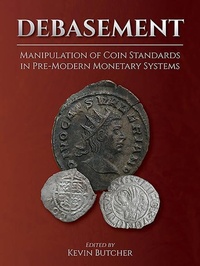
Debasement
Manipulation of Coin Standards in Pre-Modern Monetary Systems
Published on 25. February 2020
Book
Hardback
240 pages
978-1-78925-398-6 (ISBN)
Description
The debasement of coinage, particularly of silver, was a common feature of pre-modern monetary systems. Most coinages were issued by state authorities and the condition of a coinage is often seen (rightly or wrongly) as an indicator of the broader fiscal health of the state that produced it. While in some cases the motives behind the debasements or reductions in standards are clear, in many cases the intentions of the issuing authorities are uncertain.
Various explanations have been advanced: fiscal motives (such as a desire to profit or a to cover a deficit caused by the failure to balance expenditure and revenues); monetary motives (such as changing demand for coined money or a desire to maintain monetary stability in the face of changing values of raw materials or labour costs); pressure from groups within society that would profit from debasement; misconduct at the mint; or the decline of existing monetary standards due to circulation and wear of the coinage in circulation. Certain explanations have tended to gain favour with monetary historians of specific periods, partly reflecting the compartmentalization of scholarship. Thus the study of Roman debasements emphasizes fiscal deficits, whereas medievalists are often more prepared to consider monetary factors as contributing to debasements. To some extent these different approaches are a reflection of discrepancies in the amount of documentary evidence available for the respective periods, but the divide also underlines fundamentally different approaches to the function of coinage: Romanists have preferred to see coins as a medium for state payments; whereas medievalists have often emphasized exchange as an important function of currency.
The volume is inter-disciplinary in scope. Apart from bringing together monetary historians of different periods, it also contains contributions from archaeometallurgists who have experience with the chemical and physical composition of coins and technical aspects of production of base alloys.
Various explanations have been advanced: fiscal motives (such as a desire to profit or a to cover a deficit caused by the failure to balance expenditure and revenues); monetary motives (such as changing demand for coined money or a desire to maintain monetary stability in the face of changing values of raw materials or labour costs); pressure from groups within society that would profit from debasement; misconduct at the mint; or the decline of existing monetary standards due to circulation and wear of the coinage in circulation. Certain explanations have tended to gain favour with monetary historians of specific periods, partly reflecting the compartmentalization of scholarship. Thus the study of Roman debasements emphasizes fiscal deficits, whereas medievalists are often more prepared to consider monetary factors as contributing to debasements. To some extent these different approaches are a reflection of discrepancies in the amount of documentary evidence available for the respective periods, but the divide also underlines fundamentally different approaches to the function of coinage: Romanists have preferred to see coins as a medium for state payments; whereas medievalists have often emphasized exchange as an important function of currency.
The volume is inter-disciplinary in scope. Apart from bringing together monetary historians of different periods, it also contains contributions from archaeometallurgists who have experience with the chemical and physical composition of coins and technical aspects of production of base alloys.
Reviews / Votes
All in all, this anthology gives everyone who deals with the phenomenon of government coin production a lot of food for thought. * Coins Weekly * There is much of value in this richly illustrated volume [...] Despite the predominant focus on the Roman period, much will interest medieval archaeologists, not least the challenge of whether the comparative approach presented here is a worthwhile way forward. * Medieval Archaeology *More details
Language
English
Place of publication
Oxford
United Kingdom
Target group
Professional and scholarly
Product notice
sewn/stitched
Cloth over boards
Illustrations
b/w and colour
Dimensions
Height: 288 mm
Width: 224 mm
Thickness: 25 mm
Weight
1097 gr
ISBN-13
978-1-78925-398-6 (9781789253986)
Copyright in bibliographic data and cover images is held by Nielsen Book Services Limited or by the publishers or by their respective licensors: all rights reserved.
Schweitzer Classification
Other editions
Additional editions
E-Book
04/2020
Oxbow Books
€36.99
Available for download
E-Book
04/2020
OXBOW BOOKS
€36.99
Available for download
Person
Kevin Butcher is Professor in the Department of Classics and Ancient History at Warwick University. He holds a PhD from the Institute of Archaeology, University College London, in the field of Roman numismatics and specialises in Greek and Roman coinage, particularly the civic and provincial coinages of the Roman empire; and the Hellenistic and Roman Near East, particularly coastal Syria and Lebanon.
Content
Introduction
Kevin Butcher
PART I COIN DEBASEMENT: APPROACHES AND EXPLANATIONS
1. The scientific analysis of coinage: expectations, realities, problems and potential
Matthew Ponting
2. Debasement in the ancient and medieval worlds: explanations and theories
Martin Allen
3. Gold coinage and debasement. A preliminary examination of the fineness of Roman
gold coinage from the Republic and early Empire
Arnaud Suspene, Maryse Blet-Lemarquand and Dorian Bocciarelli
4. Coin debasement, climate and contagion in second-century Egypt: some
intersections
Colin P. Elliott
PART II COIN PRODUCTION, METAL SUPPLY AND DEBASEMENT
5. Experiments reproducing Roman debased alloys
Nicola George
6. From Owls to Eagles. Metallic composition of Egyptian coinage (5th- 1stc. BC)
Thomas Faucher and Julien Olivier
7. Gold and silver mining in the Roman Empire
Alfred Hirt
8. Metal and system in Roman mints. Flan production, quality control and the internal
organisation of minting establishments during the Principate
Bernhard E. Woytek
PART III DEBASEMENT AND ITS CONSEQUENCES
9. The Severan reforms of the late second century AD: a case of monetary deja vu?
Nathan Murphy
10. Inflation and monetary reforms in the fourth century: Dioetian's twin edicts of AD
301
Gilles Bransbourg
11. Denarii mixti: Debasement and rhetoric in the early Middle Ages (5th-11th
centuries)
Rory Naismith
12. Was later medieval sterling too strong?
Nick Mayhew
Kevin Butcher
PART I COIN DEBASEMENT: APPROACHES AND EXPLANATIONS
1. The scientific analysis of coinage: expectations, realities, problems and potential
Matthew Ponting
2. Debasement in the ancient and medieval worlds: explanations and theories
Martin Allen
3. Gold coinage and debasement. A preliminary examination of the fineness of Roman
gold coinage from the Republic and early Empire
Arnaud Suspene, Maryse Blet-Lemarquand and Dorian Bocciarelli
4. Coin debasement, climate and contagion in second-century Egypt: some
intersections
Colin P. Elliott
PART II COIN PRODUCTION, METAL SUPPLY AND DEBASEMENT
5. Experiments reproducing Roman debased alloys
Nicola George
6. From Owls to Eagles. Metallic composition of Egyptian coinage (5th- 1stc. BC)
Thomas Faucher and Julien Olivier
7. Gold and silver mining in the Roman Empire
Alfred Hirt
8. Metal and system in Roman mints. Flan production, quality control and the internal
organisation of minting establishments during the Principate
Bernhard E. Woytek
PART III DEBASEMENT AND ITS CONSEQUENCES
9. The Severan reforms of the late second century AD: a case of monetary deja vu?
Nathan Murphy
10. Inflation and monetary reforms in the fourth century: Dioetian's twin edicts of AD
301
Gilles Bransbourg
11. Denarii mixti: Debasement and rhetoric in the early Middle Ages (5th-11th
centuries)
Rory Naismith
12. Was later medieval sterling too strong?
Nick Mayhew