

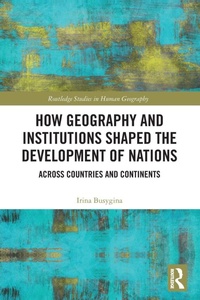
How Geography and Institutions Shaped the Development of Nations
Across Countries and Continents
1st Edition
Published on 21. May 2026
Book
Paperback/Softback
246 pages
978-1-032-80410-1 (ISBN)
Description
This book provides a concise and informative introduction to how geography and institutions shaped the development of nations, showing that while the role of institutions for the development of nations is indisputable, the role of geographic factors remains underexplored and underestimated.
Drawing on rich empirical material from the history and modernity of different continents and nations, How Geography and Institutions Shaped the Development of Nations: Across Countries and Continents seeks to show not only the importance of geographical explanations of development but also their extraordinary diversity. This book is divided into two parts. The first part examines the main contributions to the understanding of development under the influence of geographic and institutional factors, as well as state's geographic attributes and borders as geographic institutions. The second part immerses the reader in empirical material, presenting various cases on different continents in different historical periods.
This book is an essential read for researchers in a broad range of areas, including international organizations and practitioners involved accelerating national development. It will also be of interest to scholars and students in development studies and, more broadly, to geography, comparative politics, and regional studies.
Drawing on rich empirical material from the history and modernity of different continents and nations, How Geography and Institutions Shaped the Development of Nations: Across Countries and Continents seeks to show not only the importance of geographical explanations of development but also their extraordinary diversity. This book is divided into two parts. The first part examines the main contributions to the understanding of development under the influence of geographic and institutional factors, as well as state's geographic attributes and borders as geographic institutions. The second part immerses the reader in empirical material, presenting various cases on different continents in different historical periods.
This book is an essential read for researchers in a broad range of areas, including international organizations and practitioners involved accelerating national development. It will also be of interest to scholars and students in development studies and, more broadly, to geography, comparative politics, and regional studies.
More details
Series
Language
English
Place of publication
London
United Kingdom
Publishing group
Taylor & Francis Ltd
Target group
College/higher education
Professional and scholarly
Academic, Postgraduate, and Undergraduate Advanced
Illustrations
2 s/w Tabellen
2 Tables, black and white
Dimensions
Height: 234 mm
Width: 156 mm
Weight
470 gr
ISBN-13
978-1-032-80410-1 (9781032804101)
Copyright in bibliographic data and cover images is held by Nielsen Book Services Limited or by the publishers or by their respective licensors: all rights reserved.
Schweitzer Classification
Other editions
Additional editions
Irina Busygina
How Geography and Institutions Shaped the Development of Nations
Across Countries and Continents
E-Book
11/2024
1st Edition
Routledge
€60.49
Available for download
Irina Busygina
How Geography and Institutions Shaped the Development of Nations
Across Countries and Continents
Book
11/2024
1st Edition
Routledge
€197.50
Shipment within 10-20 days
Irina Busygina
How Geography and Institutions Shaped the Development of Nations
Across Countries and Continents
E-Book
11/2024
1st Edition
Routledge
€60.49
Available for download
Person
Irina Busygina, Research Fellow, Davis Center for Russian and Eurasian Studies at Harvard University, USA.
Content
Introduction. PART I. 1.Development, institutions, and geography: how do they fit together. 2.Modern states and their geographical attributes: size, shape, location. 3.Borders as geographical institutions. PART II. 4.Europe. 5.Asia. 6.Africa. 7.Latin America. 8.North America. 9.Oceania. 10.Russia. Conclusion.