

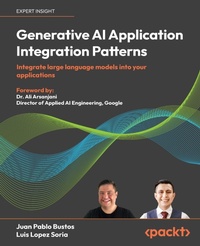
Generative AI Application Integration Patterns
Integrate large language models into your applications
Published on 5. September 2024
Book
Paperback/Softback
218 pages
978-1-83588-760-8 (ISBN)
Description
Unleash the transformative potential of GenAI with this comprehensive guide that serves as an indispensable roadmap for integrating large language models into real-world applications. Gain invaluable insights into identifying compelling use cases, leveraging state-of-the-art models effectively, deploying these models into your applications at scale, and navigating ethical considerations.
Key Features
Get familiar with the most important tools and concepts used in real scenarios to design GenAI apps
Interact with GenAI models to tailor model behavior to minimize hallucinations
Get acquainted with a variety of strategies and an easy to follow 4 step frameworks for integrating GenAI into applications
Book DescriptionExplore the transformative potential of GenAI in the application development lifecycle. Through concrete examples, you will go through the process of ideation and integration, understanding the tradeoffs and the decision points when integrating GenAI.
With recent advances in models like Google Gemini, Anthropic Claude, DALL-E and GPT-4o, this timely resource will help you harness these technologies through proven design patterns.
We then delve into the practical applications of GenAI, identifying common use cases and applying design patterns to address real-world challenges. From summarization and metadata extraction to intent classification and question answering, each chapter offers practical examples and blueprints for leveraging GenAI across diverse domains and tasks. You will learn how to fine-tune models for specific applications, progressing from basic prompting to sophisticated strategies such as retrieval augmented generation (RAG) and chain of thought.
Additionally, we provide end-to-end guidance on operationalizing models, including data prep, training, deployment, and monitoring. We also focus on responsible and ethical development techniques for transparency, auditing, and governance as crucial design patterns.What you will learn
Concepts of GenAI: pre-training, fine-tuning, prompt engineering, and RAG
Framework for integrating AI: entry points, prompt pre-processing, inference, post-processing, and presentation
Patterns for batch and real-time integration
Code samples for metadata extraction, summarization, intent classification, question-answering with RAG, and more
Ethical use: bias mitigation, data privacy, and monitoring
Deployment and hosting options for GenAI models
Who this book is forThis book is not an introduction to AI/ML or Python. It offers practical guides for designing, building, and deploying GenAI applications in production. While all readers are welcome, those who benefit most include:
Developer engineers with foundational tech knowledge
Software architects seeking best practices and design patterns
Professionals using ML for data science, research, etc., who want a deeper understanding of Generative AI
Technical product managers with a software development background
This concise focus ensures practical, actionable insights for experienced professionals
Key Features
Get familiar with the most important tools and concepts used in real scenarios to design GenAI apps
Interact with GenAI models to tailor model behavior to minimize hallucinations
Get acquainted with a variety of strategies and an easy to follow 4 step frameworks for integrating GenAI into applications
Book DescriptionExplore the transformative potential of GenAI in the application development lifecycle. Through concrete examples, you will go through the process of ideation and integration, understanding the tradeoffs and the decision points when integrating GenAI.
With recent advances in models like Google Gemini, Anthropic Claude, DALL-E and GPT-4o, this timely resource will help you harness these technologies through proven design patterns.
We then delve into the practical applications of GenAI, identifying common use cases and applying design patterns to address real-world challenges. From summarization and metadata extraction to intent classification and question answering, each chapter offers practical examples and blueprints for leveraging GenAI across diverse domains and tasks. You will learn how to fine-tune models for specific applications, progressing from basic prompting to sophisticated strategies such as retrieval augmented generation (RAG) and chain of thought.
Additionally, we provide end-to-end guidance on operationalizing models, including data prep, training, deployment, and monitoring. We also focus on responsible and ethical development techniques for transparency, auditing, and governance as crucial design patterns.What you will learn
Concepts of GenAI: pre-training, fine-tuning, prompt engineering, and RAG
Framework for integrating AI: entry points, prompt pre-processing, inference, post-processing, and presentation
Patterns for batch and real-time integration
Code samples for metadata extraction, summarization, intent classification, question-answering with RAG, and more
Ethical use: bias mitigation, data privacy, and monitoring
Deployment and hosting options for GenAI models
Who this book is forThis book is not an introduction to AI/ML or Python. It offers practical guides for designing, building, and deploying GenAI applications in production. While all readers are welcome, those who benefit most include:
Developer engineers with foundational tech knowledge
Software architects seeking best practices and design patterns
Professionals using ML for data science, research, etc., who want a deeper understanding of Generative AI
Technical product managers with a software development background
This concise focus ensures practical, actionable insights for experienced professionals
More details
Language
English
Place of publication
Birmingham
United Kingdom
Target group
Professional and scholarly
US School Grade: College Graduate Student
Dimensions
Height: 235 mm
Width: 191 mm
Thickness: 13 mm
Weight
417 gr
ISBN-13
978-1-83588-760-8 (9781835887608)
Copyright in bibliographic data and cover images is held by Nielsen Book Services Limited or by the publishers or by their respective licensors: all rights reserved.
Schweitzer Classification
Other editions
Additional editions
Juan Pablo Bustos | Luis Lopez Soria
Generative AI Application Integration Patterns
Integrate large language models into your applications
E-Book
03/2025
Packt Publishing
from
€38.39
Available for download
Persons
Juan Pablo Bustos is a forward-thinking technology leader at the forefront of the generative AI revolution. With a distinguished background at industry giants including Google, Stripe, and Amazon Web Services, Juan specializes in operationalizing Artificial Intelligence for the enterprise. Currently at Google, he serves as a strategic partner to Fortune 50 corporations and global institutions, guiding them through the complex lifecycle of agentic AI adoption-from identifying high-impact use cases to deploying multi-agent systems at scale. Juan possesses the unique ability to zoom in and out of complex challenges, seamlessly translating high-level business strategy into rigorous technical architecture. He is passionate about empowering organizations to move beyond experimentation and deliver transformative value through cutting-edge technology. Luis Lopez Soria is an experienced software architect specialized in AI/ML. He has gained practical experience from top firms across heavily regulated industries (healthcare, and finance) as well as big tech. He brings a blended lens from his experience managing global partnerships, AI product development, and customer facing roles.
Content
Table of Contents
Introduction to Generative AI Design Patterns
Identifying Generative AI Use Cases
Designing Patterns for Interacting with Generative AI
Generative AI Batch & Real-time Integration Patterns
Integration Pattern: Batch Metadata Extraction
Integration Pattern: Batch Summarization
Integration Pattern: Real-Time Intent Classification
Integration Pattern: Real-Time Retrieval Augmented Generation
Operationalizing Generative AI Integration Patterns
Embedding Responsible AI into your GenAI Applications
Introduction to Generative AI Design Patterns
Identifying Generative AI Use Cases
Designing Patterns for Interacting with Generative AI
Generative AI Batch & Real-time Integration Patterns
Integration Pattern: Batch Metadata Extraction
Integration Pattern: Batch Summarization
Integration Pattern: Real-Time Intent Classification
Integration Pattern: Real-Time Retrieval Augmented Generation
Operationalizing Generative AI Integration Patterns
Embedding Responsible AI into your GenAI Applications