

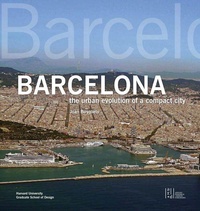
Barcelona
The Urban Evolution of a Compact City
2nd Edition
Will be published approx. on 13. July 2026
Book
Paperback/Softback
468 pages
978-1-966515-71-5 (ISBN)
Description
Barcelona can be regarded as a prototype of a European Mediterranean city with a long urban tradition. As such, it has undergone a specific process of historic formation: density and compactness of urban form, evolution by extension rather than by reform, etc. A history of urban planning necessarily includes a summary of the territorial and urban experience, and pays particular attention to the physical dimensions of the city that condition its cultural and economic development.
This book centres on the construction of Barcelona, taking as its basis the most important planning operations and city projects, and drawing on various sources for the different phases. Its urban development was very varied, even without taking into account the interventions of royalty or aristocrats that produced large avenues and parks. The local scale of many of the projects contrasts with the cosmopolitan aspirations that have made some of these interventions so innovative; these might include some of the major projects carried out for special events, such as the events in 1888 (World Exhibition), 1929 (Electrical Industries Exhibition) and 1992 (Olympic Games).
Now, in the 21st century, new prospects are opening up thanks to the recent European institutional framework, particularly changes in the economic system to a post-industrial phase, during which the various means of communication are coming to the fore. It is difficult to gauge the spatial repercussions, but the urban planning history of Barcelona shows how it has already overcome major contradictions in recent centuries.
This book centres on the construction of Barcelona, taking as its basis the most important planning operations and city projects, and drawing on various sources for the different phases. Its urban development was very varied, even without taking into account the interventions of royalty or aristocrats that produced large avenues and parks. The local scale of many of the projects contrasts with the cosmopolitan aspirations that have made some of these interventions so innovative; these might include some of the major projects carried out for special events, such as the events in 1888 (World Exhibition), 1929 (Electrical Industries Exhibition) and 1992 (Olympic Games).
Now, in the 21st century, new prospects are opening up thanks to the recent European institutional framework, particularly changes in the economic system to a post-industrial phase, during which the various means of communication are coming to the fore. It is difficult to gauge the spatial repercussions, but the urban planning history of Barcelona shows how it has already overcome major contradictions in recent centuries.
More details
Edition
2nd New edition
Language
English
Place of publication
San Rafael
United States
Edition type
New edition
Product notice
Paperback (trade)
Unsewn / adhesive bound
Dimensions
Height: 229 mm
Width: 221 mm
Thickness: 41 mm
Weight
2064 gr
ISBN-13
978-1-966515-71-5 (9781966515715)
Copyright in bibliographic data and cover images is held by Nielsen Book Services Limited or by the publishers or by their respective licensors: all rights reserved.
Schweitzer Classification
Person
Joan Busquets is a world-renowned architect, urban designer, and educator. He is the Martin Bucksbaum Professor in Practice of Urban Planning and Design at the Harvard University Graduate School of Design, and the founder of the design firm, BAU Barcelona.