

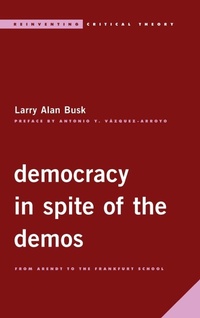
Democracy in Spite of the Demos
From Arendt to the Frankfurt School
Published on 14. February 2020
Book
Hardback
194 pages
978-1-78661-525-1 (ISBN)
Description
The value of democracy is taken for granted today, even by those interested in criticizing the fundamental structures of society. Things would be better, the argument goes, if only things were more democratic. The word "democracy" means "the power of the people," and scholars with a critical and progressive outlook often invoke this meaning as a way of justifying the honorific status accorded to the term: the power of the people to resist racism, sexism, imperialism, climate change, etc. But if the people have the power to resist these structures of domination and inequality, they also have the power to reinforce them. By treating democracy as an end in itself, political theorists of a critical bent overwhelmingly assume that the demos, if given the opportunity, will advance progressive or even radical politics. But given the recent successes of right-wing populism, and the persistence of pathological views such as climate skepticism, is this assumption still warranted? If not, then can democracy really save us?
Reviews / Votes
A bold intervention that questions the widespread assumption among critical theorists that democracy is an end in itself. This assumption, Busk contends, leaves us without the resources that we need to confront a demos that is increasingly xenophobic, right-wing, and authoritarian in character. In this situation, what we need is not more democracy but rather a critique of the demos itself. For the latter, Busk turns to the theory of ideology developed in the work of Adorno and Marcuse. This book combines an insightful and provocative analysis of the limits and ambivalences of contemporary democratic theory with a compelling defense of the ongoing relevance of the early Frankfurt School. -- Amy Allen, Liberal Arts Professor of Philosophy and Women's, Gender, and Sexuality Studies, The Pennsylvania State University, USA In his bracing and timely new book, Larry Busk shows why the democratic turn among left-leaning theorists leaves them mute in the face of post-truth politics. Astutely tracing a fundamental contradiction in the writings of Arendt, Ranciere, Mouffe, and Laclau, Busk proposes instead a model of ideology critique derived from Adorno and Marcuse. Without such a critique, he argues, emancipatory theory will neither understand nor adequately address the politics of climate change denial, authoritarian populism, and anti-immigrant xenophobia. His book convincingly demonstrates the acute insights and ongoing relevance of the early Frankfurt School. -- Lambert Zuidervaart, Professor of Philosophy, University of Toronto, CanadaMore details
Series
Language
English
Place of publication
United Kingdom
Publishing group
Bloomsbury Publishing PLC
Target group
Professional and scholarly
Dimensions
Height: 235 mm
Width: 157 mm
Thickness: 15 mm
Weight
440 gr
ISBN-13
978-1-78661-525-1 (9781786615251)
Copyright in bibliographic data and cover images is held by Nielsen Book Services Limited or by the publishers or by their respective licensors: all rights reserved.
Schweitzer Classification
Other editions
Additional editions
E-Book
02/2020
1st Edition
Rowman & Littlefield Publishers
€32.99
Available for download
Person
Larry Alan Busk received his doctorate from the University of Oregon and currently teaches philosophy at California State University, Stanislaus. His articles have appeared in many journals, including Philosophy Today, Radical Philosophy Review, and Constellations.
Content
Preface
Chapter 1: The Categorical Imperative of Democracy
Chapter 2: Arendt's Island of Freedom
Chapter 3: Radical Democracy at its Limits: Ranciere, Mouffe, and Laclau
Chapter 4: From False Democracy to False Demos: Adorno, Marcuse, and Climate Skepticism
Chapter 5: What is Elitism?
Bibliography
Index
Chapter 1: The Categorical Imperative of Democracy
Chapter 2: Arendt's Island of Freedom
Chapter 3: Radical Democracy at its Limits: Ranciere, Mouffe, and Laclau
Chapter 4: From False Democracy to False Demos: Adorno, Marcuse, and Climate Skepticism
Chapter 5: What is Elitism?
Bibliography
Index