

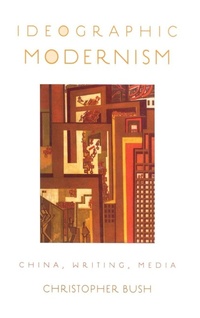
Ideographic Modernism
China, Writing, Media
Published on 4. February 2010
Book
Hardback
208 pages
978-0-19-539382-8 (ISBN)
Description
The ideograph is conventionally understood as a script that is ancient and Chinese; it is neither. The 'ideograph' is a modern Western invention, one contemporaneous with, and related to, such modern inventions as photography, phonography, and cinematography. Ideographic Modernism analyzes the collective significance of an array of figures of Chinese writing in Euro-American literature, showing how the ideograph becomes, in the modernist era, a prism through which to imagine the world in ethnographic and in technological terms.
Chapters on writing-as-image take up Kafka's 'An Imperial Message' and the way photography works as a model of vision without consciousness in the poetics of Imagists and their seeming opposite number, the French allegorist Paul Claudel. Chapters on writing-as-inscription, focus on Victor Segalen's Steles (1912), a prose poem collection that formally emulates the Chinese stone monuments from which it takes its name; and on a series of generally unremarked references to Chinese writing in the work of Walter Benjamin. A final chapter considers Paul Valery's response to the now almost forgotten Sino-Japanese War of 1894-95, tracing Valery's challenge to envision Western History had it engaged with real China, China-as-China, from the start. Overall, the study reveals the richness of the 'ideograph' as simultaneously 1) a prominent example in the imagining of China as a cultural other; 2) a way of imagining the origin, history, and possible futures of writing; and 3) a registration of the cultural effects of modern technological media.
Chapters on writing-as-image take up Kafka's 'An Imperial Message' and the way photography works as a model of vision without consciousness in the poetics of Imagists and their seeming opposite number, the French allegorist Paul Claudel. Chapters on writing-as-inscription, focus on Victor Segalen's Steles (1912), a prose poem collection that formally emulates the Chinese stone monuments from which it takes its name; and on a series of generally unremarked references to Chinese writing in the work of Walter Benjamin. A final chapter considers Paul Valery's response to the now almost forgotten Sino-Japanese War of 1894-95, tracing Valery's challenge to envision Western History had it engaged with real China, China-as-China, from the start. Overall, the study reveals the richness of the 'ideograph' as simultaneously 1) a prominent example in the imagining of China as a cultural other; 2) a way of imagining the origin, history, and possible futures of writing; and 3) a registration of the cultural effects of modern technological media.
Reviews / Votes
This is a carefully pondered and trenchant scholarly enterprise * Translation and Literature *More details
Language
English
Place of publication
New York
United States
Target group
College/higher education
Professional and scholarly
Dimensions
Height: 235 mm
Width: 157 mm
Thickness: 16 mm
Weight
454 gr
ISBN-13
978-0-19-539382-8 (9780195393828)
Copyright in bibliographic data and cover images is held by Nielsen Book Services Limited or by the publishers or by their respective licensors: all rights reserved.
Schweitzer Classification
Other editions
Additional editions
Book
09/2012
Oxford University Press Inc
€49.30
Shipment within 15-20 days
E-Book
02/2010
1st Edition
OUP eBook
€18.49
Available for download
E-Book
02/2010
1st Edition
OUP eBook
€16.49
Available for download
Person
Bush is Assistant Professor of French at Northwestern University.
Content
PREFACE: IMPERIAL MEDIA/IMPERIAL MESSAGES: MODERNISM AND THE MYTH OF CHINA; INTRODUCTION: "NO BETTER INSTRUMENT": THE CHINESE WRITTEN CHARACTER AS A MEDIUM; WORKS CITED