

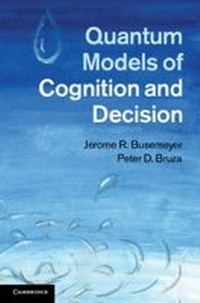
Quantum Models of Cognition and Decision
Published on 19. June 2014
Book
Paperback/Softback
424 pages
978-1-107-41988-9 (ISBN)
Description
Much of our understanding of human thinking is based on probabilistic models. This innovative book by Jerome R. Busemeyer and Peter D. Bruza argues that, actually, the underlying mathematical structures from quantum theory provide a much better account of human thinking than traditional models. They introduce the foundations for modeling probabilistic-dynamic systems using two aspects of quantum theory. The first, 'contextuality', is a way to understand interference effects found with inferences and decisions under conditions of uncertainty. The second, 'quantum entanglement', allows cognitive phenomena to be modeled in non-reductionist ways. Employing these principles drawn from quantum theory allows us to view human cognition and decision in a totally new light. Introducing the basic principles in an easy-to-follow way, this book does not assume a physics background or a quantum brain and comes complete with a tutorial and fully worked-out applications in important areas of cognition and decision.
Reviews / Votes
'Mathematical models of cognition so often seem like mere formal exercises. Quantum theory is a rare exception. Without sacrificing formal rigor, it captures deep insights about the workings of the mind with elegant simplicity. This book promises to revolutionize the way we think about thinking.' Steven Sloman, Brown University, Rhode Island 'This book is about why and how formal structures of quantum theory are essential for psychology - a breakthrough resolving long-standing problems and suggesting novel routes for future research, convincingly presented by two main experts in the field.' Harald Atmanspacher, Institut fuer Grenzgebiete der Psychologie und Psychohygiene e.V. 'This is the first book putting forward the main scientific results of an intriguing and promising new research domain called 'quantum cognition'. In this emergent field, the mathematical structure of quantum theory is employed to model essential aspects of human cognition impossible to be modelled properly within classical approaches. The authors are both engaged intensively in quantum cognition and [have written] a high-quality and well-understandable treatise showing how this new approach carries the potential of a real breakthrough, with deep implications for how cognition will be looked upon in the decades to come. The approach may also signify a thorough new opening to the old problem of artificial intelligence and the structuring of semantics.' Diederik Aerts, Brussels Free UniversityMore details
Language
English
Place of publication
Cambridge
United Kingdom
Target group
College/higher education
Product notice
Paperback (trade)
Illustrations
20 Tables, black and white; 1 Halftones, unspecified; 53 Line drawings, unspecified
Dimensions
Height: 229 mm
Width: 152 mm
Thickness: 22 mm
Weight
570 gr
ISBN-13
978-1-107-41988-9 (9781107419889)
Copyright in bibliographic data and cover images is held by Nielsen Book Services Limited or by the publishers or by their respective licensors: all rights reserved.
Schweitzer Classification
Other editions
New editions
Jerome R. Busemeyer | Peter D. Bruza
Quantum Models of Cognition and Decision
Principles and Applications
Book
11/2024
2nd Edition
Cambridge University Press
€48.30
Shipment within 15-20 days
Persons
Jerome R. Busemeyer is a Professor in the Department of Psychological and Brain Sciences at Indiana University, Bloomington. His research includes mathematical models of learning and decision making and he has formulated a dynamic theory of human decision making called decision field theory. Professor Busemeyer has published over 100 articles in cognitive and decision science journals including Psychological Review and was Chief Editor of the Journal of Mathematical Psychology from 2005 to 2010. Peter D. Bruza is a Professor in the Faculty of Science and Technology at Queensland University of Technology, Brisbane. His research intersects information retrieval, cognitive science and applied logic. He is a pioneer and co-instigator of the field of quantum interaction (QI) and serves on the steering committee of the quantum interaction symposia. Professor Bruza also serves on the editorial boards of Information Retrieval, the Journal of Applied Logic, The Logic Journal of the IGPL and the Information Science and Knowledge Management book series.
Content
1. Why use quantum theory for cognition and decision? Some compelling reasons; 2. What is quantum theory? An elementary introduction; 3. What can quantum theory predict? Predicting question order effects on attitudes; 4. How to apply quantum theory? Accounting for human probability judgment errors; 5. Quantum inspired models of concept combination; 6. An application of quantum theory to conjoint memory recognition; 7. Quantum-like models of human semantic space; 8. What about quantum dynamics? More advanced principles; 9. What is the quantum advantage? Applications to decision making; 10. How to model human information processing using quantum information theory; 11. Can quantum systems learn? Quantum updating; 12. What are the future prospects for quantum cognition and decision?