

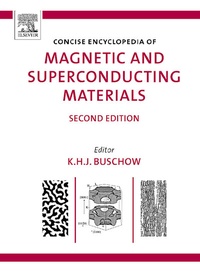
Concise Encyclopedia of Magnetic and Superconducting Materials
2nd Edition
2nd Edition
Published on 28. December 2005
Book
Paperback/Softback
1360 pages
978-0-08-044586-1 (ISBN)
Description
Magnetic and superconducting materials pervade every avenue of the technological world - from microelectronics and mass-data storage to medicine and heavy engineering. Both areas have experienced a recent revitalisation of interest due to the discovery of new materials, and the re-evaluation of a wide range of basic mechanisms and phenomena.
This Concise Encyclopedia draws its material from the award-winning Encyclopedia of Materials and Engineering, and includes updates and revisions not available in the original set -- making it the ideal reference companion for materials scientists and engineers with an interest in magnetic and superconducting materials.
This Concise Encyclopedia draws its material from the award-winning Encyclopedia of Materials and Engineering, and includes updates and revisions not available in the original set -- making it the ideal reference companion for materials scientists and engineers with an interest in magnetic and superconducting materials.
Reviews / Votes
"The listing of all the articles at the beginning of the book made it very easy to quickly scan the contents and find the desired article. The topics covered contain excellent coverage...you will find this book to be an excellent source of comprehensive information all in one text."- John J. Shea in IEEE ELECTRICAL INSULATION MAGAZINE
More details
Series
Edition
2nd edition
Language
English
Place of publication
Oxford
United Kingdom
Publishing group
Elsevier Science & Technology
Target group
Professional and scholarly
Material scientists, engineers. Any scientist or technologist with an interest in magnetic and superconducting materials.
Edition type
New edition
Dimensions
Height: 262 mm
Width: 192 mm
Weight
3260 gr
ISBN-13
978-0-08-044586-1 (9780080445861)
Copyright in bibliographic data and cover images is held by Nielsen Book Services Limited or by the publishers or by their respective licensors: all rights reserved.
Schweitzer Classification
Other editions
Additional editions
K. H. J. Buschow
Concise Encyclopedia of Magnetic and Superconducting Materials
E-Book
12/2005
2nd Edition
Elsevier
€330.00
Available for download
Person
Professor Kurt Heinz Juergen Buschow is a member of the Experimental Physics Department of the University of Amsterdam, where he teaches Magnetism and Magnetic Materials. He studied Physical Chemistry at the Free University of Amsterdam, starting in 1954.After having received his M.Sc. degree in 1960 he prepared his thesis work dealing with "Ion-pair Formation with Polyacene Mono and Dinegative Ions?. He received his Ph.D. degree at the Free University in 1963.
In 1964 he held a research position at the Philips Research Laboratories in Eindhoven. He was appointed Senior Scientist in 1976 and Chief Scientist in 1988. His research activities comprised fundamental as well as applied aspects. During this period he stayed for one year (1977) as a guest scientist at the Bell Laboratories, Murray Hill, N.Y. In March 1994 he left the Philips Research Laboratories, taking a position at the Van der Waals-Zeeman Institute, University of Amsterdam and having simultaneously a part-time professorship at the University of Leiden.
His teaching activities are in the field of Metal Physics and Magnetic Materials. He has published more than 1100 papers in international scientific journals and is author of several review papers and handbook chapters on magnetic materials, metal hydrides and amorphous alloys. He is Editor-in-Chief of the Journal of Alloys and Compounds, Advisory Editor of the Journal of Magnetism and Magnetic Materials and is also Editor of the Series Handbook Magnetic Materials. Recently he became one of the Editors-in-Chief of the Encyclopedia of Materials: Science and Technology.
In 1964 he held a research position at the Philips Research Laboratories in Eindhoven. He was appointed Senior Scientist in 1976 and Chief Scientist in 1988. His research activities comprised fundamental as well as applied aspects. During this period he stayed for one year (1977) as a guest scientist at the Bell Laboratories, Murray Hill, N.Y. In March 1994 he left the Philips Research Laboratories, taking a position at the Van der Waals-Zeeman Institute, University of Amsterdam and having simultaneously a part-time professorship at the University of Leiden.
His teaching activities are in the field of Metal Physics and Magnetic Materials. He has published more than 1100 papers in international scientific journals and is author of several review papers and handbook chapters on magnetic materials, metal hydrides and amorphous alloys. He is Editor-in-Chief of the Journal of Alloys and Compounds, Advisory Editor of the Journal of Magnetism and Magnetic Materials and is also Editor of the Series Handbook Magnetic Materials. Recently he became one of the Editors-in-Chief of the Encyclopedia of Materials: Science and Technology.
Content
Selected articles.
AC applications of superconducting materials. AC losses in superconducting materials. Amorphous superconductors. Anisotropy in magnetic materials. Anisotropy in superconducting materials. Biomagnetic measurements. Chevrel phases. Coercivity and domain wall pinning. Coherence length, proximity effect and fluctuations. Design with magnetic materials. Design with magnetic materials: computer simulation. Domains and domain walls. Ferrites, hard. Fluids, magnetic. Flux creep phenomena. Flux pinning and the summation of pinning forces. Granular superconductors. High-frequency impedance of superconducting materials. High-frequency properties of magnetic materials. Josephson effects in weak links. Magnetic energy storage. Magnetic properties of superconductors. Magnetic separation. Magnetic storage media. Magnetic units and material specification. Magnetization imaging. Magnetocaloric effect. Magnetoelastic phenomena. Magnetooptic materials. Magnetooptic storage media. Millimeter-wave detection. Multifilamentary superconducting composites. Nanocrystalline soft magnetic materials. Niobium-titanium alloys. Nonequilibrium superconductivity. Nuclear magnetic resonance imaging. Optical properties of superconductors. Organic and molecular ferromagnets. Oxide glasses as magnetic materials. Oxide superconductors: ceramic processing. Oxide superconductors: physical properties. Oxide superconductors: thin-film deposition. Power loss in magnetic materials. Radiation effects on magnetic materials. Radiation effects on superconducting materials. Superconducting magnets. Superconducting materials: BCS and phenomenological theories. Thin films and multilayers, magnetic.
AC applications of superconducting materials. AC losses in superconducting materials. Amorphous superconductors. Anisotropy in magnetic materials. Anisotropy in superconducting materials. Biomagnetic measurements. Chevrel phases. Coercivity and domain wall pinning. Coherence length, proximity effect and fluctuations. Design with magnetic materials. Design with magnetic materials: computer simulation. Domains and domain walls. Ferrites, hard. Fluids, magnetic. Flux creep phenomena. Flux pinning and the summation of pinning forces. Granular superconductors. High-frequency impedance of superconducting materials. High-frequency properties of magnetic materials. Josephson effects in weak links. Magnetic energy storage. Magnetic properties of superconductors. Magnetic separation. Magnetic storage media. Magnetic units and material specification. Magnetization imaging. Magnetocaloric effect. Magnetoelastic phenomena. Magnetooptic materials. Magnetooptic storage media. Millimeter-wave detection. Multifilamentary superconducting composites. Nanocrystalline soft magnetic materials. Niobium-titanium alloys. Nonequilibrium superconductivity. Nuclear magnetic resonance imaging. Optical properties of superconductors. Organic and molecular ferromagnets. Oxide glasses as magnetic materials. Oxide superconductors: ceramic processing. Oxide superconductors: physical properties. Oxide superconductors: thin-film deposition. Power loss in magnetic materials. Radiation effects on magnetic materials. Radiation effects on superconducting materials. Superconducting magnets. Superconducting materials: BCS and phenomenological theories. Thin films and multilayers, magnetic.