

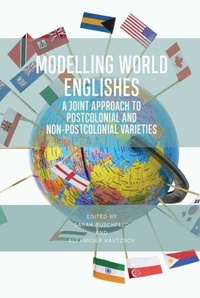
Modelling World Englishes
A Joint Approach to Postcolonial and Non-Postcolonial Varieties
Published on 30. May 2022
Book
Paperback/Softback
440 pages
978-1-4744-4587-0 (ISBN)
Description
This book brings together two types of varieties of English that have so far been treated separately: postcolonial and non-postcolonial Englishes. It examines these varieties of English against the backdrop of current World Englishes theory, with a special focus on the extra- and Intra-Territorial Forces (EIF) Model. Bringing together a range of distinguished researchers in the field, each chapter tests the validity of this new model, analyses a different variety of English and assesses it in relation to current models of World Englishes. In doing so, the book ends the long-standing conceptual gap between postcolonial and non-postcolonial Englishes and integrates these in a unified framework of World Englishes. Case studies examine English(es) in England, Namibia, the United Arab Emirates, India, Singapore, the Philippines, South Korea, Japan, Australia, North America, the Bahamans, Trinidad, Tristan da Cunha, St. Helena, Bermuda, and the Falkland Islands, Ireland, Gibraltar and Ghana.
More details
Language
English
Place of publication
Edinburgh
United Kingdom
Target group
Professional and scholarly
Product notice
Paperback (trade)
Unsewn / adhesive bound
Illustrations
40 black and white illustrations
Dimensions
Height: 236 mm
Width: 157 mm
Thickness: 27 mm
Weight
641 gr
ISBN-13
978-1-4744-4587-0 (9781474445870)
Copyright in bibliographic data and cover images is held by Nielsen Book Services Limited or by the publishers or by their respective licensors: all rights reserved.
Schweitzer Classification
Other editions
Additional editions
Sarah Buschfeld | Alexander Kautzsch
Modelling World Englishes
A Joint Approach to Postcolonial and Non-Postcolonial Varieties
E-Book
07/2020
Edinburgh University Press
€26.49
Available for download
Persons
Sarah Buschfeld is a Professor of English Linguistics (Multilingualism) at TU Dortmund University, Germany Alexander Kautzsch was an assistant professor at the University of Regensburg
Content
Foreword, Sarah Buschfeld
1: Introduction, Sarah Buschfeld and Alexander Kautzsch
2: English in England: The Parent Perspective, Clive Upton
3: English in Namibia: Multilingualism and Ethnic Variation in the Extra- and Intra-territorial Forces Model, Anne Schroeder and Frederic Zaehres
4: English in the United Arab Emirates: Status and Functions, Saeb Sadek
5: English in India: Global Aspirations, Local Identities at the Grassroots, Sachin Labade, Claudia Lange and Sven Leuckert
6: English in Singapore: Two Issues for the EIF Model , Lionel Wee
7: English in the Philippines: A Case of Rootedness and Routedness, Bejay Villaflores Bolivar
8: English in South Korea: Applying the EIF Model, Sofia Ruediger
9: English in Japan: The Applicability of the EIF Model, Saya Ike and James D'Angelo
10: English in Australia - Extra-Territorial Influences, Kate Burridge and Pam Peters
11: English in North America: Accounting for Its Evolution, Edgar W. Schneider
12: English in The Bahamas and Developmental Models of World Englishes: A Critical Analysis, Stephanie Hackert, Alexander Laube and Diana Wengler
13: Standard English in Trinidad: Multinormativity, Translocality, and Implications for the Dynamic Model and the EIF Model, Philipp Meer and Dagmar Deuber
14: Englishes in Tristan da Cunha, St Helena, Bermuda and the Falkland Islands: PCE, non-PCE or both? Blurred Boundaries in the Atlantic, Daniel Schreier
15: English in Ireland: Intra-territorial Perspectives on Language Contact, Patricia Ronan
16: English in Gibraltar: Applying the EIF Model to English in Non-Postcolonial Overseas Territories, Cristina Suarez-Gomez
17: English in Ghana: Extra- and Intra-Territorial Forces in a Developmental Perspective, Thorsten Brato
18: Synopsis: Fine-Tuning the EIF Model, Sarah Buschfeld
1: Introduction, Sarah Buschfeld and Alexander Kautzsch
2: English in England: The Parent Perspective, Clive Upton
3: English in Namibia: Multilingualism and Ethnic Variation in the Extra- and Intra-territorial Forces Model, Anne Schroeder and Frederic Zaehres
4: English in the United Arab Emirates: Status and Functions, Saeb Sadek
5: English in India: Global Aspirations, Local Identities at the Grassroots, Sachin Labade, Claudia Lange and Sven Leuckert
6: English in Singapore: Two Issues for the EIF Model , Lionel Wee
7: English in the Philippines: A Case of Rootedness and Routedness, Bejay Villaflores Bolivar
8: English in South Korea: Applying the EIF Model, Sofia Ruediger
9: English in Japan: The Applicability of the EIF Model, Saya Ike and James D'Angelo
10: English in Australia - Extra-Territorial Influences, Kate Burridge and Pam Peters
11: English in North America: Accounting for Its Evolution, Edgar W. Schneider
12: English in The Bahamas and Developmental Models of World Englishes: A Critical Analysis, Stephanie Hackert, Alexander Laube and Diana Wengler
13: Standard English in Trinidad: Multinormativity, Translocality, and Implications for the Dynamic Model and the EIF Model, Philipp Meer and Dagmar Deuber
14: Englishes in Tristan da Cunha, St Helena, Bermuda and the Falkland Islands: PCE, non-PCE or both? Blurred Boundaries in the Atlantic, Daniel Schreier
15: English in Ireland: Intra-territorial Perspectives on Language Contact, Patricia Ronan
16: English in Gibraltar: Applying the EIF Model to English in Non-Postcolonial Overseas Territories, Cristina Suarez-Gomez
17: English in Ghana: Extra- and Intra-Territorial Forces in a Developmental Perspective, Thorsten Brato
18: Synopsis: Fine-Tuning the EIF Model, Sarah Buschfeld