

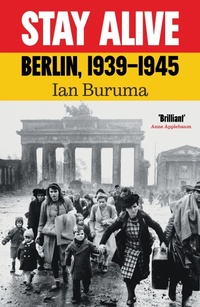
Stay Alive
Berlin, 1939-1945
Published on 5. March 2026
Book
Hardback
400 pages
978-1-80546-289-7 (ISBN)
Description
'A captivating mosaic of wartime Berlin' Katja Hoyer, Financial Times
'Brilliant and beautifully written' Anne Applebaum
'Brings to life Berlin during World War II so vividly that you can imagine yourself blithely strolling the streets of the city or hunkering down in the bomb shelters' Barbara Demick
'A rich and fascinating portrait of Berlin at war' Literary Review
'Wonderfully nuanced' Guardian
When war broke out in September 1939, what was most striking in the German capital at first was how little changed. Unless you were Jewish. Then life, already hard, soon got unfathomably worse.
Drawing on diaries, letters and memoirs, Stay Alive chronicles daily life in wartime Berlin with extraordinary power and immediacy. Here are the movie stars and swing dancers, the resistance circles and SS patrols hunting deserters, the desperate calculations of survival and collaboration. As Allied bombs reduced the city to rubble and Soviet troops closed in, the common greeting of Berliners became not auf Wiedersehen or Heil Hitler but bleiben Sie uebrig - 'Stay alive'.
Revelatory, devastating and deeply humane, this book illuminates how ordinary people navigated the moral catastrophe of the Third Reich - what it meant to resist, to conform or simply to endure. Buruma shows how a society's accommodation to evil unfolds one compromise at a time, and why understanding this descent remains urgently relevant today.
'Brilliant and beautifully written' Anne Applebaum
'Brings to life Berlin during World War II so vividly that you can imagine yourself blithely strolling the streets of the city or hunkering down in the bomb shelters' Barbara Demick
'A rich and fascinating portrait of Berlin at war' Literary Review
'Wonderfully nuanced' Guardian
When war broke out in September 1939, what was most striking in the German capital at first was how little changed. Unless you were Jewish. Then life, already hard, soon got unfathomably worse.
Drawing on diaries, letters and memoirs, Stay Alive chronicles daily life in wartime Berlin with extraordinary power and immediacy. Here are the movie stars and swing dancers, the resistance circles and SS patrols hunting deserters, the desperate calculations of survival and collaboration. As Allied bombs reduced the city to rubble and Soviet troops closed in, the common greeting of Berliners became not auf Wiedersehen or Heil Hitler but bleiben Sie uebrig - 'Stay alive'.
Revelatory, devastating and deeply humane, this book illuminates how ordinary people navigated the moral catastrophe of the Third Reich - what it meant to resist, to conform or simply to endure. Buruma shows how a society's accommodation to evil unfolds one compromise at a time, and why understanding this descent remains urgently relevant today.
Reviews / Votes
Buruma's personal connection shines through in the care with which he paints a vivid yet never overly sentimental portrait of the city at war... A captivating mosaic of wartime Berlin. -- Katja Hoyer * Financial Times * In wartime Berlin it was possible to find every form of human behaviour, from conformity and cruelty to bravery and indifference. Using his father's memories and letters as well as a wide range of other sources, Ian Buruma has composed a brilliant account of what it felt like to be there. Stay Alive is a beautifully written account of a city under military and moral siege. -- Professor Anne Applebaum * author of Autocracy Inc. * A rich and fascinating portrait of Berlin at war * Literary Review * Beautifully written and deeply researched, Stay Alive is particularly haunting in showing how ordinary Germans conformed with Nazism and the persecution and deportation of their Jewish neighbours. It makes a chilling warning of how people can acquiesce and look away from the worst realities. -- Gary Bass * author of Judgment at Tokyo: World War II on Trial and the Making of Modern Asia * An exceptional excursion into the multiple, contradictory lives, voices and dilemmas of Berlin's inhabitants during the Nazi war years... By providing a compelling and compulsive immersion into that crucial period of history, Buruma also eloquently reminds us of how, in our own time, the temptation to look away from persecution and injustice has terrifying consequences. -- Ariel Dorfman * author of Death and the Maiden * Ian Buruma brings to life Berlin during World War II so vividly that you can imagine yourself blithely strolling the streets of the city or hunkering down in the bomb shelters. Buruma tapped a wealth of sources -- not only published memoirs, but first-hand interviews with elderly survivors and a cache of letters stored in a tin written by Buruma's own father, a forced labourer in Berlin during the war. The beauty of the book is Buruma's nuanced writing about the Germans who weighed resistance against the imperative to stay alive, and those who simply became cogs in Hitler's murderous regime. -- Barbara Demick, Samuel Johnson Prize-winning author of Nothing to Envy Buruma draws on an abundant source of material, including letters and diaries, enriching these with interviews with wartime eyewitnesses. * Kirkus (starred review) *More details
Edition
Main
Language
English
Place of publication
London
United Kingdom
Dimensions
Height: 239 mm
Width: 160 mm
Thickness: 38 mm
Weight
615 gr
ISBN-13
978-1-80546-289-7 (9781805462897)
Copyright in bibliographic data and cover images is held by Nielsen Book Services Limited or by the publishers or by their respective licensors: all rights reserved.
Schweitzer Classification
Other editions
Additional editions
Person
Ian Buruma was born in the Netherlands. He studied Chinese at Leiden University and cinema at Nihon University, Tokyo. He has lived and worked in Tokyo, Hong Kong, London, and New York. He is a regular contributor to Harper's and the New Yorker and writes monthly columns for Project Syndicate. He is a professor at Bard College and lives in New York City.
Content
Part One: 1939 Part Two: 1940 Part Three: 1941 Part Four: 1942 Part Five: 1943 Part Six: 1944 Part Seven: 1945 Aftermath: Aftermath