

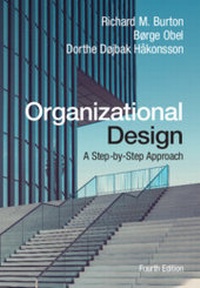
Organizational Design
A Step-by-Step Approach
4th Edition
Published on 16. July 2020
Book
Paperback/Softback
284 pages
978-1-108-71756-4 (ISBN)
Description
Now in its fourth edition, this is the definitive step-by-step 'how to' guide to designing an organization. Building on information processing theory, the book proposes a holistic, multi-contingency model of the organization. This textbook communicates the fundamentals of traditional and new organizational forms, including up-to-date analysis of self-organizing, boss-less, digital, and sustainable organizations. Providing a framework for the practical implementation of organizational design changes, the authors break the process down into seven basic steps: (1) Assessing Goals, (2) Assessing Strategy, (3) Analyzing Structure, (4) Assessing Process and People, (5) Analyzing Coordination, Control and Incentives, (6) Designing the Architecture, and (7) Implementing the Architecture. Each step connects with one of the nine interdependent components of the multi-contingency model, and the authors also provide a logical query process for approaching each of these components. This is an ideal guide for managers or executives interested in assessing their organization and taking steps to redesign it for success, as well as for MBA and executive MBA students looking for an introduction to organizational design.
Reviews / Votes
'Advances in AI are effecting organizations in a variety of complex ways, and a systematic approach to organization design has never been more valuable. Burton, Obel and Hakonsson provide the conceptual framework for such an approach. Managers at all levels in organizations will benefit from it.' Phanish Puranam, The Roland Berger Chaired Professor of Strategy and Organisation Design, INSEAD 'Burton, Obel and Hakonsson have written here the definitive guide to organization design, comprising both partitioning of tasks and their coordination to realize an organization's goals. Their information-processing framework is ageless, tried and true, incorporating real examples of contemporary transformations and variations that build upon it - including the mix of human and machine agents, digitalization of work, and new forms of organizing. For anyone looking to do a deep dive and to improve their organization's performance, the authors provide a step-by-step approach for diagnosis (of fit or misfit) and design (i.e., taking action to realign the organization) that is holistic, realistic and effective.' Samina Karim, Professor, Entrepreneurship and Innovation Group, D'Amore-McKim School of Business, Northeastern UniversityMore details
Edition
4th Revised edition
Language
English
Place of publication
Cambridge
United Kingdom
Target group
Professional and scholarly
Edition type
Revised edition
Product notice
Paperback (trade)
Illustrations
Worked examples or Exercises; 17 Tables, black and white; 26 Line drawings, color; 10 Line drawings, black and white
Dimensions
Height: 244 mm
Width: 170 mm
Thickness: 16 mm
Weight
505 gr
ISBN-13
978-1-108-71756-4 (9781108717564)
Copyright in bibliographic data and cover images is held by Nielsen Book Services Limited or by the publishers or by their respective licensors: all rights reserved.
Schweitzer Classification
Other editions
New editions
Richard M. Burton | Borge Obel | Dorthe Dojbak Hakonsson
Organizational Design
A Step-by-Step Approach
Book
05/2026
5th Edition
Cambridge University Press
€56.00
Shipment within 15-20 days
Previous edition
Richard M. Burton | Borge Obel | Dorthe Dojbak Hakonsson
Organizational Design
A Step-by-Step Approach
Book
07/2015
3rd Edition
Cambridge University Press
€42.08
Article exhausted; check for reprint
Persons
Richard M. Burton is Professor Emeritus of Organization and Strategy at The Fuqua School of Business, Duke University, North Carolina. Richard has published articles in journals including Organization Science, Management Science, Administrative Science Quarterly, and Strategic Management Journal, among others. He is the recipient of an honorary doctorate from Aarhus University, Denmark. Borge Obel is a professor at the Interdisciplinary Center for Organizational Architecture, Department of Management, Business, and Social Sciences, Aarhus University, Denmark, and The European Institute for Advanced Studies in Management (EIASM), Brussels. Borge has published numerous academic papers in journals including Strategic Management Journal, Organization Science, ASQ, and Management Science. Dorthe Dojbak Hakonsson is a professor at the Department of Management, Business, and Social Sciences, Aarhus University, Denmark, where she also serves as Center Leader of ICOA (the Interdisciplinary Center for Organizational Architecture). She is Associate Editor of the Journal of Organization Design, and a member of the board of the Organizational Design Community. Dorthe has published articles in journals including Strategic Management Journal, California Management Review, and Long Range Planning, among others.
Content
Step 1. Getting Started: 1. Assessing the scope and goals of the organization; Step 2. Assessing the Strategy: 2. Strategy; 3. Environment; Step 3. Analyzing the Structure: 4. Traditional configurations of the firm; 5. New organizational forms?; Step 4. Assessing Process and People: 6. Work, task design and agents; 7. Leadership and organizational climate; Step 5. Analyzing Coordination, Control, and Incentives: 8. Coordination and control; 9. Incentives; 10. Designing the structure and coordination; Step 6. Designing the Architecture: 11. Designing the architecture and the sequence of change; Step 7. Implementing the Architecture: 12. Implementing the change: who should do what when?