

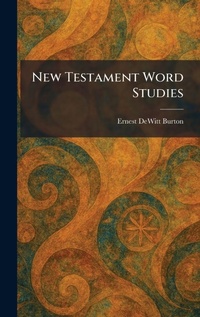
New Testament Word Studies
Description
"New Testament Word Studies" is a scholarly examination of the linguistic and theological nuances found within the Greek text of the Christian scriptures. Authored by the noted biblical scholar Ernest DeWitt Burton, this work provides meticulous analysis of key terms and concepts that are central to understanding the New Testament's message. Burton's approach combines rigorous philological investigation with an appreciation for the historical and cultural context in which these words were first penned.
By tracing the evolution of meanings and the specific usage of vocabulary within various books of the New Testament, this volume serves as an essential tool for students, theologians, and researchers seeking a deeper comprehension of biblical Greek. The study delves into the etymology and semantic range of significant theological terms, clarifying complex passages through precise linguistic detail. "New Testament Word Studies" remains a significant contribution to the field of biblical exegesis, offering insights that bridge the gap between ancient language and modern interpretation. Its structured presentation makes it an accessible yet profound resource for anyone dedicated to the serious study of the biblical text.
This work has been selected by scholars as being culturally important, and is part of the knowledge base of civilization as we know it. This work was reproduced from the original artifact, and remains as true to the original work as possible. Therefore, you may see the original copyright references, library stamps (as most of these works have been housed in our most important libraries around the world), and other notations in the work.
This work is in the public domain in the United States of America, and possibly other nations. Within the United States, you may freely copy and distribute this work, as no entity (individual or corporate) has a copyright on the body of the work.
As a reproduction of a historical artifact, this work may contain missing or blurred pages, poor pictures, errant marks, etc. Scholars believe, and we concur, that this work is important enough to be preserved, reproduced, and made generally available to the public. We appreciate your support of the preservation process, and thank you for being an important part of keeping this knowledge alive and relevant.