

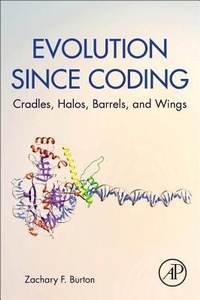
Evolution since Coding
Cradles, Halos, Barrels, and Wings
Published on 3. August 2017
Book
Paperback/Softback
212 pages
978-0-12-813033-9 (ISBN)
Description
Evolution since Coding: Cradles, Halos, Barrels, and Wings describes genesis of metabolism, transcription, translation, cell structure, eukaryotic complexity, LUCA (the last universal common (cellular) ancestor), the great divergence of archaea and bacteria, LECA (the last eukaryotic common ancestor), extinction, and cancer in very simple ways. The work (almost) "synthesizes life from scratch" (since coding) and describes the tools for readers to check the author's work. As a result, readers understand living systems and their evolution in a conceptual way and are empowered to utilize powerful but accessible tools in computer-based biology.
The work serves as foundational reading for a variety of researchers, academics, and students in life sciences, for example in evolution/evolutionary biology, biochemistry, genetics/molecular genetics, molecular biology, cell biology, and microbiology, as well as disciplines beyond biological science. Its approachable style makes the book accessible for introductory students and educated laypersons. Evolution since Coding is suitable to supplement college courses that mix computers, evolution, and biology from freshman to senior level.
The work serves as foundational reading for a variety of researchers, academics, and students in life sciences, for example in evolution/evolutionary biology, biochemistry, genetics/molecular genetics, molecular biology, cell biology, and microbiology, as well as disciplines beyond biological science. Its approachable style makes the book accessible for introductory students and educated laypersons. Evolution since Coding is suitable to supplement college courses that mix computers, evolution, and biology from freshman to senior level.
More details
Language
English
Place of publication
San Diego
United States
Publishing group
Elsevier Science Publishing Co Inc
Target group
Professional and scholarly
Researchers, academics, and students in life sciences, for example in molecular biology, evolutionary biology, biochemistry, genetics/molecular genetics, epidemiology, oncology, gerontology, cell biology, and microbiology, as well as many disciplines beyond biological science; secondarily, as an auxiliary text for specific courses and seminars at colleges and universities
Product notice
Paperback (trade)
Unsewn / adhesive bound
Dimensions
Height: 151 mm
Width: 228 mm
Thickness: 15 mm
Weight
320 gr
ISBN-13
978-0-12-813033-9 (9780128130339)
Copyright in bibliographic data and cover images is held by Nielsen Book Services Limited or by the publishers or by their respective licensors: all rights reserved.
Schweitzer Classification
Other editions
Additional editions
E-Book
08/2017
Academic Press
€45.95
Available for download
Person
Dr. Burton has been a professor at Michigan State University since 1987 and is also Director of Undergraduate Education in the Department of Biochemistry and Molecular Biology, as well as Principle Investigator of the Burton Lab at MSU. His research is on RNA polymerase mechanisms and ancient evolution of transcription and translation systems, on which he has published several papers. He is interested in the genesis, divergence, and complexity of life on Earth, told in core protein and DNA sequences.
Content
1. Big Questions2. What This Book Is About 3. Scientific Acronyms 4. Molecular Graphics
Section I: The Old Testament of Gene Regulation 5. Evolution as a Cutout Doll Problem I 6. Evolution as a Cutout Doll Problem II 7. The Best Art 8. Intelligent Design 9. Polymers 10. LEGO (Trademark) Life 11. ?/? Proteins 12. The Inevitability of ?/? Folds 13. Evolution Puts the Y (Why) in Biology 14. Evolution Is Not Anti-Religion 15. Computers in Biology 16. The Old and New Testaments of Gene Regulation 17. Evolution as a Cutout Doll Problem III 18. Multi-subunit RNA Polymerases Book I 19. Multi-Subunit RNA Polymerases Book II 20. The Chemical Synthesis of Life 21. The RNA World 22. Ribosomes 23. The RNA-Protein World 24. Transfer RNA 25. The Three Domains of Life on Earth and Scientific Working Hypotheses 26. LUCA 27. General Transcription Factors and Promoters 28. Archaea 29. Bacteria 30. Methane and Oxygen
Section II: The New Testament of Gene Regulation 31. LECA 32. Eukaryotic Multi-Subunit RNA Polymerases, General Transcription Factors and the CTD 33. Patchwork Eukaryotic Phylogenomics 34. Plants 35. The Permian-Triassic Extinction 36. The Triassic-Jurassic Extinction 37. The Cretaceous-Paleogene Extinction 38. The Paleocene-Eocene Thermal Maximum 39. Promoter Proximal Pausing and the CTD Interactome 40. Human Evolution 41. Human Cancer 42. Homology Modeling and Cryoelectron Microscopy 43. Human Extinction 44. Evolution Versus Faith 45. Concept in Biology 46. Other Books and Studies
Section I: The Old Testament of Gene Regulation 5. Evolution as a Cutout Doll Problem I 6. Evolution as a Cutout Doll Problem II 7. The Best Art 8. Intelligent Design 9. Polymers 10. LEGO (Trademark) Life 11. ?/? Proteins 12. The Inevitability of ?/? Folds 13. Evolution Puts the Y (Why) in Biology 14. Evolution Is Not Anti-Religion 15. Computers in Biology 16. The Old and New Testaments of Gene Regulation 17. Evolution as a Cutout Doll Problem III 18. Multi-subunit RNA Polymerases Book I 19. Multi-Subunit RNA Polymerases Book II 20. The Chemical Synthesis of Life 21. The RNA World 22. Ribosomes 23. The RNA-Protein World 24. Transfer RNA 25. The Three Domains of Life on Earth and Scientific Working Hypotheses 26. LUCA 27. General Transcription Factors and Promoters 28. Archaea 29. Bacteria 30. Methane and Oxygen
Section II: The New Testament of Gene Regulation 31. LECA 32. Eukaryotic Multi-Subunit RNA Polymerases, General Transcription Factors and the CTD 33. Patchwork Eukaryotic Phylogenomics 34. Plants 35. The Permian-Triassic Extinction 36. The Triassic-Jurassic Extinction 37. The Cretaceous-Paleogene Extinction 38. The Paleocene-Eocene Thermal Maximum 39. Promoter Proximal Pausing and the CTD Interactome 40. Human Evolution 41. Human Cancer 42. Homology Modeling and Cryoelectron Microscopy 43. Human Extinction 44. Evolution Versus Faith 45. Concept in Biology 46. Other Books and Studies