


Design Models for Hierarchical Organizations
Computation, Information, and Decentralization
Published on 2. October 2012
Book
Paperback/Softback
XIV, 279 pages
978-1-4613-5964-7 (ISBN)
Description
Design Models for Hierarchical Organizations: Computation,
Information, and Decentralization
provides state-of-the-art research on organizational design models, and in particular on mathematical models. Each chapter views the organization as an information processing entity. Thus, mathematical models are used to examine information flow and decision procedures, which in turn, form the basis for evaluating organization designs. Each chapters stands alone as a contribution to organization design and the modeling approach to design. Moreover, the chapters fit together and that totality gives us a good understanding of where we are with this approach to organizational design issues and where we should focus our research efforts in the future.
More details
Edition
Softcover reprint of the original 1st ed. 1995
Language
English
Place of publication
New York
United States
Target group
Professional and scholarly
Research
Illustrations
XIV, 279 p.
Dimensions
Height: 235 mm
Width: 155 mm
Thickness: 17 mm
Weight
452 gr
ISBN-13
978-1-4613-5964-7 (9781461359647)
DOI
10.1007/978-1-4615-2285-0
Schweitzer Classification
Other editions
Additional editions
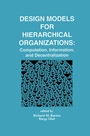
Richard M. Burton | Børge Obel
Design Models for Hierarchical Organizations
Computation, Information, and Decentralization
Book
09/1995
Kluwer Academic Publishers
€160.49
Shipment within 15-20 days
Content
Section 1: Mathematical Programming Models, Hierarchy and Decentralization.- Mathematical Contingency Modelling for Organizational Design: Taking Stock.- Design Insights from Alternative Decompositions.- Primal and Dual Decomposition as Organizational Design: Price and/or Resource Directive Decomposition.- Aggregation Approaches to Decentralized Planning Structures.- General Mathematical Programming Models in Multi-Level Planning.- Section 2: Hierarchical Planning Models.- A Conceptual Framework for Hierarchical Planning and Bargaining.- Hierarchical Negotiations.- Hierarchical Production Planning.- Section 3: Counterpoint; The Individual and the Emergent Structure.- The Emergence of Organizational Structures.- Technological Spillovers and Incentive Schemes for R&D.- Judging with Uncertainty in Diagnosis.