

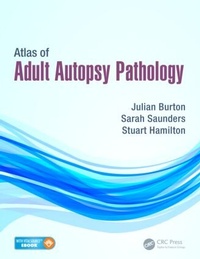
Atlas of Adult Autopsy Pathology
1st Edition
Published on 27. July 2015
Book
Hardback
312 pages
978-1-4441-3752-1 (ISBN)
Description
The Atlas of Adult Autopsy Pathology is a full-color atlas for those performing, or learning to perform, adult autopsies. It is arranged by organ systems and also includes chapters on external examination findings, the effect of decomposition, and histopathological findings, as well as procedures and devices one may encounter during autopsy.
The book includes a series of more than 700 color clinical images of adult autopsy pathology. It covers both diseases that are commonly seen as well as less common, or even rare, diseases. In some instances, a diagnosis may be made on the basis of the macroscopic appearance alone, while in others further investigation is required and appropriate guidance is provided.
Unlike other atlases, this book goes beyond simply providing a collection of images. It features concise guidance on how to interpret macroscopic findings and prompts when further considerations are useful. This atlas is designed to be a visual reference that can assist with rapid diagnosis of autopsy findings.
Comprehensive in its coverage with high-quality illustrations, this definitive atlas is an invaluable resource to trainees and consultant pathologists performing non-forensic autopsies. The book is also an important reference for anatomical pathology technicians, medico-legal specialists, and their officers.
The book includes a series of more than 700 color clinical images of adult autopsy pathology. It covers both diseases that are commonly seen as well as less common, or even rare, diseases. In some instances, a diagnosis may be made on the basis of the macroscopic appearance alone, while in others further investigation is required and appropriate guidance is provided.
Unlike other atlases, this book goes beyond simply providing a collection of images. It features concise guidance on how to interpret macroscopic findings and prompts when further considerations are useful. This atlas is designed to be a visual reference that can assist with rapid diagnosis of autopsy findings.
Comprehensive in its coverage with high-quality illustrations, this definitive atlas is an invaluable resource to trainees and consultant pathologists performing non-forensic autopsies. The book is also an important reference for anatomical pathology technicians, medico-legal specialists, and their officers.
Reviews / Votes
"This atlas is more than a collection of images. It provides reliable instruction on the interpretation of macroscopic findings ... [and] represents a wealth of information for medical students, pathology trainees, more experienced pathologists, and physicians interested in pathology."-Sherry Krawitz, MD, PhD, University of Manitoba College of Medicine in Doody's Book Reviews
More details
Language
English
Place of publication
London
United Kingdom
Publishing group
Taylor & Francis Ltd
Target group
College/higher education
Professional and scholarly
Professional Reference
Illustrations
717 farbige Abbildungen, 4 s/w Tabellen
4 Tables, black and white; 717 Illustrations, color
Dimensions
Height: 280 mm
Width: 210 mm
Weight
1080 gr
ISBN-13
978-1-4441-3752-1 (9781444137521)
Copyright in bibliographic data and cover images is held by Nielsen Book Services Limited or by the publishers or by their respective licensors: all rights reserved.
Schweitzer Classification
Other editions
Additional editions
Julian Burton | Sarah Saunders | Stuart Hamilton
Atlas of Adult Autopsy Pathology
E-Book
06/2015
1st Edition
Hodder Arnold
€244.99
Available for download
Julian Burton | Sarah Saunders | Stuart Hamilton
Atlas of Adult Autopsy Pathology
E-Book
06/2015
CRC Press
€244.99
Available for download
Persons
Julian L. Burton, MBChB (Hons), MEd, FHEA is the lead coronial pathologist at the Medico-Legal Centre in Sheffield, UK. He is also a senior teaching fellow and director of undergraduate medical admissions at the University of Sheffield Medical School. Dr. Burton performs 350 to 400 adult medico-legal autopsies per year. These include investigation of deaths where the cause of death is not known. He also investigates possible suicides, accidental deaths, industrial deaths, peri/post-operative deaths and deaths where there are concerns that death may have been due to medical or surgical intervention. He has taught autopsy practice to audiences around the world.
Sarah Saunders, BSc (Hons), MBChB, MD, DMJ (Path), PGCert Clin.Ed, FHEA is a speciality registrar in the Department of Cellular Pathology at Royal Devon and Exeter NHS Foundation Trust. Dr. Saunders was trained in forensic pathology at the East Midlands Forensic Pathology Unit and holds the DMJ in Forensic Pathology. She also obtained a medical doctorate in forensic radiology and maintains a research interest in minimally invasive autopsy techniques. As part of her role as a histopathologist, she undertakes hospital and medico-legal autopsies. Dr. Saunders holds a PGCert in clinical education and is a fellow of the higher education authority.
Stuart J. Hamilton, BMSc(Hons), MBChB, FRCPath, MFFLM is a Home Office Registered forensic pathologist at East Midlands Forensic Pathology Unit in Leicester, UK. He is the deputy chief forensic pathologist for the East Midlands at the East Midlands Forensic Pathology Unit. He has performed around 3000 autopsies ranging from simple sudden and unexpected deaths to complex multiple homicides. Dr. Hamilton has provided expert comment for various newspaper articles and TV programmes as well as expert testimony in various courts. He is also the honorary secretary of the British Association in Forensic Medicine and a member of the American Academy of Forensic Sciences.
Sarah Saunders, BSc (Hons), MBChB, MD, DMJ (Path), PGCert Clin.Ed, FHEA is a speciality registrar in the Department of Cellular Pathology at Royal Devon and Exeter NHS Foundation Trust. Dr. Saunders was trained in forensic pathology at the East Midlands Forensic Pathology Unit and holds the DMJ in Forensic Pathology. She also obtained a medical doctorate in forensic radiology and maintains a research interest in minimally invasive autopsy techniques. As part of her role as a histopathologist, she undertakes hospital and medico-legal autopsies. Dr. Saunders holds a PGCert in clinical education and is a fellow of the higher education authority.
Stuart J. Hamilton, BMSc(Hons), MBChB, FRCPath, MFFLM is a Home Office Registered forensic pathologist at East Midlands Forensic Pathology Unit in Leicester, UK. He is the deputy chief forensic pathologist for the East Midlands at the East Midlands Forensic Pathology Unit. He has performed around 3000 autopsies ranging from simple sudden and unexpected deaths to complex multiple homicides. Dr. Hamilton has provided expert comment for various newspaper articles and TV programmes as well as expert testimony in various courts. He is also the honorary secretary of the British Association in Forensic Medicine and a member of the American Academy of Forensic Sciences.
Content
External Examination: Natural Disease and Common Artifacts. External Examination: Trauma. The Cardiovascular System. The Respiratory System. The Gastrointestinal System. The Hepatobiliary System and Pancreas. The Genitourinary System. The Endocrine System. The Lymphoreticular System. The Locomotor System. The Central Nervous System. Decomposed Bodies. Histology of the Autopsy. Medical Procedures and Devices Encountered at Autopsy.