

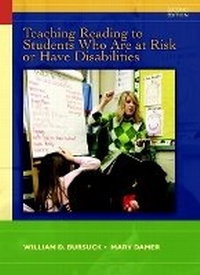
Teaching Reading to Students Who Are At-Risk or Have Disabilities
A Multi-Tier Approach
2nd Edition
Published on 2. July 2010
Book
Paperback/Softback
408 pages
978-0-13-705781-8 (ISBN)
Description
New edition includes more direction for teaching older readers, increased coverage of RTI, expanded assessment and spelling coverage as well as content on ELL.
The public focus on children who struggle with learning to read has never been greater. Bursuck and Damer have done an extraordinary job of answering that exact charge-to help all students succeed at reading-in writing this extraordinary book.Organized according to the Reading First categories of reading development and instruction as presented in the report of the National Reading Panel, the book uses a systematic, explicit, success-oriented approach for teaching struggling readers in today's accountability-driven schools. Teachers will appreciate the authentic, research-validated reality-based strategies and the accessible language used throughout. All of the strategies presented are research-based, and have been field-tested with at-risk children in both rural and urban teaching settings. Most of the strategies have resulted from the authors' work in K-3, inner-city schools, working every day with at-risk children, including children of poverty, children for whom English is not their primary language, and children with learning and behavioral disabilities, not just findings from research articles! The text covers the 5 key elements of reading, delineated in the National Reading Panel Report in order to help teachers learn how to differentiate instruction within each of these areas for a range of learners, using systematic, explicit teaching strategies within a multi-tier RTI framework. Teachers can also rest assure that all of the strategies not only follow the guidelines put forth by the National Reading Panel, but cover the essential areas of phonemic awareness, alphabetic principle (phonics), reading fluency, vocabulary, and comprehension, and are carefully tied to specific assessments, producing a level of accountability that is required of all teachers in today's schools. Other hallmarks of the book include: all of the strategies benefit English Language Learners; newly added chapter vignettes profile students and their struggles with reading, IEP goals and objectives in reading, and tips for differentiating instruction for each of the featured children; Research to Practice features; Reflective Teacher features, and more.
The public focus on children who struggle with learning to read has never been greater. Bursuck and Damer have done an extraordinary job of answering that exact charge-to help all students succeed at reading-in writing this extraordinary book.Organized according to the Reading First categories of reading development and instruction as presented in the report of the National Reading Panel, the book uses a systematic, explicit, success-oriented approach for teaching struggling readers in today's accountability-driven schools. Teachers will appreciate the authentic, research-validated reality-based strategies and the accessible language used throughout. All of the strategies presented are research-based, and have been field-tested with at-risk children in both rural and urban teaching settings. Most of the strategies have resulted from the authors' work in K-3, inner-city schools, working every day with at-risk children, including children of poverty, children for whom English is not their primary language, and children with learning and behavioral disabilities, not just findings from research articles! The text covers the 5 key elements of reading, delineated in the National Reading Panel Report in order to help teachers learn how to differentiate instruction within each of these areas for a range of learners, using systematic, explicit teaching strategies within a multi-tier RTI framework. Teachers can also rest assure that all of the strategies not only follow the guidelines put forth by the National Reading Panel, but cover the essential areas of phonemic awareness, alphabetic principle (phonics), reading fluency, vocabulary, and comprehension, and are carefully tied to specific assessments, producing a level of accountability that is required of all teachers in today's schools. Other hallmarks of the book include: all of the strategies benefit English Language Learners; newly added chapter vignettes profile students and their struggles with reading, IEP goals and objectives in reading, and tips for differentiating instruction for each of the featured children; Research to Practice features; Reflective Teacher features, and more.
More details
Edition
2nd edition
Language
English
Place of publication
United States
Publishing group
Pearson Education (US)
Target group
Professional and scholarly
Dimensions
Height: 276 mm
Width: 216 mm
Weight
957 gr
ISBN-13
978-0-13-705781-8 (9780137057818)
Copyright in bibliographic data and cover images is held by Nielsen Book Services Limited or by the publishers or by their respective licensors: all rights reserved.
Schweitzer Classification
Other editions
Previous edition
William D. Bursuck | Mary Damer
Reading Instruction for Students Who Are at Risk or Have Disabilities
Book
12/2006
Pearson
€64.67
Article exhausted; check for reprint
Persons
Dr. Bursuck, who received his Ph.D. from the University of Illinois at Urbana-Champaign, is a Professor of Special Education at the University of North Carolina at Greensboro. He is the co-author of the best-selling textbook on inclusive practices, Including Students with Special Needs: A Practical Guide for Teachers, also published by Pearson. In addition, he has also authored and co-authored over 50 research-based articles on ways to teach students who are at-risk or who have disabilities.
Mary Damer is an educational consultant and co-founder of Multi-Tier, LLC, a consulting company that works with school districts to increase reading achievement through an intensive, multi-tiered model based on preventing reading failure. For over seven years, she has directed her multi-tier reading project in high-poverty, urban schools. A former teacher, principal, and behavior consultant, she is currently a lecturer in special education at The Ohio State University, and the co-author of Managing Unmanageable Students: Practical Solutions for Administrators.
Mary Damer is an educational consultant and co-founder of Multi-Tier, LLC, a consulting company that works with school districts to increase reading achievement through an intensive, multi-tiered model based on preventing reading failure. For over seven years, she has directed her multi-tier reading project in high-poverty, urban schools. A former teacher, principal, and behavior consultant, she is currently a lecturer in special education at The Ohio State University, and the co-author of Managing Unmanageable Students: Practical Solutions for Administrators.
Content
Chapter 1 An Introduction to Systematic, Explicit Reading Instruction
Chapter 2 Phonemic Awareness
Chapter 3 Beginning Reading Early Decoding
Chapter 4 Advanced Word-Reading
Chapter 5 Reading Fluency
Chapter 6 Vocabulary Instruction
Chapter 7 Comprehension
Applied Activities
References
Appendix A Early Reading Assessment Batteries Used for Screening
Appendix B DIBELS Benchmark Tables
Appendix C Tier Decision Guidelines Made by a District Based on DIBELS Scores
Appendix D Consonant Blends, Consonant Digraphs, Consonant Diphthongs
Appendix E Informal Phonics Diagnostic Assessment for Beginning Reader
Appendix F Lesson Plan for Beginning Reader
Appendix G Informal Advanced Word Reading Diagnostic Assessment
Appendix H Diagnostic Spelling Assessment for Advanced Readers
Appendix I Lesson Plan for an Advanced Word Reader
Appendix J Vocabulary Assessments
Gloassary
Index
Chapter 2 Phonemic Awareness
Chapter 3 Beginning Reading Early Decoding
Chapter 4 Advanced Word-Reading
Chapter 5 Reading Fluency
Chapter 6 Vocabulary Instruction
Chapter 7 Comprehension
Applied Activities
References
Appendix A Early Reading Assessment Batteries Used for Screening
Appendix B DIBELS Benchmark Tables
Appendix C Tier Decision Guidelines Made by a District Based on DIBELS Scores
Appendix D Consonant Blends, Consonant Digraphs, Consonant Diphthongs
Appendix E Informal Phonics Diagnostic Assessment for Beginning Reader
Appendix F Lesson Plan for Beginning Reader
Appendix G Informal Advanced Word Reading Diagnostic Assessment
Appendix H Diagnostic Spelling Assessment for Advanced Readers
Appendix I Lesson Plan for an Advanced Word Reader
Appendix J Vocabulary Assessments
Gloassary
Index