

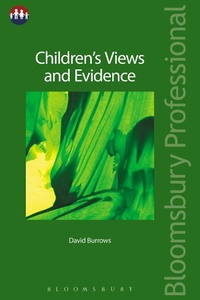
Children's Views and Evidence
Published on 27. October 2017
Book
Paperback/Softback
408 pages
978-1-5265-0317-6 (ISBN)
Description
Can you hear the child's voice?
The Court of Appeal have commented that the family courts are 'still feeling their way forward in order to determine how best to 'hear the voice of a child'.
In this new title David Burrows looks at the jurisprudence surrounding this remark, relates it to European and UN Convention rights and looks at the most recent children case law.
It concentrates on:
Children in court proceedings, particularly in family proceedings
Contrasting the way courts hear children's views with the way their evidence is heard
Any rights to which a child is entitled (common law; European Convention 1950; UN Conventions; and EU Directives), such as to confidentiality and to take part (or be heard) in proceedings.
The meaning and effect of a child's 'understanding' in court proceedings, and the way that term varies according to a child's age and the issue before the court.
Legislation and case law covered and analysed includes:
Children Act 1989 and applicable Family Procedure Rules 2010
Human Rights Act 1998 and European Convention 1950
Civil Procedure Rules 1998
LASPO Act 2012
Youth Justice and Criminal Evidence Act 1999
Re D (A Child) (International Recognition) - child's right to be heard
Re W (A Child)- rules for child representation in hearings
P v A Local Authority (Fam) - legal aid and statutory damages
Re W (Children) (Abuse: Oral Evidence) - child's evidence
R (D (a minor)) v Camberwell Green Youth Court - safeguards in criminal law for children
Protocol and Good Practice Model Disclosure of information in cases of alleged child abuse and linked criminal and care directions hearings - October 2013
Achieving Best Evidence: Guidance on interviewing children March 2011
This title is included in Bloomsbury Professional's Family Law online service.
The Court of Appeal have commented that the family courts are 'still feeling their way forward in order to determine how best to 'hear the voice of a child'.
In this new title David Burrows looks at the jurisprudence surrounding this remark, relates it to European and UN Convention rights and looks at the most recent children case law.
It concentrates on:
Children in court proceedings, particularly in family proceedings
Contrasting the way courts hear children's views with the way their evidence is heard
Any rights to which a child is entitled (common law; European Convention 1950; UN Conventions; and EU Directives), such as to confidentiality and to take part (or be heard) in proceedings.
The meaning and effect of a child's 'understanding' in court proceedings, and the way that term varies according to a child's age and the issue before the court.
Legislation and case law covered and analysed includes:
Children Act 1989 and applicable Family Procedure Rules 2010
Human Rights Act 1998 and European Convention 1950
Civil Procedure Rules 1998
LASPO Act 2012
Youth Justice and Criminal Evidence Act 1999
Re D (A Child) (International Recognition) - child's right to be heard
Re W (A Child)- rules for child representation in hearings
P v A Local Authority (Fam) - legal aid and statutory damages
Re W (Children) (Abuse: Oral Evidence) - child's evidence
R (D (a minor)) v Camberwell Green Youth Court - safeguards in criminal law for children
Protocol and Good Practice Model Disclosure of information in cases of alleged child abuse and linked criminal and care directions hearings - October 2013
Achieving Best Evidence: Guidance on interviewing children March 2011
This title is included in Bloomsbury Professional's Family Law online service.
More details
Series
Language
English
Place of publication
London
United Kingdom
Publishing group
Bloomsbury Publishing PLC
Target group
Professional and scholarly
Product notice
Paperback (trade)
Unsewn / adhesive bound
Dimensions
Height: 234 mm
Width: 156 mm
Thickness: 21 mm
Weight
562 gr
ISBN-13
978-1-5265-0317-6 (9781526503176)
Copyright in bibliographic data and cover images is held by Nielsen Book Services Limited or by the publishers or by their respective licensors: all rights reserved.
Schweitzer Classification
Person
David Burrows is a solicitor advocate who deals with all aspects of family breakdown. As a solicitor advocate he has appeared in family courts and appellate courts at all levels.
As practitioner, teacher and writer he has a specialist interest in the law relating to confidentiality and privacy; and concerning rules of evidence and procedure in family proceedings.
He was chairman of SFLA (now Resolution) in 2003/4, and remains an active member. He was secretary to the steering committee for the first mediation service in UK in 1975/6, and of its trustees thereafter.
As practitioner, teacher and writer he has a specialist interest in the law relating to confidentiality and privacy; and concerning rules of evidence and procedure in family proceedings.
He was chairman of SFLA (now Resolution) in 2003/4, and remains an active member. He was secretary to the steering committee for the first mediation service in UK in 1975/6, and of its trustees thereafter.
Content
1 INTRODUCTION
2 MEANING OF 'CHILD': LAW AND REALITY
3 CHILD'S EVIDENCE
4 CHILD'S VIEWS
5 HUMAN RIGHTS AND THE CHILD
6 THE CHILD AS A PARTY TO PROCEEDINGS
7 CHILDREN'S RIGHTS: INTERNATIONAL LEGISLATION AND EU WITHDRAWAL
8 CONFIDENTIALITY
9 DISCLOSURE IN CHILDREN PROCEEDINGS
10 RESTRICTING OR WITHHOLDING DISCLOSURE
11 CLOSED MATERIAL PROCEDURES
12 PUBLIC INTEREST IMMUNITY
13 PRIVACY AND ANONYMITY IN CHILDREN PROCEEDINGS
2 MEANING OF 'CHILD': LAW AND REALITY
3 CHILD'S EVIDENCE
4 CHILD'S VIEWS
5 HUMAN RIGHTS AND THE CHILD
6 THE CHILD AS A PARTY TO PROCEEDINGS
7 CHILDREN'S RIGHTS: INTERNATIONAL LEGISLATION AND EU WITHDRAWAL
8 CONFIDENTIALITY
9 DISCLOSURE IN CHILDREN PROCEEDINGS
10 RESTRICTING OR WITHHOLDING DISCLOSURE
11 CLOSED MATERIAL PROCEDURES
12 PUBLIC INTEREST IMMUNITY
13 PRIVACY AND ANONYMITY IN CHILDREN PROCEEDINGS