

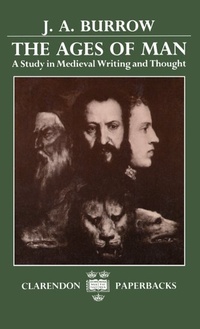
The Ages of Man
A Study in Medieval Writing and Thought
Published on 15. September 1988
Book
Paperback/Softback
240 pages
978-0-19-811755-1 (ISBN)
Description
Medieval Europe inherited from antiquity a rich and varied tradition of thought about the aetates hominum. Scholars divided human life into three, four, six, or seven ages, and so related it to larger orders of nature and history in which similar patterns were to be found. Thus, the seven ages correspond to and are governed by the seven planets. These ideas flowed through the Middle Ages in many channels: sermons and Bible commentaries, moral and political treatises, encyclopaedias and lexicons, medical and astrological handbooks, didactic and courtly poems, tapestries, wall-paintings, and stained-glass windows.
Professor Burrow's account of this material, using mainly but not exclusively English medieval sources, includes a consideration of some of the ways in which such ideas of natural order entered into the medieval writer's assessment of human behaviour.
The book ends by showing how medieval writers commonly recognize and endorse the natural processes by which ordinary folk pass from the joys and folly of youth to the sorrows and wisdom of old age.
`I cannot believe that it will ever be superseded... it is the very strong but perfectly clear distillate of a great amount of labour and thought.' London Review of Books
`short, pointed, witty, tightly packed, richly illustrated, inspired and illuminating.' Essays in Criticism
`If we regret anything as we read this excellent book, we regret that it is not longer.' Christina von Nolcken, Review of English Studies
`There is much to praise in the book; Burrow is learned and imaginative, writes lucidly, and... has illuminating things to say... J. A. Burrow is one of the best living critics of medieval English literature, and this book is a rich and informative literary history of an important topic.' Studies in the Age of Chaucer
Professor Burrow's account of this material, using mainly but not exclusively English medieval sources, includes a consideration of some of the ways in which such ideas of natural order entered into the medieval writer's assessment of human behaviour.
The book ends by showing how medieval writers commonly recognize and endorse the natural processes by which ordinary folk pass from the joys and folly of youth to the sorrows and wisdom of old age.
`I cannot believe that it will ever be superseded... it is the very strong but perfectly clear distillate of a great amount of labour and thought.' London Review of Books
`short, pointed, witty, tightly packed, richly illustrated, inspired and illuminating.' Essays in Criticism
`If we regret anything as we read this excellent book, we regret that it is not longer.' Christina von Nolcken, Review of English Studies
`There is much to praise in the book; Burrow is learned and imaginative, writes lucidly, and... has illuminating things to say... J. A. Burrow is one of the best living critics of medieval English literature, and this book is a rich and informative literary history of an important topic.' Studies in the Age of Chaucer
Reviews / Votes
`This book is likely to be about as permanent as scholarly books ever are: other people may add footnotes to it, but I cannot believe that it will ever be superseded. What one is especially grateful for, though, is its grace and size: it is the very strong but perfectly clear distillate of a great amount of labour and thought.' London Review of Books 'an ideal example, I should say, of what comparative literary studies might be but too often aren't: short, pointed, witty, tightly packed, richly illustrated, inspiring and illuminating.' Essays in Criticism 'If we regret anything as we read this excellent book, we regret that it is not longer.' Christina von Nolcken, Review of English Studies 'Burrow's characteristically lucid and well-documented book, an important contribution to the history of ideas, surveys for the first time medieval applications of the cursus aetatis, the belief that human life is naturally divisible into distict 'ages'... Highly recommended.' ChoiceMore details
Series
Language
English
Place of publication
Oxford
United Kingdom
Publishing group
Oxford University Press
Target group
College/higher education
Professional and scholarly
Illustrations
frontispiece, 12 halftones
Dimensions
Height: 216 mm
Width: 139 mm
Thickness: 13 mm
Weight
296 gr
ISBN-13
978-0-19-811755-1 (9780198117551)
Copyright in bibliographic data and cover images is held by Nielsen Book Services Limited or by the publishers or by their respective licensors: all rights reserved.
Schweitzer Classification
Person
Content
Nature; time; ideals of transcendence; ideals of nature; appendix - loci classici.